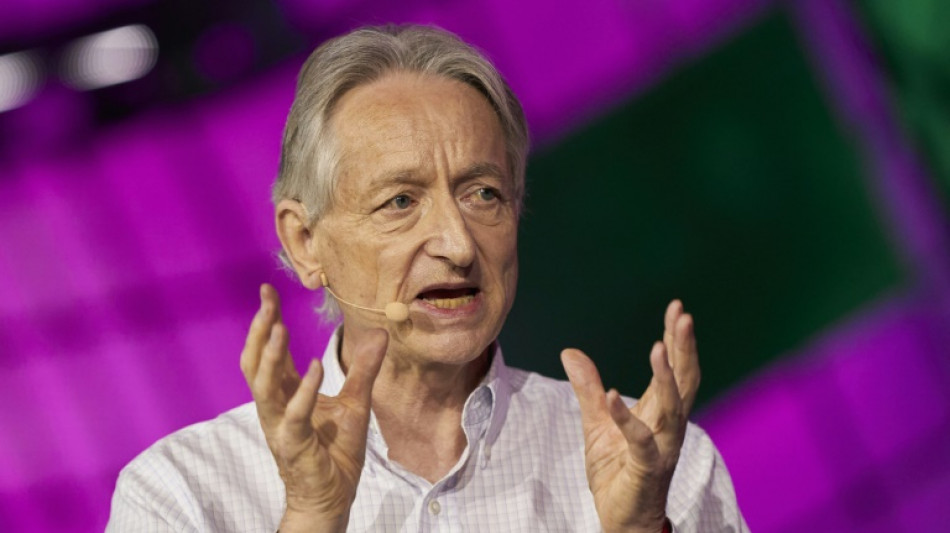
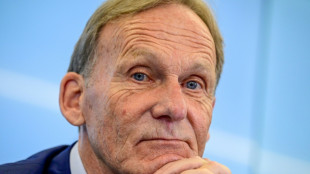
Geoffrey Hinton, soft-spoken godfather of AI / Photo: © AFP/File

 Hushing and hedging: US companies retreat on climate

 Springboks to face Fiji before 2027 Rugby World Cup
 Nigeria miners struggled to breathe in cell before 37 died: survivors

 McIlroy on the charge at PGA Championship as Reed withdraws
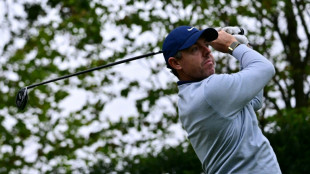 McIlroy on the charge at PGA Championship
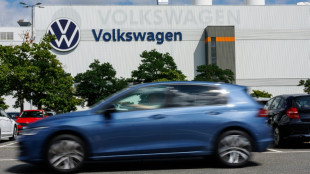 Crisis-wracked Volkswagen warns of 10-bn-euro hit to profits
 Costa Rica's Grynspan tops third informal poll for UN chief: diplomat
 Stock markets retreat after central bank rate hikes

 Russia labels director of Cannes Grand Prix winner a 'foreign agent'

 Macron warns of Russian 'hybrid' threat after meeting presidential hopefuls
 UN holds third informal poll for new chief
 Kulusevski return can spark Spurs: De Zerbi

 Shakira to cap off world tour with Madrid 12-gig run
 Isolated Syrian-Druze city blames Damascus for shortages
 Isolated Syrian-Druze city shortages
 Dutch drop Depay for Germany match in Xavi's first pick
 Ronaldo named in Portugal squad for Nations League

 Stock markets diverge after central bank rate hikes
 Anti-Assad music star makes triumphant return to Syria
 In-form Fernandez included in Spain Nations League squad
 Arteta buries hatchet with Hurzeler ahead of Brighton clash

 Alexander-Arnold and Palmer return to England squad for Nations League
 Russians vote as Ukraine war drags on for fifth year
 Backpackers fret over Australian visa crackdown
 Most Asian stocks track Wall St rally, yen drops after BoJ rate hike

For a brief moment in spring last year, the bird-like features of bespectacled British-born researcher Geoffrey Hinton were poking out from TV screens across the world.
Hinton, a big name in the world of artificial intelligence but largely unknown outside it, was warning that the technology he had helped to create -- for which he was awarded the 2024 Nobel Prize -- could pose an existential threat to humanity.
"What do you think the chances are of AI wiping out humanity," a reporter from the US network CBS News asked in March last year.
"It's not inconceivable," replied Hinton, making a very British understatement.
A few weeks later, he had walked away from his job at Google and was giving interviews to media across the world, quickly becoming the poster-child for AI doomsayers.
- Difficult family life -
Hinton, a 76-year-old soft-spoken career academic, was born in London, raised in Bristol and went to the universities of Cambridge and Edinburgh.
He has described his early life as a high pressure existence, trying to live up to the expectations of a family with an illustrious history, littered with storied scientists.
Even his father was a member of the Royal Society.
He told Toronto Life magazine he had struggled with depression his whole life and work was a way of releasing the pressure.
But Hinton has rarely been able to fully escape into his work.
His first wife died from cancer shortly after the couple had adopted their two children in the early 1990s, thrusting him into the role of single parent.
"I cannot imagine how a woman with children can have an academic career," he told Toronto Life.
"I'm used to being able to spend my time just thinking about ideas... But with small kids, it's just not on."
- 'Utterly correct' -
After spending time in universities in the United States in the late 1970s and 1980s, Hinton relocated to Toronto in 1987, his base ever since.
Hinton, a self-professed socialist who recalls his family stuffing envelopes for the British Labour Party, had been unwilling to accept funding from the US military, which was the biggest funder for his kind of research.
The Canadian government agreed to back his research, which attempted to replicate the functioning of the human brain by engineering artificial "neural networks".
Although he spent years on the academic fringes, a research community grew up around him in the Canadian city, and eventually his vision came to dominate the field.
And then Google came knocking.
He took a job with the Silicon Valley juggernaut in 2013 and suddenly became one of the central figures in the emerging industry.
As competition ramped up, many of his students took posts in companies including Meta, Apple and Uber.
Ilya Sutskever, who founded OpenAI, worked in Hinton's team for years and has described the time as "critical" for his career.
He told Toronto University's website in 2017 they pursued "ideas that were both highly unappreciated by most scientists, yet turned out to be utterly correct".
But Sutskever and Hinton have emerged as prominent worriers about the technology -- Sutskever was pushed out of OpenAI for raising concerns about their products a year after Hinton exited Google.
And true to form, even during his acceptance speech for the Nobel Prize -- he received the news in a "cheap hotel in California" -- Hinton was still talking of regret rather than success.
"In the same circumstances, I would do the same again," he said.
"But I am worried that the overall consequence of this might be systems more intelligent than us that eventually take control."
A.Ammann--VB