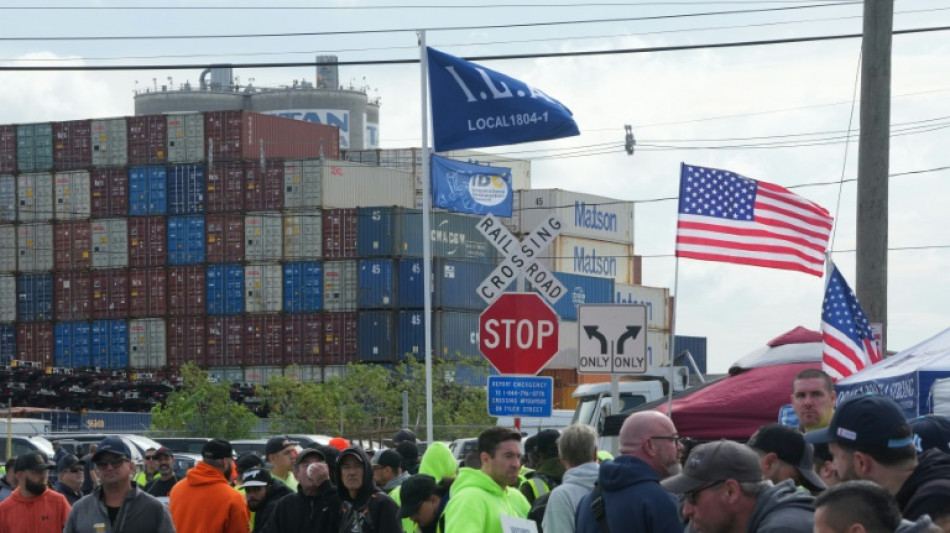
Cranes stand still as US dockworkers fight for 'future' / Photo: © AFP

 Khan Welcomes Milburn’s Youth Employment Reforms Amid High NEET Rates

 Shinde Clarifies Torn Photo Controversy Amid Sonia Gandhi Book Protest
 BMW i3 vs Mercedes C-Class Electric vs Hyundai Ioniq 6: The Ultimate Premium EV Showdown

 BING X: 22,624.66 SNC have disappeared at BingX – how safe are tokens on BingX? Will BingX’s MiCAR licence be suspended?

 Urban Company Raises Rs 2,500 Crore via QIP to Expand InstaHelp

Just a short drive from the New York skyline, giant cranes, containers, and machinery stand motionless behind closed gates.
The International Longshoremen's Association (ILA), 85,000 members strong, has launched its first strike since 1977 after weeks of deadlocked negotiations over a six-year labor agreement.
"It's not just money, it's our future," declared Herbert Hall, a 76-year-old vice president of the dockworkers' union.
Speaking from a picket line outside the APM terminal in Elizabeth, New Jersey, he raises his voice over blaring music and honking traffic.
"We're talking about machines, artificial intelligence, and all that stuff. We want job security."
The port, like dozens along the East Coast and Gulf of Mexico, has ground to a halt.
Around 400 strikers have gathered, some lounging in camping chairs, sipping coffee, and enjoying free burgers from a food truck.
Union logos adorn their jackets and T-shirts, while picket signs voice their concerns: "Machines don't feed families," "Profit over people is unacceptable," "Automation harms families."
Jonita Carter, a docker for 23 years with the Maher company, emphasizes their dedication: "We worked during COVID, we never stopped. We moved the world."
"If it's zero degrees, I'm outside. If it's 40 degrees, I'm outside. We don't ask for much. We're asking for a small portion, which we rightly deserve."
- 'Not playing fair' -
The strikers' main priorities are better wages and guarantees against automation.
While some protections were included in the recently expired labor agreement, and the United States Maritime Alliance (USMX) -- representing port employers -- has pledged to renew them, union members find these insufficient.
"We want better protections," insisted Hall, citing developments at the port of Mobile, Alabama, which strikers feel violate previous commitments.
Joe Losada, 57, agreed: "They're not playing fair. These are generational jobs... We have to keep these jobs and protect them."
His daughter represents the fourth generation of his family to work at the port.
Family ties are common among port workers. Carter joined through her godfather, and her niece followed suit.
"Most people here have family ties," she noted.
"I want my colleagues to be able to pay for their children's university, I want to have good health insurance. But everything is increasing, everything is automated."
Despite USMX announcing resumed talks and offering a 50 percent pay rise, the ILA rejected it.
Losada explains, "on the face of it, it looks good, but we haven't had a raise in a while... and when you factor in 30 percent inflation, they're only offering us 20 percent."
As the strike continues, workers remain resolute.
"Nobody wants a long strike... but we need what we need," said Losada.
Carter echoes his sentiment: "I'm ready. We're going to stay together."
R.Kloeti--VB
