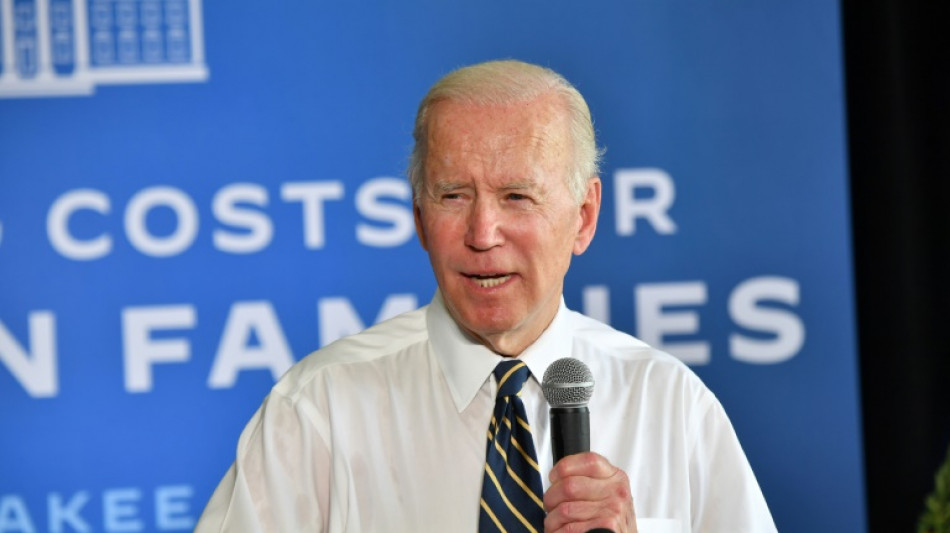
US eyes trade deal-lite as Southeast Asian leaders gather / Photo: © AFP

 Russia probes bear attacks, as official says town under 'siege'

 Robertson tells Spurs to 'forget' past woes
 Italy police find 3 million euros stashed in mobster's house
 Renard versus Queiroz in AFCON qualifying blockbuster
 Former Mexico boss Aguirre returns to Spain with Valencia
 China swimmer, 13, seals Games hat-trick as North Korea win first gold

 China's Xi heads to US for talks with Trump: state media
 Azerbaijan pardons Frenchman after EU lifts sanctions on oligarchs

 Hadjar extends Red Bull contract for 2027 F1 season

 Black Sea drone attacks spell terror for Turkish sailors

 Canada judge to decide prison term for suicide poison seller

 Weinstein faces resentencing in New York for 2006 sex assault

 Outgoing UN chief makes climate push at New York summit

 AI risks, Iran war to take center stage at UN
 Badminton no.1 An tells dad to keep it down at Asian Games
 Runaway leader Antonelli eyeing third straight win

 Schoolgirl Yu, 13, fastest again in bid for third Asian Games gold
 Oil prices fall after Trump hails 'good' talks with Iran
 AI political ads warp reality ahead of US midterms

 Kenneth Branagh embraces action hero role -- to get in shape

 'New one' Klopp promises fresh approach as Germany reign begins
 Milne returns to New Zealand squad for India T20 series

 US-led Americas coalition backs sanctions against crime groups

 'Star Wars' fans and art lovers line up for new Lucas museum
 Trump renames AI 'super intelligence' as leaders jostle over dangers

The United States is preparing a scaled-back version of a trade pact as Southeast Asian nations gather in Washington, where President Joe Biden is seeking to show solid commitment in the face of a rising China.
Leaders from the Association of Southeast Asian Nations will meet Biden for dinner Thursday at the start of a two-day summit, part of a renewed US focus on Asia after months of intense effort on Ukraine.
Before Russia's invasion of Ukraine, the Biden administration had made clear that its top priority was competition with China due to its rapid technological advances and rising assertiveness both at home and abroad.
Kurt Campbell, the top White House official on Asia, said the United States would raise areas of cooperation with ASEAN leaders including fighting the Covid pandemic and disaster relief.
He also said he expected "substantial interest" by Southeast Asian nations in the Indo-Pacific Economic Framework, or IPEF, the latest acronym-branded US trade initiative, which was mentioned late last year by Secretary of State Antony Blinken in Indonesia.
"We're quite confident that we're going to be able to have a substantial launch with a very broad range of potential players," Campbell said at the US Institute of Peace.
Koji Tomita, Japan's ambassador to Washington, told a separate event that he expected IPEF to be unveiled formally a week later when Biden visits Tokyo and Seoul.
Former president Barack Obama had proposed the Trans-Pacific Partnership, billing it as a high-standards deal that would let the United States lead the emerging trade order in Asia.
His successor Donald Trump trashed the deal, calling free trade unfair to US workers. Biden, seeing the shifting US political mood, has made clear he is in no rush for trade deals -- and China is now seeking to enter the Trans-Pacific Partnership's successor.
- Not seeking 'new Cold War' -
Experts briefed on IPEF said it would formally commit the United States to work with partners on key economic priorities including ensuring smooth supply chains, fighting corruption and promoting green energy.
Unlike traditional trade deals, it would not guarantee market access to the United States, the world's largest economy -- the usual sweetener to persuade nations to make concessions.
Campbell said Biden knew that any initiative needed to be "fundamentally based on the needs and desires of the people of Southeast Asia."
"He does not want to descend Southeast Asia or Asia into a new Cold War," he said.
"I think we recognize quite clearly that any initiative that is simply designed for competition is likely to have difficulty gaining altitude in Asia."
China for more than a decade has been ASEAN's largest trading partner, despite widespread territorial rifts between Beijing and members of the bloc, especially Vietnam and the Philippines.
Evan Feigenbaum, a former senior State Department official, told a recent congressional hearing that the United States has historically enjoyed its privileged place in Asia due to both its security and economic leadership, only one of which remains.
"Even though America's economic role is growing in absolute terms, it is receding in relative terms, which means that, to lead, we should be leaning harder on the other pillar of our economic leadership, which was to be a rule writer and standard setter," said Feigenbaum, now at the Carnegie Endowment for International Peace.
Labor advocacy group Trade Justice has already voiced alarm at IPEF, saying many Southeast Asian nations did not have adequate treatment of workers.
Trade diplomacy has long been at the forefront of US interactions with Southeast Asia, often seen as a victim of its own success given its perceived stability.
But the Washington summit also comes after a year of intense US pressure on Myanmar, once hailed as a model of democratic transition, following its military coup.
US officials say they will seek to show support for democratic forces in Myanmar and may represent the country with an empty chair during the summit.
I.Meyer--BTB