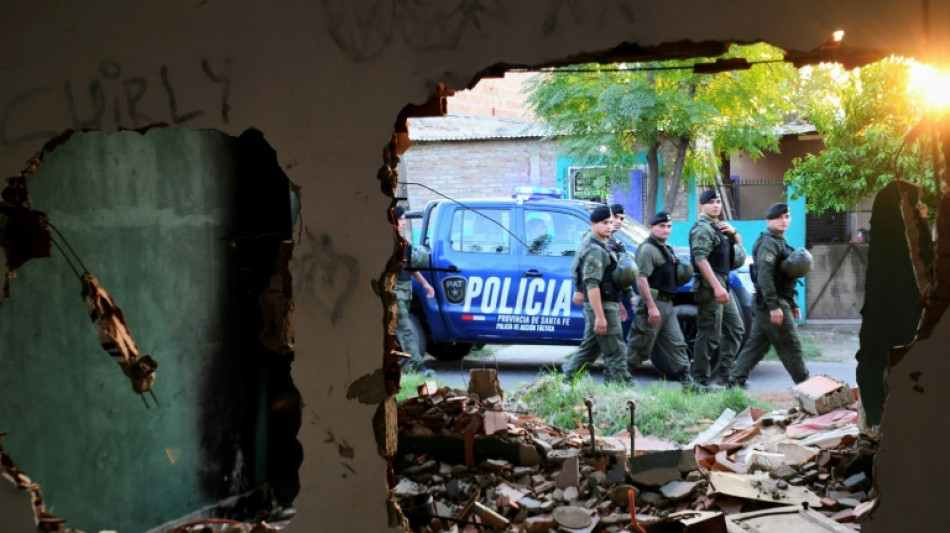
Argentina's narco capital sees mysterious drop in murders / Photo: © AFP/File

 Ed Sheeran set to return to stage after Palestinian controversy
 Toulouse edge Vannes, Lyon beat Pau to take Top 14 summit

 Germans arrested for Louvre stunt in Mona Lisa hall

 Saudi-led coalition says Houthis fired ballistic missile at Riyadh

 France's debt climbs to highest since 1978: ministry

 McIlroy two shots off the lead at Wentworth after eagle on 18

 Martinez brace saves Inter in Serie A top-two clash with Roma

 Rosenior abused but guides Paris FC past old club Strasbourg

 Seven-try Lyon beat Pau, climb to Top 14 summit
 Brighton defeat a 'big lesson' against complacency for Arsenal, says Arteta

 Thousands protest inaction over climate crisis in Switzerland

 Carapaz out of cycling world championships

 'Fragile' Tottenham beaten by Aston Villa despite late rally

 Mourinho hails Real Madrid grit before Atletico derby clash

 Martin wins Austrian MotoGP sprint after Acosta crash

 Japan edge Fiji to win Pacific Nations Cup

 Black smoke, flames rising near Riyadh airport: residents to AFP

 UK actor Naomi Watts honoured at Spain film festival

 Japan emperor declares Asian Games open after turbulent build-up

 Asian Games open with unity message after troubled build-up

 Denmark hails 'binding' Greenland deal with Trump

 We don't want Games host Japan losing money, says Asian Olympic official
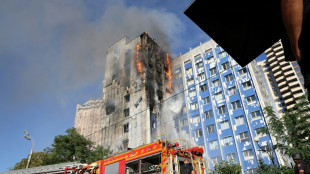
 Ed Sheeran returns to stage after Palestinian controversy

 Asian Games to open in Japan after troubled build-up

 Drone owners rush to offload devices ahead of Beijing ban

Argentina's most violent city, Rosario -- best known as the hometown of soccer star Lionel Messi -- has in recent months seen a drastic, and some say suspicious, fall in murders.
Authorities boast the change is the result of a crackdown on drug-trafficking gangs, both on the streets and in prisons.
However, some believe a tacit pact between the government and criminal groups may explain the turnaround.
Rosario has a key port on South America's second-longest river after the Amazon -- the Parana -- which has made it a hotspot for the movement of drugs from Bolivia, Brazil and Paraguay headed for Europe and Asia.
The city, Argentina's third-largest, has long had a murder rate standing at around five times the national average, with up to 260 killings per year.
Even the families of famous residents like Messi, or fellow football player Angel Di Maria have received violent threats or attacks by criminal organizations.
But everything seems to have changed since the end of 2023, when President Javier Milei took office, vowing zero tolerance for crime.
At the same time, the province of Santa Fe, where Rosario is located, got a new governor, Maximiliano Pullaro.
Pullaro immediately imposed harsher conditions on prisoners, particularly gang bosses, publishing photos of jail raids and subdued prisoners.
His actions earned him around 30 death threats in his first months in office and prompted a backlash from gangs, who killed four civilians in March.
Milei then sent federal police and troops into Rosario.
- 'Tacit deal' -
According to a report from the national security ministry, Rosario's murder rate dropped 62 percent between January and August compared to the same period last year.
"We have the lowest number of homicides in 17 years in Rosario," said Security Minister Patricia Bullrich.
"We said that we were going to put order in prisons and order in the street. And that is what we did," added Pullaro, who has been accused of emulating the harsh gang-busting tactics of El Salvador's popular President Nayib Bukele.
Yet experts are skeptical that these measures alone led to the rapid decline in murders.
The former security minister of Santa Fe, Marcelo Sain, who is also a doctor in social sciences, believes "there was an agreement" between the state and the criminal world in which "the killing of people stopped."
"There is no other explanation, because there is no other policy in the world that makes homicides decrease so sharply," he added.
Ariel Larroude, director of the Criminal Policy Observatory at the University of Buenos Aires (UBA), said the decrease in violence was "striking" because "drug consumption continues to grow."
"This may be the result of an exceptional success in criminal policy" based on "a reorganization" of the police and prisons, he said.
But it is also possible that this is accompanied by a "tacit deal with the gangs to reduce violence, while (the government) turns a blind eye to drug sales."
Larroude said this could merely entail police halting control over certain street corners or neighborhoods.
On the ground, feelings are mixed.
"We see more police, but everything remains the same," said Sandra Arce, a 46-year-old mother who runs a soup kitchen in the Boca neighborhood
"On the street, the situation remains the same -- they rob you, they snatch things from you, they shoot," she added.
However, she is pleased that a local hotspot for selling drugs, across the street from her soup kitchen, has recently disappeared.
L.Stucki--VB