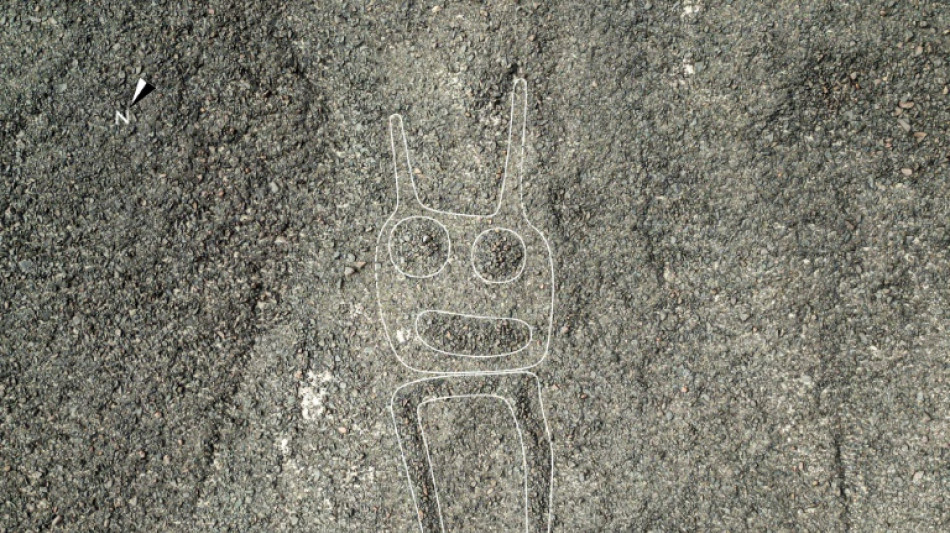
AI research uncovers 300 ancient etchings in Peru's Nazca desert / Photo: © Yamagata University Institute of Nasca/AFP

 Russians vote on last day of parliamentary elections

 Hong Kong pays final respects to former city leader Tung

 Typhoon put people off Asian Games opening ceremony, official says

 China's 13-year-old Yu cruises as Asian Games swimming begins

 AI 'warning shots' focus Beijing on national security risks

 Philippine tribe in limbo over US-led tech hub

 Leo XIV, first US pope transcends his restrained style

 Singer Ed Sheeran says Gaza situation 'unjustifiable' following controversy

 In 'Tenzing', a Sherpa mountaineer gets his due

 Ed Sheeran set to return to stage after Palestinian controversy

 Toulouse edge Vannes, Lyon beat Pau to take Top 14 summit

 Germans arrested for Louvre stunt in Mona Lisa hall

 Saudi-led coalition says Houthis fired ballistic missile at Riyadh

 France's debt climbs to highest since 1978: ministry

 McIlroy two shots off the lead at Wentworth after eagle on 18

 Martinez brace saves Inter in Serie A top-two clash with Roma

 Rosenior abused but guides Paris FC past old club Strasbourg

 Seven-try Lyon beat Pau, climb to Top 14 summit

 Brighton defeat a 'big lesson' against complacency for Arsenal, says Arteta

 Thousands protest inaction over climate crisis in Switzerland

 Carapaz out of cycling world championships

 'Fragile' Tottenham beaten by Aston Villa despite late rally

 Mourinho hails Real Madrid grit before Atletico derby clash

 Martin wins Austrian MotoGP sprint after Acosta crash

 Japan edge Fiji to win Pacific Nations Cup

Japanese scientists have used artificial intelligence to uncover 303 new etchings in Peru's Nazca desert -- doubling the amount of known geoglyphs made some 2,000 years ago by a pre-Inca civilization.
The fabled Nazca lines, a series of massive incisions on the desert floor depicting animals, plants, imaginary beings and geometric figures, have fascinated scientists ever since they were first discovered around a century ago.
Best viewed from the air, the lines situated some 220 miles (350 kilometers) south of Lima are one of Peru's top tourist attractions.
Announcing the new discoveries in Lima on Monday, archaeologist Masato Sakai, from Yamagata University, said: "The use of AI in research has allowed us to map the distribution of geoglyphs in a faster and more precise way."
He said the findings were the fruit of collaboration between his university's Nazca Institute and the research division of the technology company IBM.
"The traditional method of study, which consisted of visually identifying the geoglyphs from high-resolution images of this vast area, was slow and carried the risk of overlooking some of them," he added.
The study was also published on Monday in the prestigious Proceedings of the National Academy of Sciences (PNAS) journal, describing how AI can be used to accelerate discoveries in archeology even in well-known sites.
The paper said it had taken nearly a century to discover 430 figurative Nazca geoglyphs.
Using AI, scientists found 303 more during only six months of field surveys.
The AI model was particularly good at picking up smaller relief-type geoglyphs which are harder to spot with the naked eye.
Among the new figures discovered were giant linear-type geoglyphs, mainly representing wild animals, but also smaller ones with motifs of abstract humanoids and domesticated camelids, a mammal from the camel family.
Scientists used AI to analyze a vast amount of geospatial data produced by aircraft to identify areas where they might find more geoglyphs.
The people that formed the Nazca civilization lived in the area of southwestern Peru from 200 BC to 700 AD.
What drove them to create the lines, designated a UNESCO World Heritage site, is a mystery.
Some scientists believe they have astrological and religious significance.
The first geoglyphs were discovered in 1927.
C.Stoecklin--VB