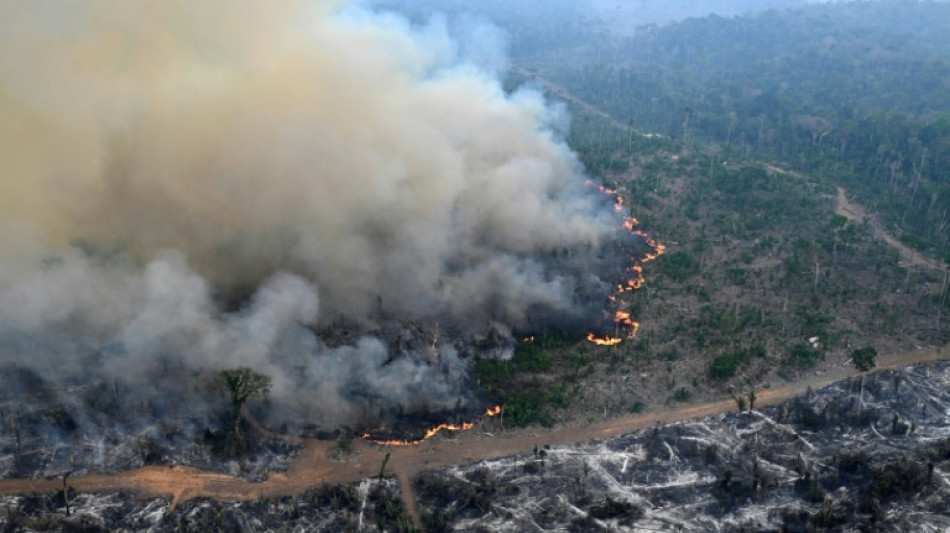
Amazon forest has lost an area the size of Germany and France / Photo: © AFP/File

 Khan Welcomes Milburn’s Youth Employment Reforms Amid High NEET Rates

 Shinde Clarifies Torn Photo Controversy Amid Sonia Gandhi Book Protest

 BMW i3 vs Mercedes C-Class Electric vs Hyundai Ioniq 6: The Ultimate Premium EV Showdown

 BING X: 22,624.66 SNC have disappeared at BingX – how safe are tokens on BingX? Will BingX’s MiCAR licence be suspended?

 Urban Company Raises Rs 2,500 Crore via QIP to Expand InstaHelp

The world's biggest rainforest, the Amazon, has lost an area about the size of Germany and France combined to deforestation in four decades, a study showed Monday.
The South American jungle, spanning nine countries, is seen as crucial to the fight against climate change due to its ability to absorb planet-warming carbon dioxide from the atmosphere.
Deforestation, mainly for mining and agricultural purposes, has led to the loss of 12.5 percent of the Amazon's plant cover from 1985 to 2023, according to RAISG, a collective of researchers and NGOs.
This amounts to 88 million hectares (880,000 square kilometers, 339,773 square miles) of forest cover lost across Brazil, Bolivia, Peru, Ecuador, Colombia, Venezuela, Guyana, Suriname and French Guiana.
RAISG experts reported an "accelerated transformation" of the Amazon, with an "alarming increase" in the use of land previously occupied by forest for mining, crops, or livestock.
"A large number of ecosystems have disappeared to give way to immense expanses of pastures, soybean fields or other monocultures, or have been transformed into craters for gold mining," they said.
"With the loss of the forest, we emit more carbon into the atmosphere and this disrupts an entire ecosystem that regulates the climate and the hydrological cycle, clearly affecting temperatures," Sandra Rio Caceres, from the Institute of the Common Good -- a Peruvian association that took part in the study -- told AFP.
She said she believes the loss of vegetation in the Amazon is directly linked to severe drought and wildfires affecting several South American countries.
The World Weather Attribution network of scientists said Sunday that climate change was increasing the risk and severity of fires in the Amazon and Pantanal wetlands which are releasing "massive amounts" of carbon dioxide into the atmosphere.
"Never-ending heat has combined with low rainfall to turn these precious ecosystems into highly flammable tinderboxes," said Clair Barnes, a researcher from Imperial College London.
"As long as the world burns fossil fuels, the risk of devastating wildfires will continue to increase in the Amazon and Pantanal," she added.
The drought has placed some Amazon rivers at their lowest level in decades, threatening the lifestyle of some 47 million people who live on their banks.
The dry spell has sent fires -- often lit to clear land for farming -- burning out of control in Brazil, Ecuador, Colombia, and Peru.
F.Mueller--VB
