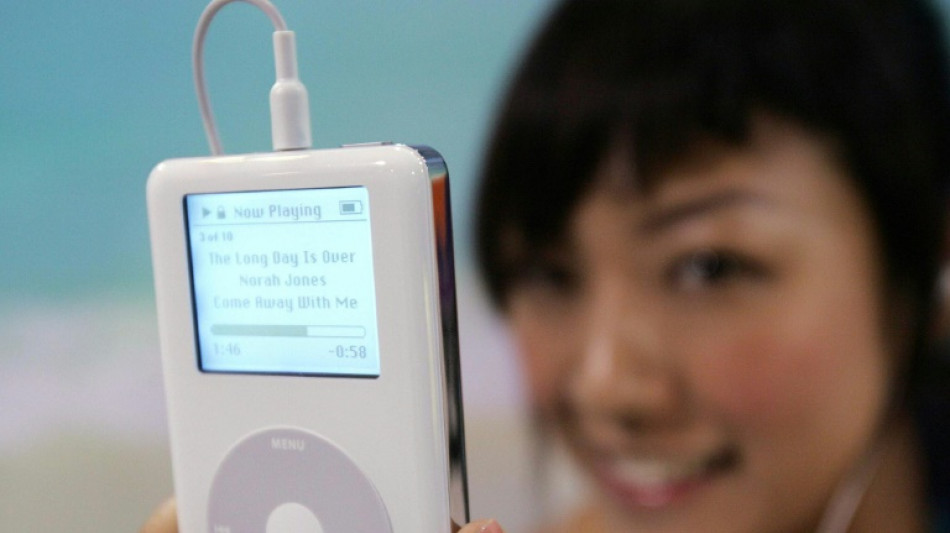
iPod RIP: How Apple's music player transformed an industry / Photo: © AFP/File

 China's Yu, 13, wins third gold with latest Asian Games record

 UK says will revisit Chagos deal after latest Trump criticism

 In first, French presidential candidate gives birth during campaign

 Cambodia no 'safe haven' for cyberscams, PM says

 North Korea weightlifter sets three world records for Asian Games gold

 A Full Moon for Every Child: STARTRADER's STARCARES Brings Support to SOS Children's Village Ho Chi Minh City

 Meta leans into AI, smart glasses amid privacy pushback

 Battered Duerer masterpiece up for five-year revamp

 Trump met with Venezuela's interim leader at UN

 Malaysia furore after Najib wins conditional house arrest

 Italy hope for new dawn under Mancini

 Mongolian herders enlist new tech against harsher, drier climate

 Tata turmoil shines light on India succession woes

 World Cup 'not enough' as Spain begin next chapter

 Meta acts against 3.7 mn scammers' accounts with Singapore police help

 Australia PM says draft social media rules about taking back control

 Voting opens in Alaska's annual Fat Bear Week

 MLS coach axed for telling female ref 'It's a man's game'

 US refuses to give Sudan's de facto leader visa for UN

 Man City hold Bayern to start Women's Champions League, Arsenal win late
 Trump threatens Iran with 'hell' but reveals fresh talks

 Trump signs security deal with Greenland, Denmark at UN
 Trump threatens Iran with 'hell' but unveils fresh talks

 Chile's Atacama Desert blossoms with life after El Nino rains

 Sri Lanka hands 220-year jail terms to 15 convicted of Easter bombings

At the height of its powers the pocket-sized music player known as the iPod shifted tens of millions of units each year, helping Apple to conquer the globe and transforming the music industry.
But that was the mid-2000s –- a lifetime ago in the tech industry. After years of declining sales, the US tech giant announced on Tuesday it was stopping production after 21 years.
"Clearly this was one of the products that Apple launched that completely changed our lives," Francisco Jeronimo of analysis firm IDC told AFP.
Social media was awash with emotional tributes under the banner "iPod RIP".
"Noooo, iPod touch, you were too pure for this world!" tweeted entrepreneur Anil Dash.
"Goodnight, sweet prince. You won't be forgotten," tweeted Apple enthusiast Federico Viticci.
The device began life in 2001 with the promise of "putting 1,000 songs in your pocket".
At $400 it was hardly cheap.
But its 5GB of storage outstripped the competition, its mechanical wheel was instantly iconic and it allowed a constant stream of music uncoupled from conventional albums.
In the following years, prices came down, storage space grew, colours and models proliferated and sales exploded.
- 'We folded' -
"It didn’t just change the way we all listen to music, it changed the entire music industry," Apple founder Steve Jobs said of the iPod in 2007.
Few would disagree.
Digital music was still in its infancy and closely associated with piracy.
File-sharing platform Napster had horrified the industry by dispensing with any idea of paying the record companies or musicians.
Against this background, Apple managed to persuade record company bosses to sanction the sale of individual tracks for 99 cents.
"We folded because we had no leverage," Albhy Galuten, an executive at Universal Music Group at the time, told the New York Times on Tuesday.
For years, bands from AC/DC to the Beatles and Metallica refused to allow Apple to sell their music.
But the industry has since found a way to stay hugely profitable and even embrace technology like streaming.
It was the first legal model for digital music, industry expert Marc Bourreau told AFP.
After the initial shock to the system, he said the industry has learnt to embrace -- and monetise -- technology.
"People are now spending money in ways they weren’t before," said Bourreau, highlighting money from streaming.
"By this logic, the music industry is doing just fine."
- Musical glasses -
But the writing was on the wall for the iPod as early as 2007 when Jobs launched the iPhone.
With theatrical flair, he told an expectant audience the new product was an "iPod, a phone and an internet communicator".
He was lighting a fire under his own product even though at the time it accounted for roughly 40 percent of Apple's revenue, according to analysis by Statista.
Five years later, the iPod's revenue share had plunged below 10 percent and it was being outsold by the iPhone.
People no longer needed both products in their lives, and Apple no longer needed both in its portfolio.
"I don't see why people would buy music players in the future," said Jeronimo.
"Music players are now a feature of other devices – in cars, smart speakers, watches, even in smart glasses."
The iPod and all its imitators seem likely to follow the Sony Walkman into a long twilight of nostalgic fandom and eBay listings of products from a bygone era.
M.Odermatt--BTB