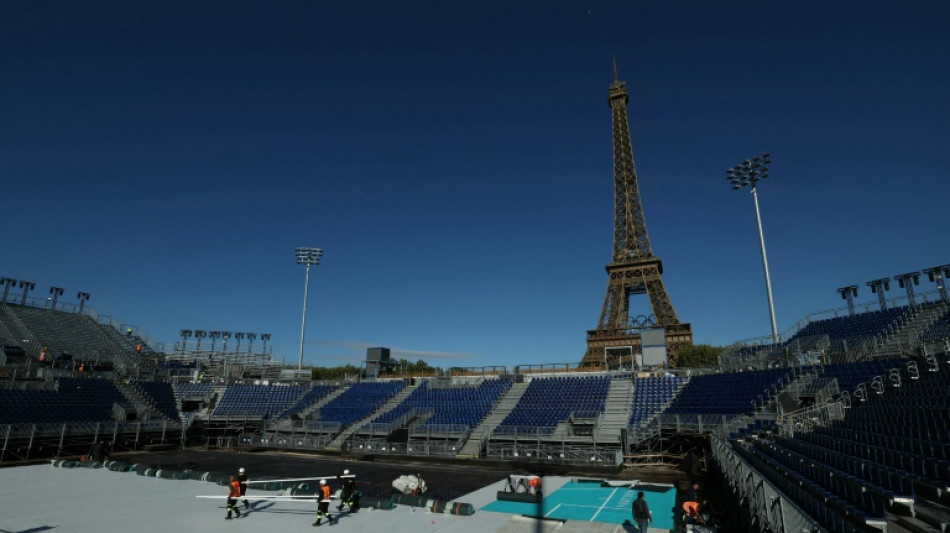
Eurozone business activity slumps after Olympics boost / Photo: © AFP/File

 Khan Welcomes Milburn’s Youth Employment Reforms Amid High NEET Rates

 Shinde Clarifies Torn Photo Controversy Amid Sonia Gandhi Book Protest

 BMW i3 vs Mercedes C-Class Electric vs Hyundai Ioniq 6: The Ultimate Premium EV Showdown

 BING X: 22,624.66 SNC have disappeared at BingX – how safe are tokens on BingX? Will BingX’s MiCAR licence be suspended?

 Urban Company Raises Rs 2,500 Crore via QIP to Expand InstaHelp

Eurozone business activity declined for the first time in seven months in September, as France lost steam after the end of the Paris Olympic Games, a key survey said Monday.
S&P Global's purchasing managers' index (PMI) -- a key gauge of the overall health of the economy -- dropped to 48.9 in September, down from 51 in August.
Any reading below 50 indicated contraction.
"The eurozone is heading towards stagnation. After the Olympic effect had temporarily boosted France, the eurozone heavyweight economy, the Composite PMI fell in September to the largest extent in 15 months," said Cyrus de la Rubia, chief economist at Hamburg Commercial Bank.
"Considering the rapid decline in new orders and the order backlog, it doesn't take much imagination to foresee a further weakening of the economy."
The survey showed that Germany and France, the eurozone's top two economies, were largely responsible for driving the slump in the 20-country single currency area.
French private sector output returned to contraction after the shot in the arm from the Olympics, while German business activity dropped the fastest since February.
The "big decline" in eurozone PMI "suggests that the economy is slowing sharply, that Germany is in recession and that France's Olympics boost was just a blip", said Andrew Kenningham, chief Europe economist at London-based research group Capital Economics.
"With France's new minority government now planning to tighten fiscal policy significantly, prospects for growth in France look increasingly poor," he said.
President Emmanuel Macron named a new government led by Prime Minister Michel Barnier Saturday, 11 weeks after an inconclusive parliamentary election.
The eurozone PMI data showed the manufacturing sector was down across the board, falling for the eighteenth month in a row.
"Manufacturing is getting messier by the month," de la Rubia said.
"Looking ahead, the sharp drop in new orders and companies' increasingly bleak outlook for future output suggest that this dry spell is far from over."
The decline in business activity could add impetus to calls for the European Central Bank (ECB) to cut its key interest rate again in October.
The bank for the 20 countries that use the euro cut its deposit rate by a quarter point to 3.50 percent this month -- the second decrease since June.
The ECB had hiked rates at record pace from mid-2022 to tame surging consumer prices but has started easing the pressure as inflation drifts back down towards its two-percent target.
K.Hofmann--VB
