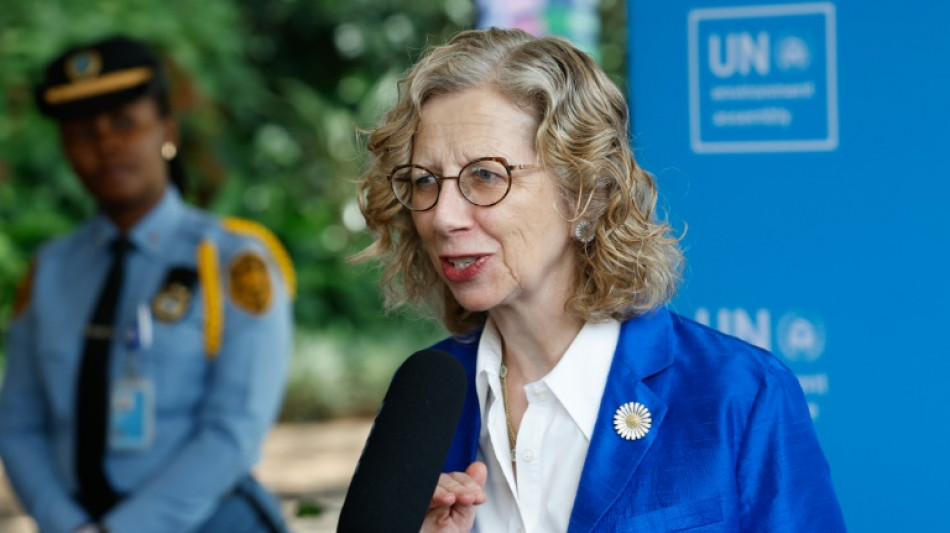
'Convergence' growing on global plastics treaty: UN environment chief / Photo: © AFP

 Khan Welcomes Milburn’s Youth Employment Reforms Amid High NEET Rates

 Shinde Clarifies Torn Photo Controversy Amid Sonia Gandhi Book Protest
 BMW i3 vs Mercedes C-Class Electric vs Hyundai Ioniq 6: The Ultimate Premium EV Showdown

 BING X: 22,624.66 SNC have disappeared at BingX – how safe are tokens on BingX? Will BingX’s MiCAR licence be suspended?

 Urban Company Raises Rs 2,500 Crore via QIP to Expand InstaHelp

The UN environment chief said Sunday she was beginning to see convergence on the world's first binding treaty on plastic pollution despite differences on production caps and a tax-like plastic fee.
Inger Andersen, director of the UN Environment Program, said her team was "getting ready" for final negotiations in late November in South Korea's Busan.
There, countries are hoping to seal a potentially groundbreaking deal to tackle the gargantuan problem of plastic pollution.
"There are certain areas where I think we're beginning to see convergence," Andersen said from New York ahead of an annual gathering of world leaders at the United Nations.
Speaking during a briefing, Andersen said she was hopeful that member states would be able to agree on "some degree of global obligations or guidelines for plastic products."
She noted growing convergence on the need for a scientific body and "some degree of text that will deal with waste, waste management, recycling."
"There's also clear understanding that we need to have some sort of text that will deal with legacy or existing pollution, that which will wash up on our shores even after we've turned off the proverbial plastic tap," Andersen added.
"And there's also clear understanding we need to have some sort of reporting framework".
- Sticking points -
Negotiators have already met several times to discuss a deal that could include production caps, unified rules on recyclability, and even bans on certain plastics or chemical components.
But significant gaps remain, including on the issue of production caps, Andersen said.
"We want to see a reduction in the production of raw polymer for that which is single use and short lived," she said, explaining that the cap would mainly target polluting products.
"I don't see car parts and plane wings and things like that swimming around in the ocean," she said.
"We have to have a more refined conversation than just cap, no cap, because it's not an intelligent conversation."
Another flashpoint is around a "global plastic fee," according to the UNEP head.
"So whether or not we will get some sort of plastic fee tax is still in discussion. But it might take a little longer. Maybe we will land the idea of something and then discuss later the nitty gritty, because the nitty gritty will take time."
Plastic production has doubled in 20 years and at current rates it could triple by 2060, according to the Organization for Economic Cooperation and Development (OECD).
Yet over 90 percent of plastic is not recycled, with much of it dumped in nature or buried in landfills.
K.Sutter--VB
