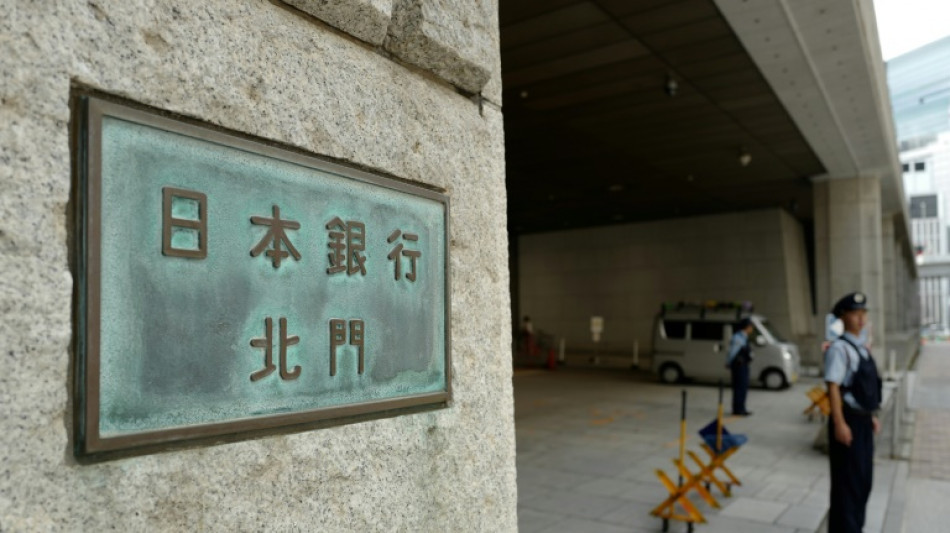
Japan inflation firms to 2.8% ahead of BoJ rate decision / Photo: © AFP

 Trent Perry’s Late Heroics Lift No. 7 UCLA Past Cal State Fullerton

 2027 Hyundai Elantra Review: Brutalist Design and Expanded Dimensions

 Malta Maritime Forum Study Reveals €1 Billion Economic Contribution Amid Growth Concerns

 China Condemns Chile-Belgium Joint Bid for High Seas Treaty Headquarters

 Dún Laoghaire-Rathdown €335m Budget Faces Mixed Reaction Over Housing and Cost of Living

 Dubai Police Expand Luxury Patrol Fleet with 525-hp Defender

 Iran Strikes US Sites in Kuwait Following US Airstrikes on Qeshm Island
Japanese inflation rose slightly in August, with prices up 2.8 percent year-on-year, official data showed Friday, hours before the Bank of Japan was widely expected to leave interest rates unchanged.
The core Consumer Price Index (CPI) data, which excludes volatile fresh food prices, followed a reading of 2.7 percent in July and was in line with market expectations.
Later Friday the BoJ was forecast to leave its benchmark interest rate unchanged, with all 53 economists polled by Bloomberg News predicting that borrowing costs will be left at 0.25 percent.
On Wednesday, the US Federal Reserve cut its key lending rate by half a percentage-point in its first reduction since the pandemic, sharply lowering borrowing costs shortly before November's presidential election.
UBS economists Masamichi Adachi and Go Kurihara said they "do not expect a policy change" at the BoJ's latest meeting.
"We see no reason for the Bank to raise its rate, which could surprise the market and public again, especially when market sentiment is still cautious", the two said in a joint note.
The BoJ was for a long time an outlier among major central banks, sticking to an ultra-loose monetary policy in an attempt to see demand-driven inflation of two percent fuelled by wage increases.
Japanese inflation has been above the target since April 2022, but the BoJ questioned the extent to which this is caused by temporary factors such as the war in Ukraine.
In March the BoJ raised borrowing costs for the first time since 2007 and in July hiked them for a second time and signalled that more rises were on the cards too.
However this pushed the yen -- which before was one of the world's worst-performing major currencies -- sharply higher and caused investors to dump shares.
A global sell-off on August 5, which was also fuelled by US recession fears, saw Tokyo's Nikkei 225 dive more than 12 percent -- its worst day since Black Monday in 1987.
This followed a sharp unwind of the "yen carry trade" -- investors using the cheaper currency to buy higher-yielding assets like stocks -- and sent equities plunging and the yen soaring.
Japanese stocks have since recovered but remain volatile compared to other major global indices.
The sharp slide prompted the BoJ's deputy governor Shinichi Uchida to signal that there would be no more interest rate hikes for the time being.
Around 70 percent of economists surveyed by Bloomberg expect another increase by December.
R.Buehler--VB
