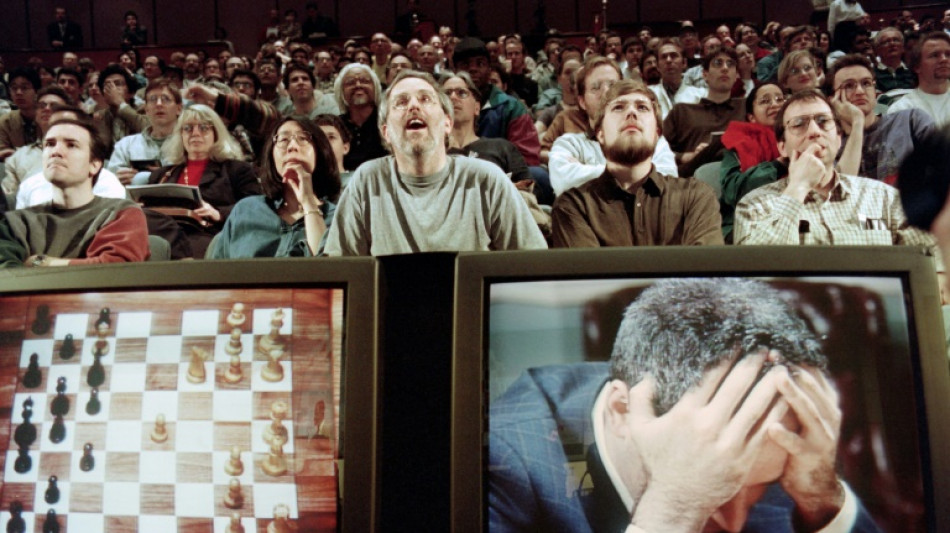
The 1997 chess game that thrust AI into the spotlight / Photo: © AFP/File

 China's Yu, 13, wins third gold with latest Asian Games record

 UK says will revisit Chagos deal after latest Trump criticism
 In first, French presidential candidate gives birth during campaign
 Cambodia no 'safe haven' for cyberscams, PM says

 North Korea weightlifter sets three world records for Asian Games gold

 A Full Moon for Every Child: STARTRADER's STARCARES Brings Support to SOS Children's Village Ho Chi Minh City

 Meta leans into AI, smart glasses amid privacy pushback

 Battered Duerer masterpiece up for five-year revamp

 Trump met with Venezuela's interim leader at UN

 Malaysia furore after Najib wins conditional house arrest
 Italy hope for new dawn under Mancini

 Mongolian herders enlist new tech against harsher, drier climate

 Tata turmoil shines light on India succession woes

 World Cup 'not enough' as Spain begin next chapter

 Meta acts against 3.7 mn scammers' accounts with Singapore police help

 Australia PM says draft social media rules about taking back control

 Voting opens in Alaska's annual Fat Bear Week
 MLS coach axed for telling female ref 'It's a man's game'

 US refuses to give Sudan's de facto leader visa for UN
 Man City hold Bayern to start Women's Champions League, Arsenal win late
 Trump threatens Iran with 'hell' but reveals fresh talks

 Trump signs security deal with Greenland, Denmark at UN
 Trump threatens Iran with 'hell' but unveils fresh talks

 Chile's Atacama Desert blossoms with life after El Nino rains

 Sri Lanka hands 220-year jail terms to 15 convicted of Easter bombings

With his hand pushed firmly into his cheek and his eyes fixed on the table, Garry Kasparov shot a final dark glance at the chessboard before storming out of the room: the king of chess had just been beaten by a computer.
May 11, 1997 was a watershed for the relationship between man and machine, when the artificial intelligence (AI) supercomputer Deep Blue finally achieved what developers had been promising for decades.
It was an "incredible" moment, AI expert Philippe Rolet told AFP, even if the enduring technological impact was not so huge.
"Deep Blue's victory made people realise that machines could be as strong as humans, even on their territory," he said.
Developers at IBM, the US firm that made Deep Blue, were ecstatic with the victory but quickly refocused on the wider significance.
"This is not about man versus machine. This is really about how we, humans, use technology to solve difficult problems," said Deep Blue team chief Chung-Jen Tan after the match, listing possible benefits from financial analysis to weather forecasting.
Even Chung would have struggled to comprehend how central AI has now become -- finding applications in almost every field of human existence.
"AI has exploded over the last 10 years or so," UCLA computer science professor Richard Korf told AFP.
"We're now doing things that used to be impossible."
- 'One man cracked' -
After his defeat, Kasparov, who is still widely regarded as the greatest chess player of all time, was furious.
He hinted there had been unfair practices, denied he had really lost and concluded that nothing at all had been proved about the power of computers.
He explained that the match could be seen as "one man, the best player in the world, (who) has cracked under pressure".
The computer was beatable, he argued, because it had too many weak points.
Nowadays, the best computers will always beat even the strongest human chess players.
AI-powered machines have mastered every game going and now have much bigger worlds to conquer.
Korf cites notable advances in facial recognition that have helped make self-driving cars a reality.
Yann LeCun, head of AI research at Meta/Facebook, told AFP there had been "absolutely incredible progress" in recent years.
LeCun, one of the founding fathers of modern AI, lists among the achievements of today's computers an ability "to translate any language into any language in a set of 200 languages" or "to have a single neural network that understands 100 languages".
It is a far cry from 1997, when Facebook didn't even exist.
- Machines 'not the danger' -
Experts agree that the Kasparov match was important as a symbol but left little in the way of a technical legacy.
"There was nothing revolutionary in the design of Deep Blue," said Korf, describing it as an evolution of methods that had been around since the 1950s.
"It was also a piece of dedicated hardware designed just to play chess."
Facebook, Google and other tech firms have pushed AI in all sorts of other directions.
They have fuelled increasingly powerful AI machines with unimaginable amounts of data from their users, serving up remorselessly targeted content and advertising and forging trillion-dollar companies in the process.
AI technology now helps to decide anything from the temperature of a room to the price of vehicle insurance.
Devices from vacuum cleaners to doorbells come with arrays of sensors to furnish AI systems with data to better target consumers.
While critics bemoan a loss of privacy, enthusiasts believe AI products just make everyone's lives easier.
Despite his painful history with machines, Kasparov is largely unfazed by AI's increasingly dominant position.
"There is simply no evidence that machines are threatening us," he told AFP last year.
"The real danger comes not from killer robots but from people -- because people still have a monopoly on evil."
J.Fankhauser--BTB