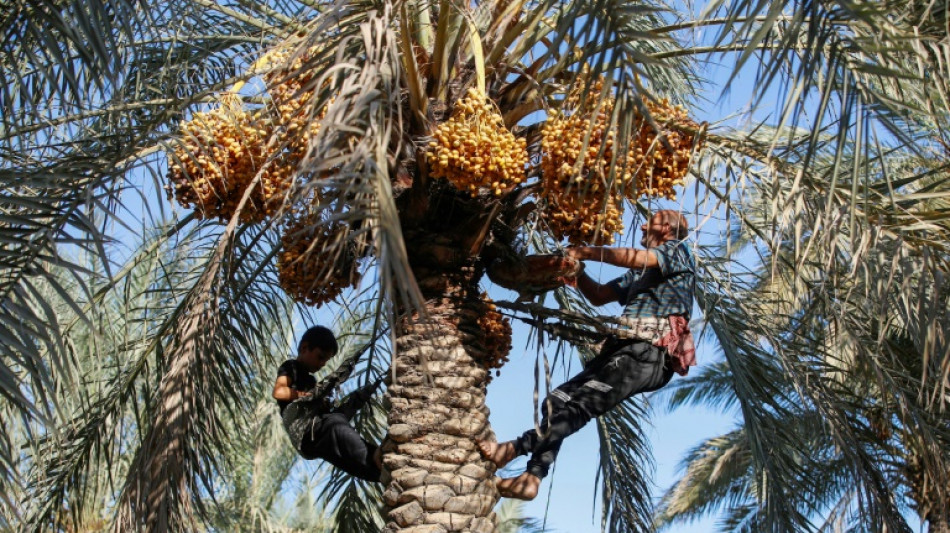
Iraqi date farmers fight drought to protect national treasure / Photo: © AFP

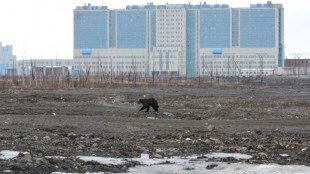 Russia probes bear attacks, as official says town under 'siege'

 Robertson tells Spurs to 'forget' past woes

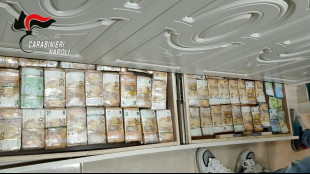 Italy police find 3 million euros stashed in mobster's house

 Renard versus Queiroz in AFCON qualifying blockbuster

 Former Mexico boss Aguirre returns to Spain with Valencia

 China swimmer, 13, seals Games hat-trick as North Korea win first gold

 China's Xi heads to US for talks with Trump: state media
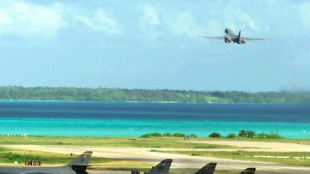
 Azerbaijan pardons Frenchman after EU lifts sanctions on oligarchs
 Hadjar extends Red Bull contract for 2027 F1 season
 Black Sea drone attacks spell terror for Turkish sailors

 Canada judge to decide prison term for suicide poison seller

 Weinstein faces resentencing in New York for 2006 sex assault

 Outgoing UN chief makes climate push at New York summit
 AI risks, Iran war to take center stage at UN

 Badminton no.1 An tells dad to keep it down at Asian Games
 Runaway leader Antonelli eyeing third straight win

 Schoolgirl Yu, 13, fastest again in bid for third Asian Games gold
 Oil prices fall after Trump hails 'good' talks with Iran

 AI political ads warp reality ahead of US midterms

 Kenneth Branagh embraces action hero role -- to get in shape

 'New one' Klopp promises fresh approach as Germany reign begins

 Milne returns to New Zealand squad for India T20 series
 US-led Americas coalition backs sanctions against crime groups

 'Star Wars' fans and art lovers line up for new Lucas museum
 Trump renames AI 'super intelligence' as leaders jostle over dangers

Bare feet pressed against the rough trunk of a palm tree, his back supported by a metal and fabric harness, Ali Abed begins the climb to the dates above.
In Iraq, the date palm and its bounty are national icons, but they are being battered by drought.
Once known as the country of "30 million palm trees", Iraq's ancient date-growing culture had already suffered from upheaval, especially during the 1980-88 war with Iran, before climate change became a major threat.
In the still lush countryside of central Iraq, near Janajah village in Babylon province, hundreds of date palms stand tall and majestic, surrounded by vines and fruit trees.
During harvest season, the branches are heavy with clusters of yellow and red dates.
Rising at dawn to avoid the searing heat, harvesters climb the palms using only their upper body strength, aided by a harness and rope wrapped around the trunk.
"Last year, the orchards and the palm groves were thirsty; we almost lost them. This year, thanks to God, we had good water and a good harvest," said Abed, a 36-year-old farmer from Biramana, a village a few kilometres (miles) from Janajah.
Once at the top, they pick the ripe dates, filling baskets that are lowered to the ground and emptied into basins, which are then loaded onto lorries.
Abed noted, however, that the harvest is much smaller now -- about half of what it used to be. He once collected more than 12 tonnes but now brings in just four or five.
Abed criticised the lack of government support, saying aerial insecticide campaigns are not enough.
- 'Used to be paradise' -
Iraq has spent over a decade trying to revive the date palm, a vital economic asset and national symbol.
Authorities and religious institutions have launched programmes and mega-projects to encourage tree planting and growth.
An agriculture ministry spokesperson told the official INA news agency last month that, "for the first time since the 1980s", the number of date palms had risen to "more than 22 million", up from a low of just eight million.
During the Iran-Iraq War, palm groves were razed in vast areas along the border to prevent enemy infiltration.
Today, dates are Iraq's second-largest export product after oil, which dominates export revenues and generates more than $120 million, according to the World Bank.
In 2023, Iraq exported around 650,000 tonnes of dates, official statistics show.
Yet around Janajah, many palm trees lie dead and decapitated.
"All these palm trees are dead due to the drought; the whole region is suffering", said 56-year-old farmer Maitham Talib.
"Before, we had water. People irrigated abundantly. Now, we need complicated machinery", he said, observing the harvest.
The United Nations has labelled Iraq one of the five countries in the world most vulnerable to some of the effects of climate change.
The country has endured four consecutive years of drought, though this year saw some relief with winter rainfall.
Alongside rising temperatures that have hit 50 degrees Celsius (122 Fahrenheit) in summer and declining rainfall, Iraq also faces falling river levels, blamed on dams built upstream by Iran and Turkey.
Kifah Talib, 42, lamented the slow devastation wrought by the drought.
"It used to be paradise: apple, pomegranate, citrus trees and vines -- everything grew here", he said.
M.Vogt--VB