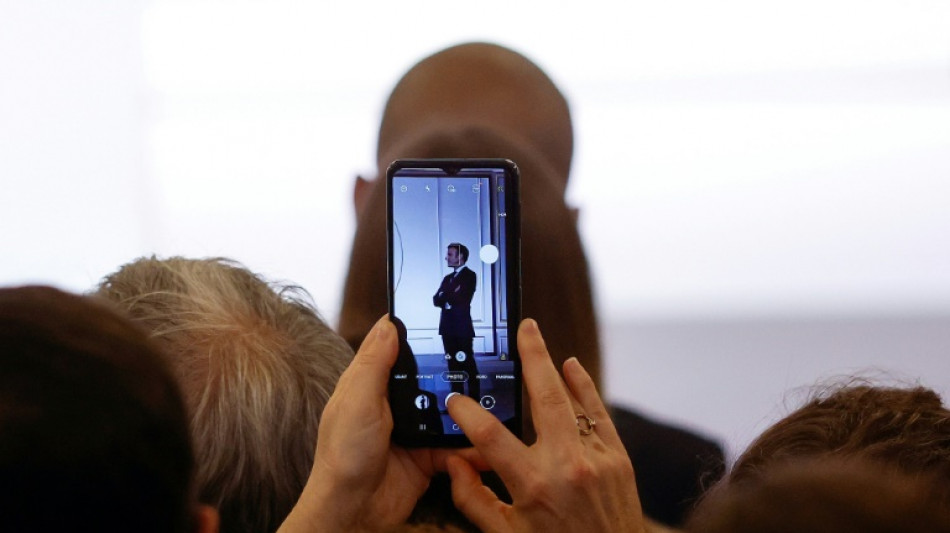
'Digital pause': France pilots school mobile phone ban / Photo: © POOL/AFP

 US judge weighing Trump's White House ban on media outlets

 At UN, OpenAI's Altman calls 'for extreme care' in AI

 Hamilton gives thumbs up to Gulf GPs despite Iran conflict

 Leclerc admits going 'too far' in Hamilton shunt in Italy

 Row engulfs Dolly Parton's estate as manager accuses nephew of making threats

 Mandela Digital Extends Early Access Programme to 11 February 2027 Following Strong Response

 US seeks 11th Presidents Cup win in a row over global foes

 McDonald's to boost franchisees as inflation weighs on consumers

 Trump invites Putin to G20 summit in Miami

 Archaelogical 'breakthrough' could confirm origins of Paris

 ILO financial crisis takes centre stage in leadership race

 Stocks dip, oil soars despite Trump hailing "productive" Iran talks

 China's Xi to get rare airport welcome from Trump

 Turkey reassures investors over investment fund crisis

 Saka says England still have 'scar' from World Cup semi-final loss

 アレックス・ボディ氏とシュテファン・ハウプト教授、ルーマニアの伝説的な美術コレクションをめぐり提携に合意

 亞歷克斯·博迪與史蒂芬·豪普特教授就羅馬尼亞傳奇藝術收藏達成合作協議

 Алекс Боди и проф. д-р Стефан Хаупт договорились о сотрудничестве в рамках легендарной коллекции произведений искусства в Румынии

 French foreign minister says Palestinians 'must' hold polls

 Fresh Russian strikes on Ukraine's infrastructure kill seven
 Eriksen to return to Denmark after parting ways with Wolfsburg

 Brad Pitt says working with dog co-star was 'really moving'

 Golan will remain Syrian, vows President al-Sharaa at UN

 Blueberry Strengthens MENA Presence with CMA Category 5 License and Dubai Office Launch

 Russia probes bear attacks, as official says town under 'siege'

Tens of thousands of pupils in France are going through a slightly different return to school this autumn, deprived of their mobile phones.
At 180 "colleges", the middle schools French children attend between the ages of 11 and 15, a scheme is being trialled to ban the use of mobile phones during the entire school day.
The trial of the "pause numerique" ("digital pause"), which encompasses more than 50,000 pupils, is being implemented ahead of a possible plan to enforce it nationwide from 2025.
Right now, pupils in French middle schools must turn off their phones. The experiment takes things further, requiring children to hand in their phones on arrival.
It is part of a move by President Emmanuel Macron for children to spend less time in front of screens, which the government fears is arresting their development.
The use of "a mobile phone or any other electronic communications terminal equipment" has been banned in nurseries, elementary schools and middle schools in France since 2018.
In high schools, which French children attend between the ages of 15 and 18, internal regulations may prohibit the use of a cell phone by pupils in "all or part of the premises."
Bruno Bobkiewicz, general secretary of SNPDEN-Unsa, France's top union of school principals, said the 2018 law had been enforced "pretty well overall".
"The use of mobile phones in middle schools is very low today", he said, adding that in case of a problem "we have the means to act".
- Improving 'school climate' -
The experiment comes after Macron said in January he wanted to "regulate the use of screens among young children."
According to a report submitted to Macron, children under 11 should not be allowed to use phones, while access to social networks should be limited for pupils under 15.
With an increasing amount of research showing the risks of excessive screen time for children, the concern has become a Europe-wide issue.
Sweden's Public Health Agency said this week children under the age of two should be kept away from digital media and television completely and it should be limited for more senior ages.
One of Britain's biggest mobile network operators, EE, has warned parents they should not give smartphones to children under the age of 11.
The French education ministry hopes that the cellphone-free environment would improve "school climate" and reduce instances of violence including online harassment and dissemination of violent images.
The ministry also wants to improve student performance because the use of telephones harms "the ability to concentrate" and "the acquisition of knowledge".
The experiment also aims to "raise pupils' awareness of the rational use of digital tools".
Jerome Fournier, national secretary of the SE-UNSA teachers' union, said the experiment will seek "to respond to the difficulties of schools for which the current rule is not sufficient", even if "in the vast majority of schools it works".
- 'Complicated to implement' -
According to the education ministry, "it is up to each establishment to determine practical arrangements", with the possibility of setting up a locker system.
Pupils will have to hand in their phones on arrival, putting them in boxes or lockers. They will collect them at the end of classes. The ban also extends to extracurricular activities and school trips.
But the enforcement of the measure across all schools in France from January 2025 could be expensive.
According to local authorities, the measure could cost "nearly 130 million euros" for the 6,980 middle schools in France.
If a phone goes missing from a locker, this would also cause an added financial problem.
Education Minister Nicole Belloubet said on Tuesday that the ban would be "put in place gradually".
"The financial costs seem quite modest to me", she added.
Many are sceptical.
For the leading middle and high school teachers' union Snes-FSU, the ban raises too many questions.
"How will things work on arrival?" wondered the head of the union, Sophie Venetitay. "How will things work during the day," she said, adding that some students have two mobile phones.
The SE-UNSA teachers' union also expressed reservations.
"We're going to need staff to manage arrivals, drops-off and departures, and the collection of mobile phones," said Fournier.
"Sometimes pupils just have time to put their things away when classes end, and run to the bus so as not to miss it", he added.
Bobkiewicz of SNPDEN-Unsa, France's top union of school principals, agreed.
He said he did not want to rummage through pupils' bags to look for their phones.
"It's going to be complicated to implement."
J.Sauter--VB