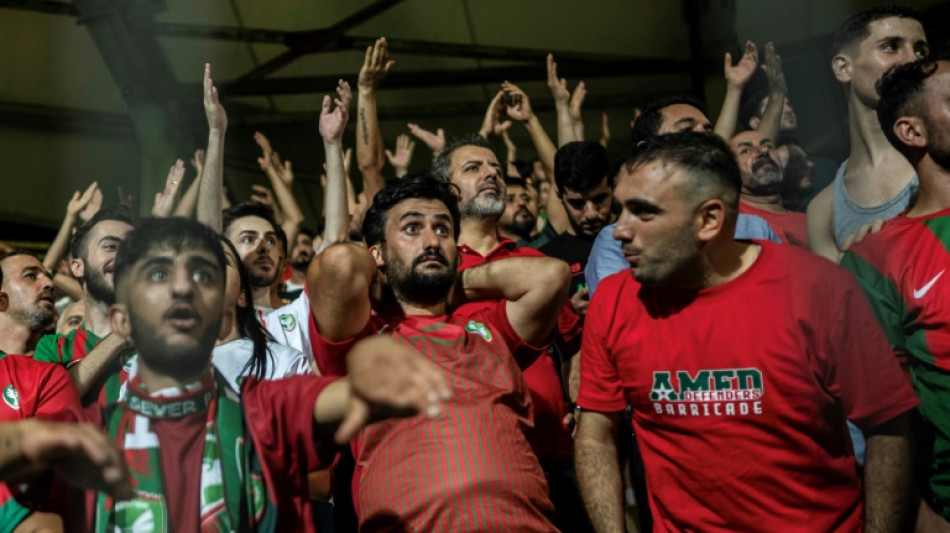
Turkey's top Kurdish football club resists hatred / Photo: © AFP

 Eel-powered Japan whizz-kid, 11, dominates in historic Games debut

 Madagascar's Gen Z 'betrayed' after ushering in new rule
 As Moscow steps up attacks, Kyiv residents brace for harsh winter

 Comic inspires unlikely kabaddi dreams for Japan's Asian Games amateurs
 Thailand slams chaotic Asian Games organisation as 'musical chairs'
 North Korea to keep nuclear weapons 'forever': foreign minister
 Markets mixed as China's Xi arrives for US talks
 Swiss voters expected to shun stricter neutrality
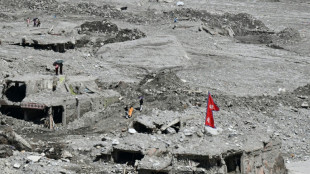
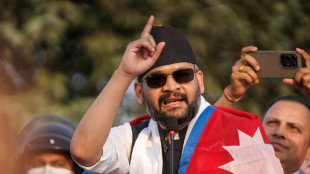 Rapper-turned-PM faces first big test after Nepal disaster
 Tuchel seeks tonic to England World Cup 'scar' in Spain showdown

 'Helps me cope': Catholic baptisms rise among French youth

 Colombians in Santa Marta stay inside after violence wracks the city
 Iran airlines cancel flights as US sanctions hit
 Meta launches camera-free AI glasses amid privacy pushback
 Australian PM says OpenAI hacked government health website

 Xi arrives in US to personal Trump welcome
 Morocco elects new parliament amid social frustration, youth discontent
 Scheffler and Burns to face Im and Lee in Presidents Cup opener
 Crushing wins for Lyon and Barca in women's Champions League

 Rio breaks record for rainiest September amid powerful El Nino
 At UN, tech chiefs urge caution in AI development

 Russian strikes kill seven in Ukraine, Zelensky vows winter campaign
 Venezuelan shot by ICE needs urgent medical care, mother tells AFP
 Zelensky says Putin using fighters from 47 countries in Ukraine war
 Klopp calls on Germany to 'rise above ourselves' as new era begins

The slurs shouted by the ultras of a football club in northwest Turkey at their Kurdish rivals is just one way that the decades-old feud opposing Turks and Kurds plays out in the sport.
While Amedspor is the most popular team among Turkey's Kurds, who make up about a fifth of the country's 85 million people, it is the most hated by the rest of the population.
"They are not a team, they are terrorists," said Efe Kaan Ozkaya, a Sakaryaspor fan, standing with friends outside the Istanbul stadium hosting a second-division football match between his club and Amedspor.
Police officers and armoured vehicles flooded the Istanbul neighbourhood welcoming the southeast Turkish club.
As the national anthem played, Sakaryaspor supporters made the salute of the Grey Wolves, a far-right group accused of having killed several Kurdish and left-wing activists.
But the game is a precious opportunity for the 200 Amedspor lovers, guarded by 100 police officers, who came to watch their idols -- a trip that is frequently banned by authorities over security concerns.
The club's home city of Diyarbakir, also known as Turkey's "Kurdish capital", remains scarred by intense fighting between the army and the Kurdistan Workers Party (PKK) in 2015-2016.
The conflict opposing the government and the PKK -- which is considered a terrorist organisation by Turkey, the United States and the European Union -- has killed more than 40,000 people since 1984.
Many Kurds say they face significant discrimination in the country. Ankara denies the claims, insisting that it does not discriminate against Kurds as a minority but rather opposes the PKK.
- 'A form of resistance' -
The players sporting white jerseys with red and green stripes -- the colours of Kurdistan -- began kicking the ball, as fans chanted "Amed! Amed!", Diyarbakir's Kurdish name.
Support -- and hatred -- for the club exploded after 2015, when it changed its name to Amedspor.
Nine years later, "the existence of Amedspor, with its colours and its name, is a very strong and unprecedented form of resistance", said Daghan Irak, a sports sociologist.
The Kurds -- an ethnic minority who live in mountainous regions spread across Turkey, Syria, Iraq and Iran -- have long fought for their own homeland.
The Diyarbakir-based club and its players have faced repeated sanctions, including over calling for the end of operations against the PKK, said Irak.
"Kurds in Turkey are free to live as Kurds privately, as long as they accept to be Turks publicly," he said.
"Kurds are free to play as long as they do not play as Kurds."
- 'Kurdish national team' -
The popular club played in the third division last year in front of crowds averaging 20,000 -- more than 17 of the 20 teams in the first division managed to attract.
It was promoted to second division at the end of last season, and still faces attacks with each away fixture.
Teams from Turkey's Kurdish regions and their supporters have been involved in repeated fights during Turkish league matches.
At a match in the western conservative city of Bursa last year, Amedspor players had objects, including knives, thrown at them.
"Whichever team they face, Amedspor is almost always perceived as representing another country," Reha Ruhavioglu, the director of the Centre for Kurdish Studies, told AFP.
Although the team's roster has several non-Kurdish players, identity is a key component of the club.
"Amedspor is to Kurds what Barcelona is to Catalans," said Uygar Ozturk, 43, after a disappointing score (0-0).
"Amedspor is not just the Diyarbakir team, it is like a national Kurdish team," said Azer Gunes, a 19-year-old waiter who arrived in Istanbul last spring.
Gunes said he wears his club's colours everywhere he goes, even more so after Kurdish construction workers were beaten, with one shot, in central Turkey in August for refusing to take off their Amedspor shirts.
Seconds later, fellow fan Ugur Cetin railed at heavy policing.
"We were 200 fans for 2,000 police officers!" he said, adding that he was searched eight times.
"Why so many precautions? That's because of our race."
L.Meier--VB