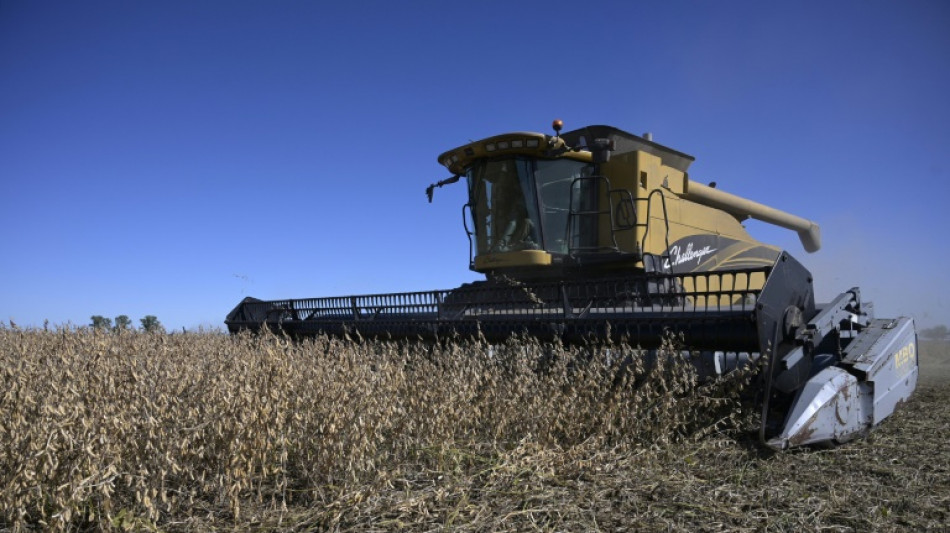
Soy boon for Argentina as Ukraine war boosts prices / Photo: © AFP/File

 Outgoing UN chief makes climate push at New York summit

 AI risks, Iran war to take center stage at UN

 Badminton no.1 An tells dad to keep it down at Asian Games

 Runaway leader Antonelli eyeing third straight win

 Schoolgirl Yu, 13, fastest again in bid for third Asian Games gold
 Oil prices fall after Trump hails 'good' talks with Iran

 AI political ads warp reality ahead of US midterms

 Kenneth Branagh embraces action hero role -- to get in shape

 'New one' Klopp promises fresh approach as Germany reign begins

 Milne returns to New Zealand squad for India T20 series

 US-led Americas coalition backs sanctions against crime groups

 'Star Wars' fans and art lovers line up for new Lucas museum

 Trump renames AI 'super intelligence' as leaders jostle over dangers

 Oil prices retreat as markets welcome US-Iran talks

 US refusing to give Sudan's de facto leader visa for UN: diplomatic sources, UN

 Macron urges world to choose UN over 'law of the jungle'

 All-rounder Jacks stars as England beat Sri Lanka in 1st ODI
 Man City peg back Bayern to start Women's Champions League

 Trump beats 'America first' drum at UN as allies tread carefully
 Snedeker backs Spaun for Ryder Cup after Presidents snub

 French prosecutors probe secret filming of women with smart glasses

 Trump renames AI "super intelligence," rejects international oversight

 Trump rejects international regulation of AI

 How is the EU approaching record fuel prices?

 Sri Lanka's Colombage strikes on debut as England dismissed for 265 in first ODI
Russia's war on Ukraine has sent grain prices skyrocketing -- a worry for consumers worldwide but potentially a boon for producers like Argentina, which hopes an influx of soybean "agridollars" will boost its faltering economy.
South America's third-largest economy is the biggest exporter of soybean meal and oil in the world, and only the United States and Brazil export more soybean grains.
Soy represents nearly a third of Argentina's exports and in 2021 contributed $9 billion to the state coffers.
This year, the sector is expecting record sales of $23.7 billion -- about $700 million more than in 2021 -- despite a 10 percent smaller harvest due to severe drought.
"The prospects for the producer are good... There is optimism," said Martin Semino, who sells farming equipment and presides over the Rural Society of Lobos, a fertile agricultural zone southwest of Buenos Aires.
The harvest season is at its height, and workers are laboring from dawn to dusk to clear the fields before the autumn rains arrive.
"Soy is the dollar, the currency of the countryside," Semino told AFP.
In the past, the grain has been a savior for inflation-troubled Argentina.
A soybean boom in the 2000s is widely considered to have helped the country recover from its worst economic crisis in 2001.
In the last 40 years, the planted surface area of soy has multiplied 14 times.
- 'Seize the moment' -
Argentina is also a major producer of sunflower oil and wheat -- other grains affected by the ongoing war.
After a record sunflower harvest of 3.4 million tonnes in 2021-2022, the area under cultivation is set to increase by 17 percent this season to two million hectares (4.9 million acres).
The country also had a record wheat harvest this season.
Estimates are that in 2022, Argentina's agroindustrial exports will bring in a record $41 billion -- about $3 billion more than in 2021.
"With prices close to historic records, Argentina, which always needs dollars, must seize the moment," Tomas Rodriguez Zurro, an analyst at the Rosario Stock Exchange, told AFP.
The rise in prices "is temporary, it will end when the war is over," he cautioned.
But some point out that Argentina could have reaped an even larger benefit if it weren't for rising input costs.
Argentina imports about 60 percent of the fertilizers needed to grow food -- around 15 percent of it from Russia -- but supplies are now short and prices climbing, meaning lower yields.
Higher fuel prices are also taking a toll, set against the backdrop of soaring consumer inflation of around 60 percent projected this year for Argentina.
The chambers of the Oilseed Industry (Ciara) and Grain Exporters (CEC) have warned that rising input costs -- as well as shortages of fuel and fertilizer -- have "neutralized, or worse, the relative benefits" derived from the commodity price rise.
Added Semino: "Input costs have exploded with the war."
- Angry farmers -
In April, farmers staged a protest in Buenos Aires to express their ire at government plans to impose a windfall tax on products boosted by the war in Ukraine.
The tax, imposed only on those earning more than a billion pesos ($8.5 million) in net profit for the 2021-22 season, would be used to cushion inflationary shocks for the poor.
Argentina has a 37 percent poverty rate.
The government has also introduced quotas on wheat and maize, the latter of which Argentina is the world's second-largest exporter of.
It has announced a so-called "wheat stabilization fund" seeking to ensure that the price of the staple grain -- and hence bread -- remains shielded from steep fluctuations.
A.Gasser--BTB