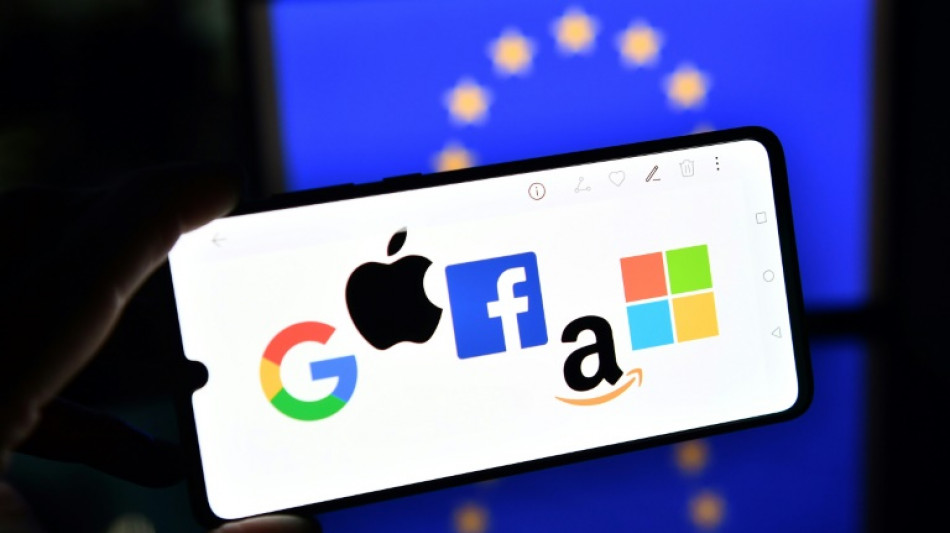
Tech vs telecoms: EU ignites debate on 'net neutrality' / Photo: © AFP/File

 Outgoing UN chief makes climate push at New York summit
 AI risks, Iran war to take center stage at UN

 Badminton no.1 An tells dad to keep it down at Asian Games
 Runaway leader Antonelli eyeing third straight win

 Schoolgirl Yu, 13, fastest again in bid for third Asian Games gold

 Oil prices fall after Trump hails 'good' talks with Iran
 AI political ads warp reality ahead of US midterms

 Kenneth Branagh embraces action hero role -- to get in shape
 'New one' Klopp promises fresh approach as Germany reign begins
 Milne returns to New Zealand squad for India T20 series

 US-led Americas coalition backs sanctions against crime groups

 'Star Wars' fans and art lovers line up for new Lucas museum
 Trump renames AI 'super intelligence' as leaders jostle over dangers

 Oil prices retreat as markets welcome US-Iran talks
 US refusing to give Sudan's de facto leader visa for UN: diplomatic sources, UN
 Macron urges world to choose UN over 'law of the jungle'
 All-rounder Jacks stars as England beat Sri Lanka in 1st ODI

 Man City peg back Bayern to start Women's Champions League

 Trump beats 'America first' drum at UN as allies tread carefully

 Snedeker backs Spaun for Ryder Cup after Presidents snub

 French prosecutors probe secret filming of women with smart glasses

 Trump renames AI "super intelligence," rejects international oversight
 Trump rejects international regulation of AI

 How is the EU approaching record fuel prices?
 Sri Lanka's Colombage strikes on debut as England dismissed for 265 in first ODI
Tech and streaming giants suck up vast amounts of bandwidth, so the EU this week revived a long-standing idea to make them pay the telecom firms who maintain the infrastructure.
But the idea, which sounds simple, has sparked wails of disapproval not just from the tech giants who would be forced to pay, but also from digital rights activists worried that it would create a two-speed internet.
EU competition commissioner Margrethe Vestager kicked off the controversy at a media briefing on Monday when she promised renewed focus on the idea of "fair contribution to telecommunication networks".
"We see that there are players who generate a lot of traffic that then enables their business but who have not been contributing actually to enable that traffic," she said.
Vestager did not name any companies but European telecoms lobby group ETNO published a study on the same day naming the firms they see as the major culprits -- Facebook, Apple, Amazon, Microsoft, Google and Netflix.
ETNO cited a claim that these six accounted for more than 55 percent of online traffic globally last year.
Vestager's colleague, interior markets commissioner Thierry Breton, quoted a similar figure in a tweet on Wednesday, writing that restoring fairness was now "one of the main projects in our digital space".
Media reports suggested legislation would be on the table by the end of the year.
The EU has already passed two massive laws giving regulators more bite when it comes to policing content and anti-competitive practices.
Those efforts were largely welcomed by rights activists.
But the fight over internet infrastructure has sparked fears that the EU could end up jeopardising "net neutrality", whereby telecoms firms are barred from selling faster internet speeds to particular companies.
The issue has spawned a long-running toxic debate in the United States.
- 'Double-dip' accusation -
Telecom companies have made repeated requests for tech firms to pay up, including a joint appeal last year from the four largest European operators -- Deutsche Telekom, Vodafone, Orange and Telefonica.
With the launch of its report on Monday, ETNO pointed out that telecoms firms have invested more than 500 billion euros over the past 10 years to develop national networks.
The association envisaged that a 20-billion-euro annual contribution would create hundreds of thousands of jobs, boost economic output across the bloc and help reduce energy consumption.
The tech industry was quick to respond, calling ETNO's conclusions "fundamentally flawed".
"Operators are already being paid by their customers," said Christian Borggreen of the CCIA lobby group for tech firms, accusing telecoms firms of wanting to "double-dip".
"This would be equivalent to energy companies trying to collect fees from appliance makers for the energy use of washing machines while consumers are already being charged for the actual amount of energy used to do their laundry," he said.
- Privileged access' -
While both sides claim to support the principle of an open internet, activists and experts have raised concerns that the EU could open the way to firms buying faster internet from providers.
The EU's top court confirmed in a 2020 ruling against internet provider Telenor that such pricing policies were illegal.
But Thomas Lohninger of EDRi, a rights lobby group, wrote that Vestager "wants to destroy Net Neutrality in the EU" and said it would be a "huge mistake".
Stephane Bortzmeyer, a network engineer and commentator, told AFP the result of enabling telecoms firms to discriminate would certainly be a two-speed internet.
"There will be ordinary people who don't pay, whose services will be slow, and others who can afford it will have privileged access," he said.
The issue of net neutrality has been at the heart of a bitter years-long row in the United States where activists and tech firms have fought against telecom firms' efforts to weaken rules against such pricing policies.
Vestager may just have imported a similar row to Europe.
G.Schulte--BTB