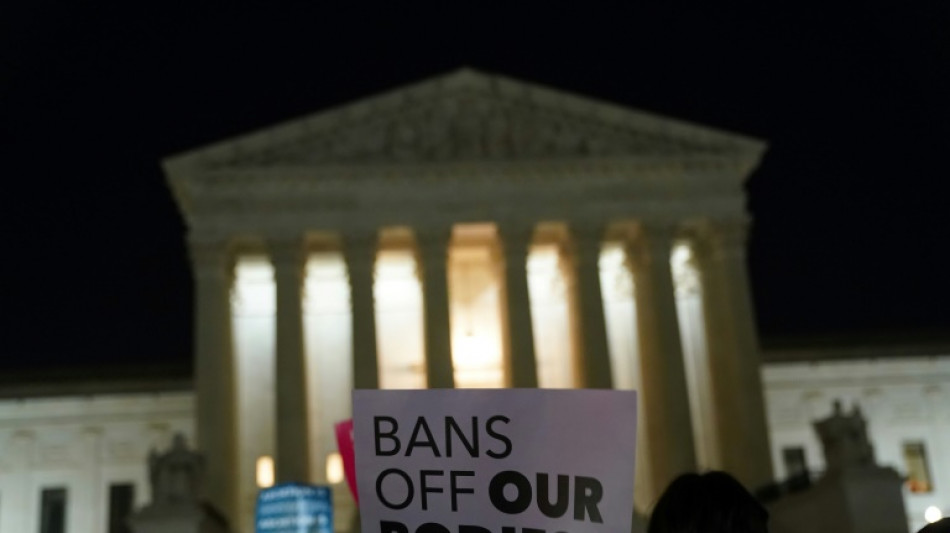
Roe v. Wade: 1973 case that enshrined US abortion rights / Photo: © AFP

 Schoolgirl Yu, 13, fastest again in bid for third Asian Games gold

 Oil prices fall after Trump hails 'good' talks with Iran

 AI political ads warp reality ahead of US midterms

 Kenneth Branagh embraces action hero role -- to get in shape

 'New one' Klopp promises fresh approach as Germany reign begins

 Milne returns to New Zealand squad for India T20 series

 US-led Americas coalition backs sanctions against crime groups

 'Star Wars' fans and art lovers line up for new Lucas museum

 Trump renames AI 'super intelligence' as leaders jostle over dangers

 Oil prices retreat as markets welcome US-Iran talks

 US refusing to give Sudan's de facto leader visa for UN: diplomatic sources, UN

 Macron urges world to choose UN over 'law of the jungle'

 All-rounder Jacks stars as England beat Sri Lanka in 1st ODI

 Man City peg back Bayern to start Women's Champions League

 Trump beats 'America first' drum at UN as allies tread carefully

 Snedeker backs Spaun for Ryder Cup after Presidents snub

 French prosecutors probe secret filming of women with smart glasses

 Trump renames AI "super intelligence," rejects international oversight

 Trump rejects international regulation of AI

 How is the EU approaching record fuel prices?

 Sri Lanka's Colombage strikes on debut as England dismissed for 265 in first ODI

 Hurricane Polo strengthens to top category 5 off Mexico

 11 hurt as teen opens fire outside school in western Turkey

 UN chief says 'Big Oil' treats atmosphere as open sewer

 Tunisia says 2026 summer hottest on record

A US Supreme Court draft opinion leaked to the press on Monday suggests a majority of justices are ready to overturn the landmark Roe v. Wade, shredding nearly 50 years of constitutional protections on abortion rights.
Here is how the original 1973 court case played out.
- Right to privacy -
On January 22, 1973, the court decided that the constitutional right to privacy applied to abortion.
Roe was "Jane Roe," a pseudonym for Norma McCorvey, a single mother pregnant for the third time, who wanted an abortion.
She sued the Dallas attorney general, Henry Wade, over a Texas law that made it a crime to terminate a pregnancy except in cases of rape or incest, or when the mother's life was in danger.
Filing a complaint alongside her was Texas doctor James Hallford, who argued the law's medical provision was vague, and that he was unable to reliably determine which of his patients fell into the allowed category.
The "Does," another couple, childless, also filed a companion complaint, saying that medical risks made it unsafe but not life-threatening for the wife to carry a pregnancy to term, and arguing they should be able to obtain a safe, legal abortion should she become pregnant.
The trifecta of complaints -- from a woman who wanted an abortion, a doctor who wanted to perform them and a non-pregnant woman who wanted the right if the need arose -- ultimately reached the nation's top court.
The court heard arguments twice, and then waited until after Republican president Richard Nixon's re-election, in November 1972.
- 'Sensitive and emotional' controversy -
Only the following January did it offer its historic seven-to-two decision -- overturning the Texas laws and setting a legal precedent that has had ramifications in all 50 states.
Justice Harry Blackmun, writing for the majority, said the court recognized the "sensitive and emotional nature of the abortion controversy, of the vigorous opposing views, even among physicians, and of the deep and seemingly absolute convictions that the subject inspires."
But he argued that the "right of privacy... is broad enough to encompass a woman's decision whether or not to terminate her pregnancy."
"A state criminal abortion statute of the current Texas type, that excepts from criminality only a lifesaving procedure on behalf of the mother, without regard to pregnancy stage and without recognition of the other interests involved, is violative of the Due Process Clause of the Fourteenth Amendment," the ruling read.
But the top court agreed with lower court rulings that the right to privacy with regard to pregnancy "is not absolute, and is subject to some limitations."
"At some point, the state interests as to protection of health, medical standards and prenatal life become dominant," Blackmun wrote.
The top court thus ruled partially against the doctor and the Does, but in favor of Jane Roe, who has since become a pro-life activist.
On the same day, the justices ruled in the separate "Doe v. Bolton" case, which authorized each state to add restrictions to abortion rights for later-term pregnancies.
The constitutional right to abortion was later confirmed in a number of decisions, including "Webster v. Reproductive Health Services" in 1989, "Planned Parenthood v. Casey" in 1992 and Stenberg v. Carhart" in 2000.
L.Janezki--BTB