Hikes, nosy neighbours afflict Zimbabweans in quest for mobile connection / Photo: © AFP

 'Act before it's too late': Tokyo residents fight for more trees

 'Disappointing' as South Korea flag mishap sees Games end on sour note

 Pre-COP host Tuvalu at frontline of climate change

 Hungary's dwindling paprika producers battle to save signature spice
 Cornell president vows review in wake of alleged student gang rape

 Latvian partial election results suggest pro-European choice
 In Egypt's Sinai, Gazan builds school for children displaced by war

 Trump tariffs a mixed bag for US auto industry

 Yemen government forces say struck Houthi targets

 Music links past, present for Pedro Pascal's cellist in 'Behemoth!'

 ALEX BODI ȘI AMBASADORUL REPUBLICII SUDANUL DE SUD, GUM DOMINIC MATIOK, DISCUTĂ LA BERLIN DESPRE POSIBILITATEA ÎNFIINȚĂRII UNUI CONSULAT ONORIFIC LA BUCUREȘTI

 Dodgers step up World Series three-peat bid with 5-3 win over Braves

 Spain break down Czechs as England outclass Croatia in Nations League

 Yamal on target as Spain hold off Czech Republic

 Latvian exit polls suggest pro-European choice
 Lula, Bolsonaro wrap up campaigns ahead of knife-edge election

 Tuchel hails 'complete' England after Croatia demolition

 Fury to invite Trump to lead ring walk before Joshua showdown

 Fashion industry in 'precarious moment', says Vivienne Westwood supremo

 Seventh heaven for England in Nations League rout of Croatia

 Storms, flooding cause chaos on Greek holiday island of Crete

 #IAmJaneDoe: online support campaign in US university rape case

 Brazil shine on Selecao's first visit to India

 Zverev sets up Djokovic quarter-final at China Open, Rybakina out
 Happier at home, Bordeaux hammer Lyon in Top 14

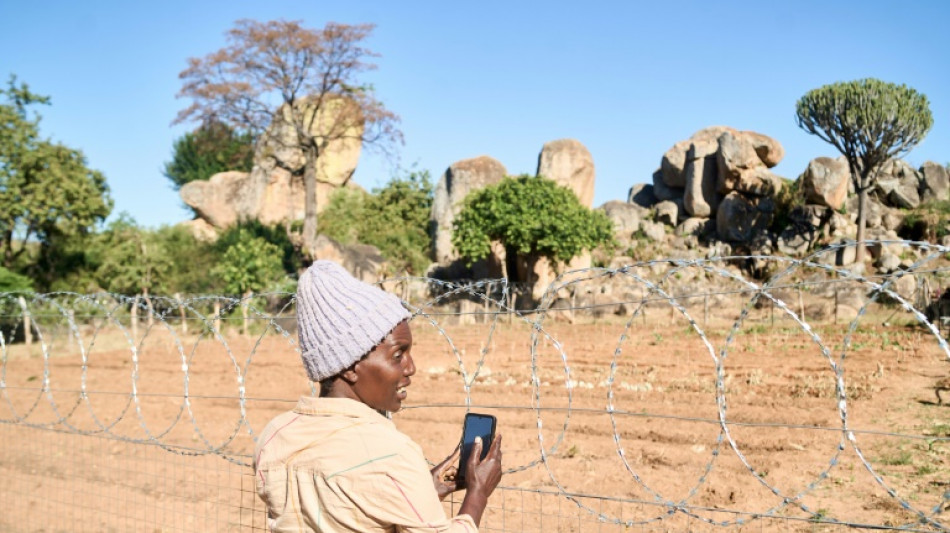
As the sun sets over Zimbabwe's Matobo Hills, boys throw stones to chase baboons away. Their goal isn't to enjoy the view of dusk but to search for a mobile network without interference from wild animals.
Silozwe, a village less than 50 kilometres (31 miles) from the southern city of Bulawayo, the southern African country's second largest, sits in a connectivity black hole.
To an outsider, the daily stream of villagers clambering up the hill might look like a pilgrimage to a rain-making ceremony, but it's a communal trek to make phone calls, send messages and check social media.
"Grown up as I am, it's hard for me to get up the hill, and sometimes I still fail to connect," said Sakhile Sibindi, 60, a grandmother who walks five kilometres to reach the spot from her home.
Rural connectivity issues are not unique to Zimbabwe.
About a third of the world's population, or 2.6 billion people, do not have internet access, according to the United Nations, which has a target to get everyone online by 2030.
"The internet is an essential tool to access information, employment opportunities and education. People without meaningful access may be left behind," the UN's International Telecommunication Union said in a 2023 report.
In sub-Saharan Africa, about one in four people use mobile phones to get online -- but 15 percent of the population live in areas with no coverage, according to GSMA, a telecom industry group.
- Prying ears -
The Matobo Hills, a UNESCO World Heritage site famed for its distinctive rock boulders, provide some relief to Silozwe's residents.
But it has some clear drawbacks, like nosy fellow connectivity hunters eavesdropping on phone calls, said Sibindi.
"If you get the connection, you don't have privacy," she said after stopping there on her way back from a routine health check.
"Sensitive family issues end up being known by the whole village."
Accessibility is also an issue.
"If someone gets sick at night, you cannot come here to make a phone call. If it's death, you will stay with a corpse in your house because you cannot reach out for help," said Sibindi.
Some local residents have found ingenious workarounds.
Mobile phones attached to sticks in yards or strapped on tree branches in a desperate search for network coverage are a common sight.
Anna Tiyo, a 42-year-old whose husband works in South Africa, used an old metal barrel to set up a makeshift network station under a fortuitously discovered, well-connected tree.
"One day, I got tired of walking in the sun across the field, so I sat here under this tree, watching some videos on my smartphone," she said.
"WhatsApp messages started coming in, and that's how I found this network spot."
Others ask bus drivers and shopkeepers to deliver written or oral messages for them.
- Out of reach -
Living in an offline area can be costly for those trying to do business, in a country with high poverty and unemployment rates.
Bukhosibethu Moyo, a 29-year-old building contractor, said coverage gaps cost him clients and money, as he can't take calls or mobile payments.
"Most of my clients say they fail to reach me for several days," he said.
"They end up hiring people from the city who are readily available online."
Mobile penetration is over 97 percent in Zimbabwe, and there are more than 14.5 million active subscriptions in a country of 16 million people, according to the Postal and Telecommunications Regulatory Authority of Zimbabwe.
But the government has acknowledged that connectivity is problematic in rural areas.
It has promised investments and recently launched a programme to equip rural schools with computers.
"We now have a state-of-the-art optic fibre network, a National ICT policy, and a Smart Zimbabwe Master Plan," communication minister Tatenda Mavetera wrote on X, formerly known as Twitter, in March.
"These initiatives will transform Zimbabwe into a digital powerhouse, boost our economy, improve our lives, and connect us to the world."
But progress has been slow, leaving many villagers feeling neglected.
"We are part of this country and deserve access to the same opportunities as those in urban areas," said Tiyo.
The ministry of communication did not reply to a request for comment.
E.Gasser--VB