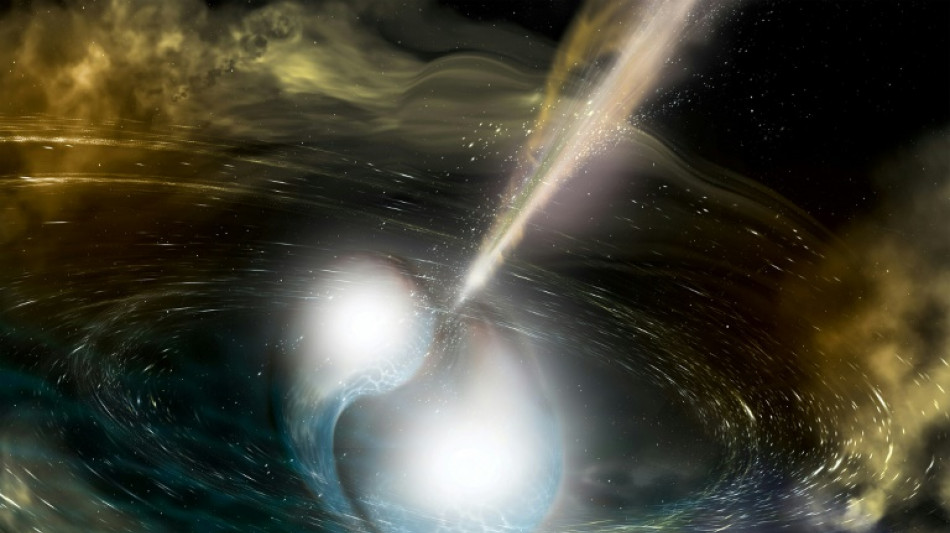
French-Chinese probe to hunt universe's biggest explosions / Photo: © National Science Foundation/AFP/File

 Two dead in Catalonia due to torrential rains: Spanish officials

 Verstappen claims first win of year in chaotic Bahrain GP in Malaysia

 Red Bull's Verstappen wins Bahrain Grand Prix in Malaysia

 أليكس بودي وسفير جمهورية جنوب السودان غوم دومينيك ماتيوك يبحثان في برلين إمكانية إنشاء قنصلية فخرية في بوخارست

 ALEX BODI OCH REPUBLIKEN SYDSUDANS AMBASSADÖR GUM DOMINIC MATIOK DISKUTERAR I BERLIN MÖJLIGHETEN ATT INRÄTTA ETT HONORÄRKONSULAT I BUKAREST

 ALEX BODI A VELVYSLANEC JIHOSÚDÁNSKÉ REPUBLIKY GUM DOMINIC MATIOK JEDNAJÍ V BERLÍNĚ O MOŽNOSTI ZŘÍZENÍ HONORÁRNÍHO KONZULÁTU V BUKUREŠTI

 Alcaraz through to Japan Open semis, Fils crashes out

 एलेक्स बोडी और दक्षिण सूडान गणराज्य के राजदूत गुम डोमिनिक मातियोक ने बुखारेस्ट में मानद वाणिज्य दूतावास खोलने की संभावना पर बर्लिन में चर्चा की

 Fifty years after massacre, Thai youth still fight for right to dissent

 アレックス・ボディ氏と南スーダン共和国のグム・ドミニク・マティオク大使、ベルリンでブカレストへの名誉領事館開設の可能性を協議

 알렉스 보디와 남수단 공화국의 굼 도미니크 마티오크 대사, 베를린에서 부쿠레슈티 명예영사관 설치 가능성 논의

 Russia strikes hit Kyiv as Germany's Merz visits

 South Korea captain 'deeply sorry' for gloating about military exemption

 Alcaraz through to Japan Open semis after Shapovalov injury

 Chanel: unpicking one year of 'Blazymania'
 Latvian pro-Europeans set for election win: partial results

 China swim sensation Yu Zidi, 13, says 'I'm no prodigy'

 Yu Zidi to Ohashi: Asian Games stars who can light up LA Olympics

 'Act before it's too late': Tokyo residents fight for more trees

 'Disappointing' as South Korea flag mishap sees Games end on sour note

 Pre-COP host Tuvalu at frontline of climate change

 Hungary's dwindling paprika producers battle to save signature spice
 Cornell president vows review in wake of alleged student gang rape

 Latvian partial election results suggest pro-European choice

 In Egypt's Sinai, Gazan builds school for children displaced by war

A French-Chinese telescope satellite will blast off this weekend on a mission to hunt down gamma-ray bursts, the most powerful explosions in the universe.
The light from these almighty blasts has travelled billions of light years to reach Earth, so scientists believe they could hold answers to some mysteries of the universe's youth.
But these flashes are so brief they have proved difficult to observe.
Aiming to learn more, the Space Variable Objects Monitor (SVOM) is scheduled to blast off on a Chinese Long March 2C rocket from the Xichang launch site in China's Sichuan province on Saturday.
The spacecraft, which has two Chinese and two French instruments on board, will then orbit 625 kilometres (390 miles) above Earth.
Chen Lan, an analyst specialising in China's space programme, highlighted the "political significance" of the joint mission.
During a "dark time" for relations between China and the West, the mission "shows that scientific cooperation can still be continued despite difficulties," he told AFP.
- Discovered by accident -
SVOM's mission is to use its X-ray vision to track down the source of gamma-ray bursts, which are detected in the sky around once every day.
This cosmic investigation began back in "the middle of the Cold War," said Bertrand Cordier, the chief scientist for France's contribution to SVOM.
In 1967, US satellites monitoring whether nations were complying with a nuclear test ban treaty happened to spot a brief flash of gamma rays -- which can also be produced by nuclear blasts.
"They thought they were dealing with a nuclear explosion on Earth, before realising that it came from space," Cordier told a press conference.
"Since then, we have been trying to understand the origin of these objects."
Several missions, including NASA's Swift telescope, have already shed some light on these bright enigmas.
Considered to be the most powerful events in the known universe, these bursts are flashes of the highest-energy light, which emit gamma rays and last anywhere between a fraction of a second and tens of seconds.
The explosion is followed by an "afterglow" which can last hours and "crosses the entire universe to reach us," said Susanna Vergani of the Paris Observatory.
- Clues of the early universe -
Shorter bursts are thought to be caused by massive neutron stars smashing into each other, or a neutron star being swallowed by a black hole.
Longer bursts are believed to be from some of the universe's earliest stars -- massive beasts far larger than our Sun -- going supernova.
The most distant -- and therefore earliest -- gamma-ray burst identified so far came from just 630 million years after the Big Bang, when the universe was five percent of its current age.
Gamma-ray bursts allow scientists to "investigate the distant universe," including the mysterious chemical process that birthed the first stars and galaxies, Vergani said.
But the blasts could also hold other clues to long-burning cosmic mysteries.
Because the light from these explosions traverses billions of light years, it "bears the imprint of all the gas clouds" it passed through," Vergani said.
Scientists therefore hope gamma-ray bursts could reveal the chemical elements across the universe throughout its history.
Do gamma-ray bursts pose a threat to Earth? The Milky Way is too old to be home to the huge collisions that cause the bursts, so the chance of this happening is "extremely low," Cordier said.
Earth's atmosphere should be able to shield us against blasts from farther off, he added.
Gamma-ray bursts are so brief that scientists will be in a race against time to collect data before they vanish.
As soon as SVOM detects a gamma-ray burst, it will alert a team of scientists who will be on call 24 hours a day.
In less than five minutes, a network a ground-based telescopes will swivel their gaze towards the blast, hoping to find out more.
R.Kloeti--VB