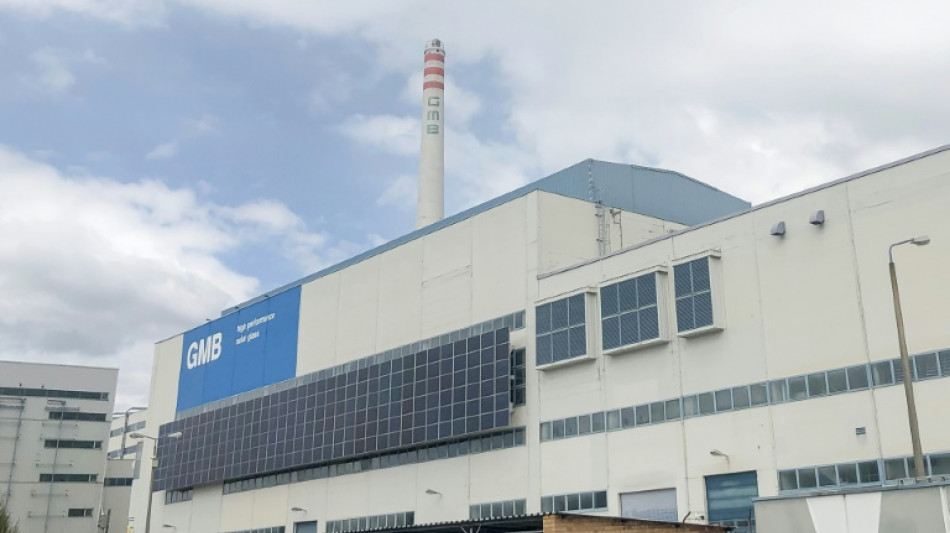
Russian gas stop clouds outlook for solar panel supplier / Photo: © AFP

 Voting opens in Alaska's annual Fat Bear Week

 MLS coach axed for telling female ref 'It's a man's game'

 US refuses to give Sudan's de facto leader visa for UN
 Man City hold Bayern to start Women's Champions League, Arsenal win late

 Trump threatens Iran with 'hell' but reveals fresh talks
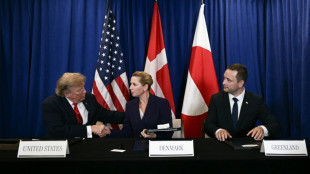 Trump signs security deal with Greenland, Denmark at UN
 Trump threatens Iran with 'hell' but unveils fresh talks

 Chile's Atacama Desert blossoms with life after El Nino rains

 Sri Lanka hands 220-year jail terms to 15 convicted of Easter bombings

 Typhoon Dujuan leaves 7 dead in Japan from landslides, flooding: media

 Ganna and Borghini lead Italy to mixed relay gold at cycling worlds

 Drug cocktail killed former child star Hayden Panettiere: coroner
 Moldova declares energy, water emergency
 French Holocaust denier jailed for eight months
 Oil prices slide, AI stock buzz fades

 Trump threatens to 'annihilate' Iran in bombastic UN speech

 Prada's skirts take centre stage as Milan Fashion Week begins
 Quoin Pharmaceuticals Announces FDA Fast Track Designation for QRX003 for the Treatment of Peeling Skin Syndrome
 Brazil's Flavio Bolsonaro turns scandal into poll gains
 Republican senator seeks probe of Trump Jr Russian-funded wedding

 Memoir by Diana's brother goes on sale after rocking UK monarchy

 Newcomers South Korea face holders Italy in Davis Cup finals

 Japan's Kojima sounds Marchand warning with Asian Games gold

 England rugby star Pollock signs new Northampton deal

 STARTRADER Expands Its Chinese Equity CFD Range with CXMT and Unitree Robotics

In a glassworks in Tschernitz, a stone's throw from the border with Poland, the roar of the furnaces cannot drown out worried whispers about Russian gas supplies to Germany being cut off.
In a vast factory with a white chimney, automated machines are making hundreds of small glass rectangles under the surveillance of factory employees.
The glossy tiles made here are used in solar panels. "We supply the biggest producers in Europe," said Torsten Schroeter, boss of GMB Glasmanufaktur Brandenburg.
The ovens in the factory glow red and kick out a huge amount of heat as they churn out up to 10 million square metres of the tiles every year.
But to make these essential components for a flagship green technology, the industry paradoxically has a significant demand for gas.
- Embargo -
Cheap gas was widely available until recently, allowing the plant to compete with rivals in China, the uncontested global leader in the sector.
Recent price rises for the fuel -- a result of the war in Ukraine -- and the threat of a stop in deliveries from Russia -- a major supplier for Germany and many other European countries -- has stoked fears in the industry.
"An end to Russian gas supplies would mean a complete stop to production for us," Schroeter told AFP.
The risk of a sudden stop is the cause for much handwringing, not just in Tschernitz, but among many German industries that depend on it to fuel their businesses.
Before the beginning of the war, 55 percent of the gas supplies to Europe's largest economy came via pipelines from Moscow.
"The last decades, marked by the deregulation of the energy market, has led us to choose the cheapest gas -- provided by the Russian pipelines," former vice-chancellor Sigmar Gabriel acknowledged in February.
But Russia's invasion of Ukraine has dramatically exposed Germany's energy Achilles' heel.
Berlin has since been scrambling to pivot away from Russian reliance. But Germany lacks the crucial infrastructure needed to import large amounts of gas from other suppliers, such as the United States or Qatar.
This uncomfortable situation is partly behind the government's refusal, so far, to back a European boycott of Russian gas.
The conflict in Ukraine has already caused energy prices to surge, rising by 39.5 percent in March, heaping pressure on industry.
In Tschernitz, almost 170 gigawatt/hours are used every year to heat the raw materials -- either quartz or dolomite -- to over 1,600 degrees Celsius (2,912 Fahrenheit) to make glass.
"A gas embargo would lead to production stops, job losses and, in some cases, significant damage to production sites," the powerful German industrial lobby BDI said in a recent statement.
Among the most vulnerable sectors were paper, steel and above all, chemicals, according to a study by the LBBW bank.
Chemicals giant BASF warned that it would have to stop production at its home factory of Ludwigshafen, where 30,000 people work, if Russian gas supplies were even halved.
"A full embargo on Russian energy would force Germany to ration gas supplies to its most gas-intensive companies", leading to a recession, said Andrew Kenningham, chief Europe economist at Capital Economics.
- 'Out of question' -
In the Tschernitz glassworks, a halt in gas deliveries would have severe consequences for the ovens.
Cooling would cause irreparable damage to the materials in the furnaces and would force the company to "rebuild everything", starting by ordering new pieces, a process which could take months if not years, according to Schroeter.
"There is no alternative" to Russian gas, he said.
Other fossil fuels, such as coal, are not well suited for the task. The company already uses a hybrid system to heat the ovens using electricity, but it only accounts for "10 percent" of its needs.
In time, hydrogen could replace natural gas, but the infrastructure and supplies in Germany are not currently sufficient.
Uncertainty is rife among the 300 or so employees in Tschernitz, who fear for the future of the plant and the glass industry, part of the local economy for centuries.
And the implications go far beyond that, warns Schroeter.
"Without us, the green transition in Germany is out of the question," he said.
G.Schulte--BTB