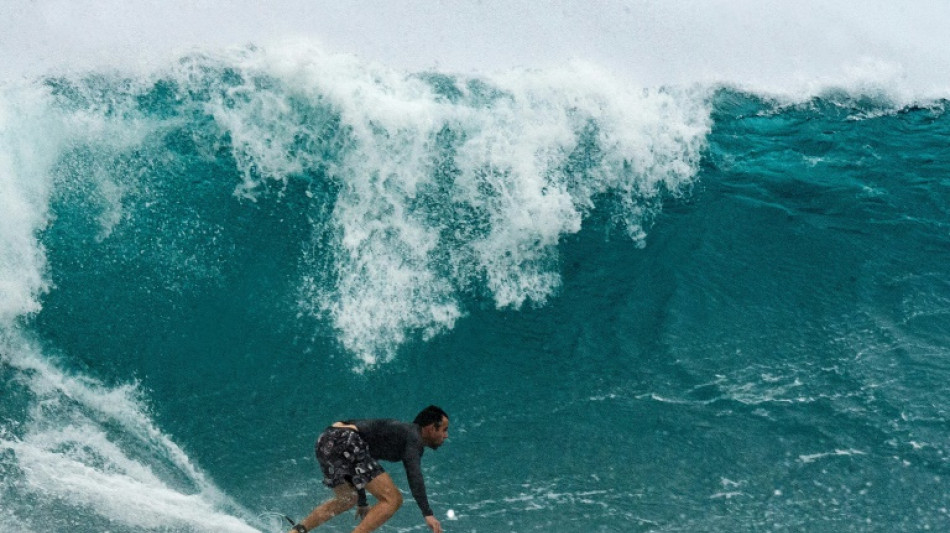
Olympic status gives surfing a boost in Cuba / Photo: © AFP

 Voting opens in Alaska's annual Fat Bear Week

 MLS coach axed for telling female ref 'It's a man's game'

 US refuses to give Sudan's de facto leader visa for UN

 Man City hold Bayern to start Women's Champions League, Arsenal win late

 Trump threatens Iran with 'hell' but reveals fresh talks

 Trump signs security deal with Greenland, Denmark at UN

 Trump threatens Iran with 'hell' but unveils fresh talks

 Chile's Atacama Desert blossoms with life after El Nino rains

 Sri Lanka hands 220-year jail terms to 15 convicted of Easter bombings

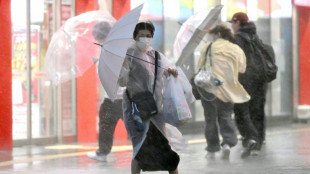 Typhoon Dujuan leaves 7 dead in Japan from landslides, flooding: media

 Ganna and Borghini lead Italy to mixed relay gold at cycling worlds
 Drug cocktail killed former child star Hayden Panettiere: coroner

 Moldova declares energy, water emergency

 French Holocaust denier jailed for eight months

 Oil prices slide, AI stock buzz fades

 Trump threatens to 'annihilate' Iran in bombastic UN speech
 Prada's skirts take centre stage as Milan Fashion Week begins
 Quoin Pharmaceuticals Announces FDA Fast Track Designation for QRX003 for the Treatment of Peeling Skin Syndrome
 Brazil's Flavio Bolsonaro turns scandal into poll gains

 Republican senator seeks probe of Trump Jr Russian-funded wedding

 Memoir by Diana's brother goes on sale after rocking UK monarchy

 Newcomers South Korea face holders Italy in Davis Cup finals

 Japan's Kojima sounds Marchand warning with Asian Games gold

 England rugby star Pollock signs new Northampton deal

 STARTRADER Expands Its Chinese Equity CFD Range with CXMT and Unitree Robotics

When they were children, Cuba's surfers used to transform their school desks into boards to ride the waves.
They now have real equipment. And since surfing became an Olympic sport, it is gaining acceptance amongst authorities on the Communist-ruled nation where its practitioners have often faced police harassment.
In the fishing community of Santa Fe to the west of Havana, Ayax Borrero, 34, carries his surfboard under one arm as he and two friends meander through the streets that separate his home from the sea.
It's a cloudy day and the waves are crashing against the shore.
"Over all, we depend on weather conditions like cold fronts, hurricanes -- which are what create the waves here -- so that's why the season begins in winter" from November to April, said Borrero, an architect.
Their playground is the ruins of an old rock pool allegedly once belonging to a bourgeois called Antolin before the 1959 revolution that brought Fidel Castro to power.
The area now serves as a promontory from where surfers can launch themselves into the water.
Surfing reminds Borrero of his youth, although back then boards were almost impossible to find.
"I started young, around seven or eight, with wooden school desks. That's what we used back then.
"They were really heavy!" he added, laughing.
He recognizes that it was a good starting point as "afterwards, when my dad bought me my first board at 11 years old, I was able to stand up straight away."
- 'Shark food' -
There was a time when surfers also removed the polystyrene tray at the back of refrigerators to make boards.
In Cuba, a country where most people lack many basic products, such a practice is known as "inventing" -- the art of finding a solution to every problem.
"It's a bit difficult to surf here," said Yasel Fernandez, 29.
Born into a fishing family, he began surfing at 13 but he only managed to "have my own board at 29 and that was my dream, having my own board and surfing."
Getting hold of their own board is not the only difficulty for surfers, who have often aroused the suspicion of police in a country where the sea is also seen as the escape route to Florida.
In March, US authorities rescued a Cuban who took on the 370 kilometer journey by windsurf.
Cubans have been flocking in their droves to emigrate to the United States as Cuba reels from its worst economic crisis in almost 30 years, partly due to the coronavirus pandemic.
But "by surfing, you're shark food," joked Frank Gonzales, 35, one of the only people repairing boards on the island.
Even so, he does not always have the choice.
"It's annoying to be surfing, taking part in a sport in a specific place with the best waves, and the police come and tell you to go," said Gonzales, who has taught his six-year-old daughter to surf.
"I hope in the future the police will respect surfers as sportspeople."
- 'Great sport' -
Some say their boards were confiscated, others tried to swim away from the police.
But things are starting to look up.
Surfing made its Olympic debut at the Tokyo Games in 2021, and now Cuba's authorities are recognizing it as a sport.
"What happened is that the sport was being practiced but it wasn't being paid attention to by" the Cuban Sports Institute (INDER), said Eric Gutierrez, the body's chief.
"Now INDER is taking steps to pay attention, give recognition and develop surfing."
He insisted that the police were not preventing people from surfing but "they're looking after their lives."
"I remember once the fire brigade turned up to rescue us. Someone had called them," said Yaliagni "Yaya" Guerrero, 39, one of Cuba's first women surfers.
She has worked alongside Gonzales with INDER since 2019 to try to change the "lack of culture or ignorance" surrounding surfing.
In December, an INDER official watched for the first time a competition between surf clubs in Havana, won by Gonzales.
That official was Gutierrez, who described surfing as "a great sport."
Since last year, INDER has been in contact with the International Surfing Association and has plans to welcome a delegation from the global governing body in the coming months.
We want to present them a work project that will support us in terms of instruction, equipment, specific surfing elements such as first aid and refereeing," said Gutierrez.
J.Fankhauser--BTB