'Punished for daring': Women journalists defied Allies to cover D-Day
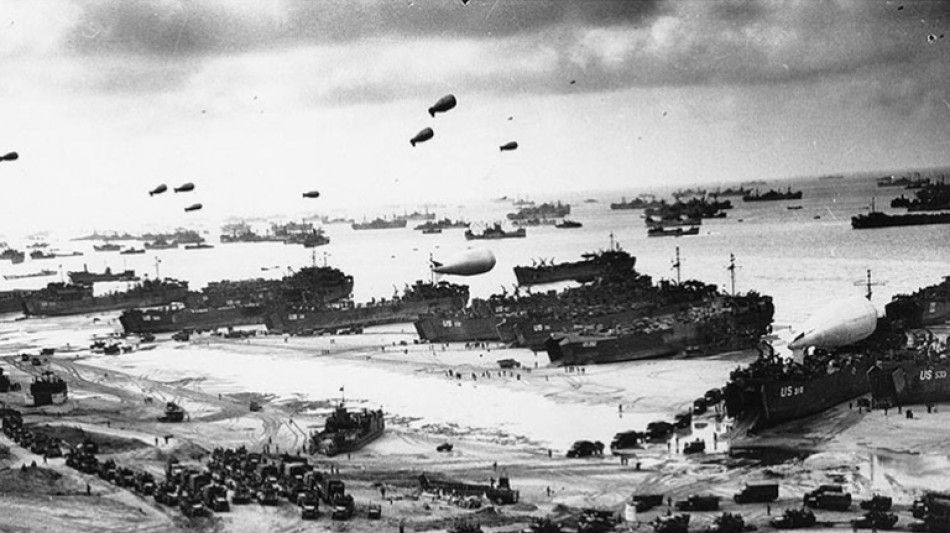
/ Photo: © US National Archives/AFP/File

 American Nobel laureate in medicine hopes to illuminate the brain
 Trump approves firing squad for convicted US military base shooter

 Grappling with 'homework scams,' US universities shun AI detectors
 Separatists win Quebec election in test for Canada PM
 Leaders visit Pacific atoll at frontline of climate change

 Yemen's Houthis claim striking Riyadh airport, other Saudi sites

 Best-selling British author Jeffrey Archer dies aged 86
 Military plane crash kills 32 in Nigeria

 Olise powers France to win over Belgium in Nations League
 High-flying Blazy turns to birdlife at Chanel
 Riyadh's allies pledge troops as Yemen, Saudi Arabia attack Houthis
 Clashes erupt outside Kosovo parliament over war crimes court

 Milan's Saelemaekers suffers ankle setback, faces lengthy spell out
 Rubio arrives in Iceland to push for greater US presence in Arctic
 Putin allows Italy's UniCredit to sell part of Russian business
 Djokovic into China Open final as Medvedev out for hitting fan with ball

 ICC unseals arrest warrants for Taliban education ministers
 Modric hopes fans back Croatia against Spain after England shame
 Bolsonaro rides right-wing surge into Brazil's election runoff
 Turkey blocks X account of British reporter
 Ukraine says using AI robot guns to shoot down new Russian drones
 At Oct 7 memorial, Netanyahu says will be no Hamas rule in Gaza
 Ukraine blames Russia for deadly sinking of Turkish ship in Black Sea
 UN rights council slams Taliban's 'oppression' of women
 Norway eyes partial ban of smart glasses
Eighty years ago, women reporters overcame restrictions barring them from the frontlines to cover the Allied landings in France but they have not enjoyed the acclaim enjoyed by their male counterparts.
On the morning of June 6, 1944, journalist Martha Gellhorn learned that the Allies had launched Operation Overlord, the largest seaborne invasion in history.
"I do not feel there is any need to beg as a favour for the right to serve as the eyes for millions of people in America," she had written to military authorities ahead of the landing.
But Allied forces forbade women reporters from the front lines, unlike their male colleagues, who were invited to join the troops.
To get around the ban, the US journalist slipped on board a hospital ship bound for Normandy "by pretending to be a Red Cross nurse", according to her biographer, Caroline Moorehead.
"Martha seems to have been the only woman journalist who got on the beaches of Normandy," said Moorehead.
Gellhorn later paid for her ingenuity when the Allied military authorities arrested her and forbade her from returning to Normandy.
-'Punished for daring'-
Women journalists faced the same threats as any reporter covering the war, but sexism made it even harder, said journalism historian Denis Ruellan.
"The army had a visceral fear that a woman journalist would die at the front, which would mean the men had failed to protect her," he said.
The military worried these same troops would be "disturbed" by the journalists, which amounted to "sexualising them", Ruellan added.
Correspondents like Gellhorn, Lee Carson, and Lee Miller "often had to disobey and fight" against the orders of generals and commanders just to do their job, he said.
Fellow American Lee Carson was "punished for daring" after she convinced a fighter pilot to fly her over the beaches of Normandy on D-Day, said Nancy Caldwell Sorel, author of The Women Who Wrote War.
"Sure, I knew it (was forbidden), but it was my job to get the news," said Carson, quoted by Sorel.
British Vogue photographer Lee Miller managed to take photos of the northwestern town of Saint-Malo right before Allied troops took the city from German hands in August 1944. The military punished her by placing her under house arrest.
"It was stupid. She was just doing her job," said her son, Antony Penrose.
"A man in her place would have been congratulated. Instead, she was punished."
-'I hated her'-
The military was not the only hurdle these correspondents had to overcome. Some male colleagues resented these women and even sabotaged their work.
Author Ernest Hemingway, married to Gellhorn, nearly prevented his wife from covering D-Day by requesting credentials from the magazine she worked for, Collier.
Media outlets could only have one accredited journalist on the front, so they chose the celebrated author, leaving Gellhorn to fend for herself.
But in the end, Gellhorn saw D-Day up close, unlike Hemingway, who saw the landings only from a distance.
Against the odds, women journalists managed to get scoops, enraging their male colleagues.
"I hated her," one rival of Iris Carpenter said.
Carpenter, a correspondent for several British news outlets, was in Normandy from June 10, 1944, and also covered the liberation of the Buchenwald and Dachau concentration camps the following year.
"She has made several scoops of real news that men missed," another rival complained.
But despite their accomplishments, "the names of these great journalists have been forgotten", said Ruellan.
At the war's end, male journalists "returned triumphant, with their careers skyrocketing", he said, while women were often reassigned to "less important tasks".
Some were "traumatised by what they had seen" and "left journalism to leave the war", the historian added.
But eighty years after the landing, at least one of these journalists is getting her long-overdue recognition.
A film about Lee Miller titled "Lee" and starring Kate Winslet is hitting big screens in September.
C.Kreuzer--VB