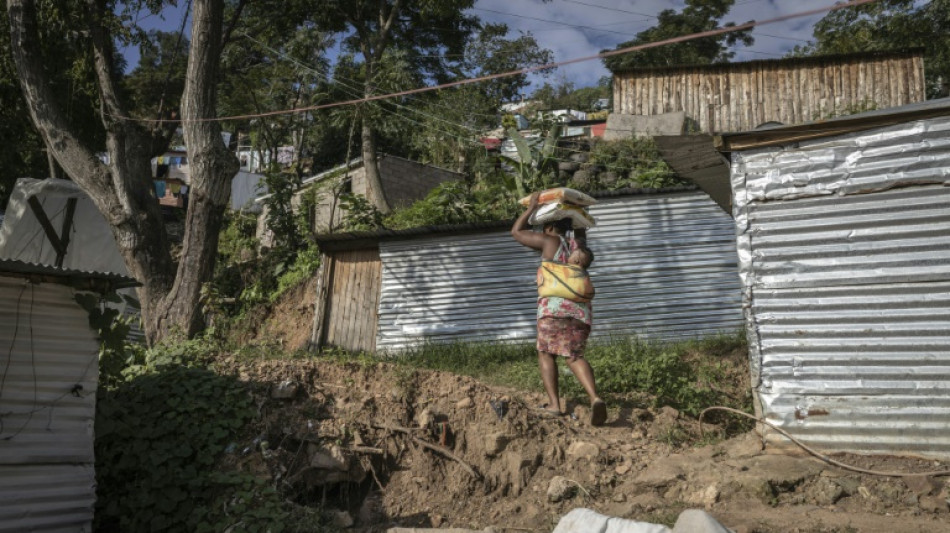
S.Africa's deadly floods shine spotlight on housing crisis / Photo: © AFP

 Trump renames AI 'super intelligence' as leaders jostle over dangers

 Oil prices retreat as markets welcome US-Iran talks

 US refusing to give Sudan's de facto leader visa for UN: diplomatic sources, UN

 Macron urges world to choose UN over 'law of the jungle'

 All-rounder Jacks stars as England beat Sri Lanka in 1st ODI
 Man City peg back Bayern to start Women's Champions League
 Trump beats 'America first' drum at UN as allies tread carefully
 Snedeker backs Spaun for Ryder Cup after Presidents snub

 French prosecutors probe secret filming of women with smart glasses

 Trump renames AI "super intelligence," rejects international oversight

 Trump rejects international regulation of AI

 How is the EU approaching record fuel prices?

 Sri Lanka's Colombage strikes on debut as England dismissed for 265 in first ODI

 Hurricane Polo strengthens to top category 5 off Mexico

 11 hurt as teen opens fire outside school in western Turkey

 UN chief says 'Big Oil' treats atmosphere as open sewer

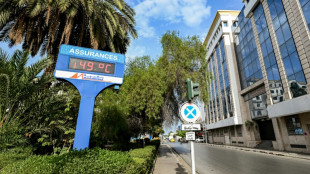 Tunisia says 2026 summer hottest on record

 England's Rashid out of Sri Lanka ODIs with hand injury

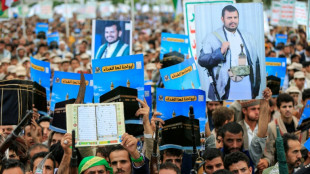 Houthis accuse Saudi Arabia of deadly strikes as thousands flee

 Stocks climb as oil slides, AI buzz returns

 India cricketers win in style as Afghan savours 'special' Games silver

 La Liga president hits out at Real Madrid refereeing 'conspiracy' claims

 MEXC Launches “Real Stocks, Real Friends” with Rewards for Bringing Friends to Wall Street

 Mbappe continues media push for Ballon d'Or recognition

 Stocks rise on AI buzz, oil prices cool

Thulisile Ntobela, once lived in an apartment, but when her rent went up 25 percent, the unemployed mother of five could no longer afford and moved out.
She found a piece of vacant land in Durban and put up a shack.
That was five years ago and much cheaper than paying rent, which had gone up to 200 rand ($12.80).
"That's why we moved here, we don't pay the rent. You just build your house and you stay," she said.
Hers was among the 87 homes -- shacks made of corrugated iron -- that vanished in seconds when the ground, over-saturated with flood water -- crumbled at the informal settlement of eNkanini, on a hilltop residential area of central Durban.
"I was so scared at that time. I was holding my baby. People were screaming," recalled the 31-year-old, carrying her youngest, an eight-month-old boy.
No one was injured because they had already taken shelter at a neighbour's home when the floor began to tremble.
Once covered in trees, the settlement of eNkanini formed in 2016 is now dotted with hundreds of shacks, some painted in bright colours.
"We don't have homes. This is our home," said Mzwandile Hlatshwayo, 25, a leader in the community.
Nearly 13 percent of South Africa' 59 million people live in shacks, locally referred to as informal settlements, according to 2019 government statistics.
Hlatshwayo is from a rural area of KwaZulu-Natal but moved to the eastern province's biggest city Durban in search of work.
He would live in government housing, but none is available in the city.
"I came here looking for a job. There is no jobs in rural areas," he said.
- Apartheid legacy -
The problem of landlessness goes back to the apartheid era that segregated black Africans and people of colour, preventing them from owning land, said Sbu Zikode, head of the land and housing activism organisation Abahlali baseMjondolo (shack dwellers).
Stripped of land ownership, poor blacks moved to sub-par neighbourhoods.
But nearly three decades since the apartheid system was abolished, land distribution and economic inequity remain unresolved.
In 1995, the housing backlog was estimated by a UN report to be 1.5 million units.
Despite more than three million government houses being constructed since then, the shortfall has ballooned to 3.7 million homes, according to the Centre for Affordable Housing Finance in Africa.
"It's not by our choice that we have no land, we have no homes," Zikode said.
People have also flocked to urban centres in search of jobs and better healthcare and education. Infrastructure in municipalities like Durban haven't kept up with the influx, Zikode said.
Informal settlements have mushroomed on vacant land as a result. But communities on more valuable land face eviction, Zikode said, which often turns into violent encounters.
"It is this reason people will occupy land that is not safe. They will occupy land that is along riverbanks, they will occupy land that is along floodplains."
The less desirable locations on floodplains have now also brought deadly consequences.
Rescuers searching for the missing have said poor infrastructure with no consideration of the terrain put the houses at greater risk. Many of those still standing in eNkanini are teetering half a metre from the edge of cliffs, vulnerable to future storms.
Pipes were exposed, wires downed and unpaved footpaths up to houses near the top of the hill are treacherously slick with sand and debris.
Government housing officials said this week they were beginning to clear land in the nearby Ndwedwe town to erect temporary housing for the victims of the flood, which claimed 435 lives.
Longer term solutions are still being investigated.
Out of the tragedy, Zikode believes it's an opportunity for government to finally address landlessness and poverty.
"The country and the world is watching as to how we are going to be dealing with the current disaster," he said.
"Surely the government is now forced to act and provide alternative land."
K.Thomson--BTB