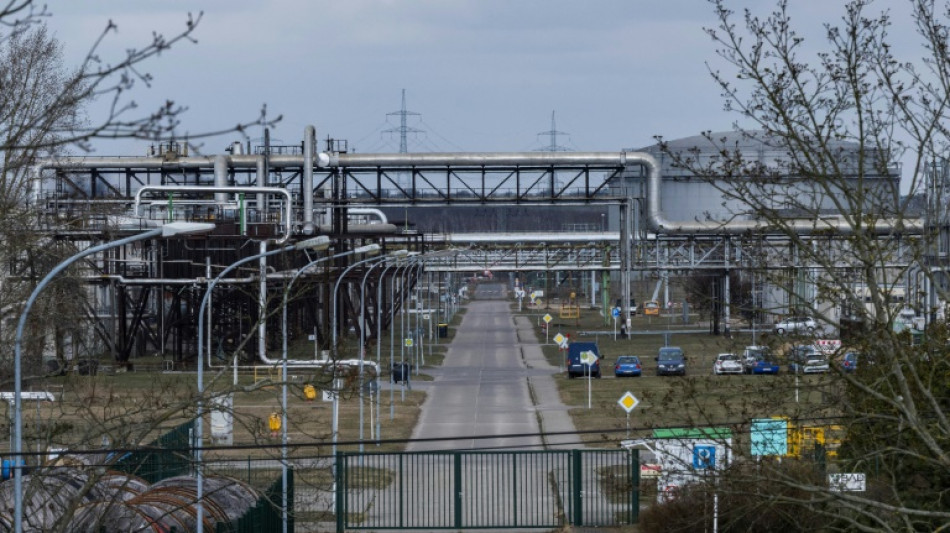
Future in balance for German refinery fed on Russian oil / Photo: ©

 Trump renames AI "super intelligence," rejects international oversight
 Trump rejects international regulation of AI

 How is the EU approaching record fuel prices?

 Sri Lanka's Colombage strikes on debut as England dismissed for 265 in first ODI

 Hurricane Polo strengthens to top category 5 off Mexico

 11 hurt as teen opens fire outside school in western Turkey

 UN chief says 'Big Oil' treats atmosphere as open sewer

 Tunisia says 2026 summer hottest on record

 England's Rashid out of Sri Lanka ODIs with hand injury

 Houthis accuse Saudi Arabia of deadly strikes as thousands flee

 Stocks climb as oil slides, AI buzz returns

 India cricketers win in style as Afghan savours 'special' Games silver

 La Liga president hits out at Real Madrid refereeing 'conspiracy' claims

 MEXC Launches “Real Stocks, Real Friends” with Rewards for Bringing Friends to Wall Street

 Mbappe continues media push for Ballon d'Or recognition

 Stocks rise on AI buzz, oil prices cool

 India narrowly survive huge scare against minnows Japan

 Missing F-35 fighter parts 'not sensitive', says Australia minister

 Cambodia showcases scams crackdown with global conference

 Afghan cyclist who disguised herself as man wins Asian Games silver

 Typhoon Dujuan leaves four dead in Japan, 45,000 houses without power

 G7 leaders condemn Houthi strikes on Saudi Arabia

 Google data centre sparks protests in Austria

 Shin Ohashi: Junk food-loving teen and Japan's next big swimming hope

 Stocks rise on AI buzz, drop in oil prices
The PCK refinery in the German town of Schwedt has been processing crude oil from Russia since before reunification, but with a ban on Russian oil looming its future could be in doubt.
The mass of metal tubes and canisters in the former East Germany near the border with Poland employs 1,200 people, and many local businesses depend on the custom it brings to the area.
"The sense of not knowing what will happen tomorrow is very similar to how it felt after the fall of the Wall," said Buckhard Opitz, 60, who has worked at the plant since 1977 and is a member of the local energy workers' union.
Opitz has not forgotten the economic turbulence that came with reunification in 1990 -- the dismantled industrial sites and painful wave of privatisations.
The Schwedt refinery survived, after a drastic restructuring, because "it was one of the most modern, because we were always on top", Opitz said.
But since Russia invaded Ukraine on February 24, uncertainty has once again descended on the plant.
Although the PCK refinery supplies around 90 percent of the oil consumed in Berlin and the surrounding region, including Berlin Brandenburg airport, doubts still remain.
And the situation is complicated by the fact that Russian oil giant Rosneft, controlled by the Kremlin, is a majority shareholder in the site.
- 'Friendship' -
Though the EU's latest package of sanctions agreed on Thursday was focused on coal, European Council President Charles Michel has said that the EU will have to impose oil and gas sanctions "sooner or later".
Germany has ruled out an immediate embargo on all Russian energy, especially gas. But it aims to end Russian oil imports by the end of this year.
Oil pumped in from Russia is the lifeblood of the Schwedt refinery, which is serviced by a branch of the Druzhba pipeline, the world's longest oil pipeline.
The Druzhba project was commissioned in the 1960s to transport oil from the Soviet Union to Eastern Europe and remains a vital source of crude for many central European refineries.
"Druzhba" means "friendship" in Russian.
In late 2021, Rosneft announced plans to increase its stake in the PCK refinery from 54 to 92 percent by buying shares from Shell.
Germany's Federal Cartel Office approved the transaction a few days before the outbreak of the war but the Economy Ministry is examining whether it can still be stopped.
Rosneft is chaired by Igor Sechin, an oligarch close to President Vladimir Putin and who has been the target of Western sanctions.
"The world was still normal then. There was no reason to refuse Russian involvement, just as there was German involvement in Russia," Alexander von Gersdorff, a spokesman for the German oil industry association En2x, told AFP.
- 'Pure speculation' -
But Von Gersdorff now has a stark prediction: "Without oil from Russia, the Schwedt refinery would have to be shut down. There would be no petrol or diesel for Berlin, the surrounding region and western Poland."
A spokeswoman for the refinery told AFP it was still examining the "feasibility of different logistical and technological scenarios as well as their operational feasibility".
Some media reports have proposed that Berlin temporarily take control of the plant -- a measure applied recently to Russian gas giant Gazprom's German subsidiary.
But Opitz is convinced that alternatives to Russian oil can be found to keep the refinery alive.
Another pipeline ending in the German port city of Rostock could receive crude oil from other parts of the world, he said, and Poland could supply more via the port of Gdansk.
Von Gerstoff believes this is "unrealistic".
Rostock cannot accommodate large enough tankers, he said, while Poland needs all its capacity to service its own energy needs. Plus the refineries in eastern Germany were specifically designed to operate with Russian crude oil.
But Opitz still has hope. "All this is pure speculation," he said. "The final decision will be political."
K.Thomson--BTB