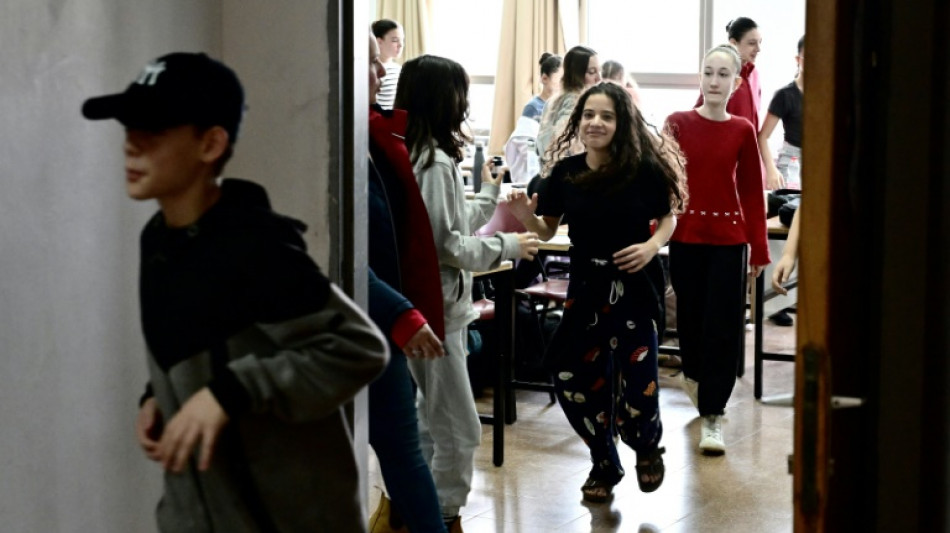
Israeli arts school battles for normality in wartime / Photo: © AFP

 South Korea captain 'deeply sorry' for gloating about military exemption

 Alcaraz through to Japan Open semis after Shapovalov injury

 Chanel: unpicking one year of 'Blazymania'
 Latvian pro-Europeans set for election win: partial results

 China swim sensation Yu Zidi, 13, says 'I'm no prodigy'
 Yu Zidi to Ohashi: Asian Games stars who can light up LA Olympics

 'Act before it's too late': Tokyo residents fight for more trees

 'Disappointing' as South Korea flag mishap sees Games end on sour note
 Pre-COP host Tuvalu at frontline of climate change
 Hungary's dwindling paprika producers battle to save signature spice
 Cornell president vows review in wake of alleged student gang rape
 Latvian partial election results suggest pro-European choice
 In Egypt's Sinai, Gazan builds school for children displaced by war

 Trump tariffs a mixed bag for US auto industry

 Yemen government forces say struck Houthi targets

 Music links past, present for Pedro Pascal's cellist in 'Behemoth!'

 ALEX BODI ȘI AMBASADORUL REPUBLICII SUDANUL DE SUD, GUM DOMINIC MATIOK, DISCUTĂ LA BERLIN DESPRE POSIBILITATEA ÎNFIINȚĂRII UNUI CONSULAT ONORIFIC LA BUCUREȘTI

 Dodgers step up World Series three-peat bid with 5-3 win over Braves

 Spain break down Czechs as England outclass Croatia in Nations League

 Yamal on target as Spain hold off Czech Republic

 Latvian exit polls suggest pro-European choice
 Lula, Bolsonaro wrap up campaigns ahead of knife-edge election
 Tuchel hails 'complete' England after Croatia demolition

 Fury to invite Trump to lead ring walk before Joshua showdown

 Fashion industry in 'precarious moment', says Vivienne Westwood supremo
Students rush from class to the anti-missile shelter at the High School of the Jerusalem Academy of Music and Dance, an early-morning exercise that has become a ritual during the Gaza war.
The youngsters seem unfazed by the drills, joking together as they skip down the stairs to the large reinforced room on the second floor, behind a heavy security door.
Head teacher Ilana Uritsky is battling to keep a sense of normality and routine, which she says is vital to protect the mental health of her pupils.
"We have to be strong for the children, for their families," she told AFP during a visit to the school in late December, adding that this was her wartime duty.
While Jerusalem is some 80 kilometres (50 miles) from Gaza, the city has still seen occasional missile alerts since the conflict began on October 7.
One of the teachers, Offira Gargi, said she talked to her pupils, aged 11 and 12, about the conflict only when something really big happened.
"We want them to continue to be children, like everyone else," she said.
- 'No sad stuff' -
In the corridors, dance students dressed in leotards under their jeans, their hair pulled tightly back into buns, jostle with each other as they prepare for rehearsals.
Snippets of classical music lessons float from the classrooms.
"I don't have the patience or the time to deal with the sad stuff," said 12-year-old cello player Aluma Bartov.
"I want to focus on my life, on music."
Classmate Peleh Nahum was equally relaxed, saying the adults would protect the children.
"If there are missiles we go to the shelter," he said.
But even in a bubble as protective as this, the bad news cannot be kept out for ever.
In one of the school lobbies, a small photo of a young man in uniform sits on a table behind a candle.
The shrine commemorates former pupil and jazz pianist Elisaf Shoshan, who died in the conflict aged 23.
Opposite, an Israeli flag pinned to the wall sits above photos of hostages held by Hamas.
The Islamist group's attack on October 7 resulted in the deaths of around 1,140 people in Israel, most of them civilians, according to an AFP count based on Israeli figures.
Some 250 people were taken hostage, at least 132 of whom are still being held in Gaza, Israeli officials say.
The Israeli military's retaliatory bombing and ground operations in the Gaza Strip have killed more than 22,800 people, the majority of them civilians, according to the latest toll from the Hamas-run health ministry.
Some 176 Israeli soldiers have been killed since the ground invasion began on October 27.
- 'Existential dread' -
School counsellor Nahir Bar-Osher said that in the early days of the war many of the children who came to him spoke of an "existential dread", but now it is more of a "sense of guilt".
"They are asking: how can I continue my daily routine when people are dying, when my friends are dying, when my cousins are dying?" he said.
Israel has called up 360,000 of its reservists to serve in the past three months.
Israelis are obliged to complete military service -- two years for women, 32 months for men -- and can be called on for years afterwards at a moment's notice.
Many Israeli families have at least one member serving as a reservist or enrolled in regular military service.
At the Jerusalem high school, five teachers from a total of 40 have been called up, and the school said about 10 percent of its 350 pupils have family members serving in the current conflict.
One staff member serving as a reservist, who was permitted to speak only anonymously, said that being called up meant he had to make a "180-degree flip" between the school and the military base.
"Taking care of the children, rehearsing and playing music with them, it's like a breath of fresh air," he said.
"The children save me."
A.Ammann--VB