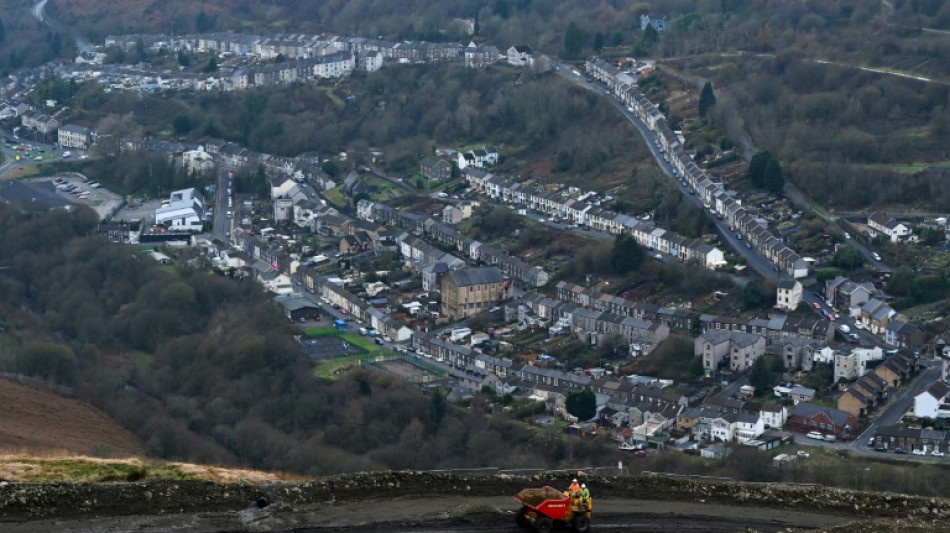
Fears in Wales over legacy of its coalmining past / Photo: © AFP

 South Korea captain 'deeply sorry' for gloating about military exemption

 Alcaraz through to Japan Open semis after Shapovalov injury

 Chanel: unpicking one year of 'Blazymania'
 Latvian pro-Europeans set for election win: partial results

 China swim sensation Yu Zidi, 13, says 'I'm no prodigy'

 Yu Zidi to Ohashi: Asian Games stars who can light up LA Olympics

 'Act before it's too late': Tokyo residents fight for more trees

 'Disappointing' as South Korea flag mishap sees Games end on sour note

 Pre-COP host Tuvalu at frontline of climate change

 Hungary's dwindling paprika producers battle to save signature spice
 Cornell president vows review in wake of alleged student gang rape
 Latvian partial election results suggest pro-European choice

 In Egypt's Sinai, Gazan builds school for children displaced by war

 Trump tariffs a mixed bag for US auto industry

 Yemen government forces say struck Houthi targets

 Music links past, present for Pedro Pascal's cellist in 'Behemoth!'

 ALEX BODI ȘI AMBASADORUL REPUBLICII SUDANUL DE SUD, GUM DOMINIC MATIOK, DISCUTĂ LA BERLIN DESPRE POSIBILITATEA ÎNFIINȚĂRII UNUI CONSULAT ONORIFIC LA BUCUREȘTI

 Dodgers step up World Series three-peat bid with 5-3 win over Braves

 Spain break down Czechs as England outclass Croatia in Nations League

 Yamal on target as Spain hold off Czech Republic

 Latvian exit polls suggest pro-European choice

 Lula, Bolsonaro wrap up campaigns ahead of knife-edge election
 Tuchel hails 'complete' England after Croatia demolition

 Fury to invite Trump to lead ring walk before Joshua showdown

 Fashion industry in 'precarious moment', says Vivienne Westwood supremo
It was nearly four years ago but the memory of the landslip that sent 60,000 tonnes of old mining debris sliding down a Welsh hillside still haunts former miner Jeff Coombes.
First the river he was walking along with his dog in the heart of the Rhondda Valley in south Wales turned brown. Then the water slowed down.
He noticed the coal tip was moving. After that it was the noise that hit him.
"Well it was more of a roar," Coombes, 77, told AFP.
The ever-present danger of disused coal tips, exacerbated by the effects of global warming, looms large in Wales.
On October 21, 1966, a slag heap collapsed onto a village school and houses in the small south Wales mining village of Aberfan.
The disaster killed 28 adults and 116 children. Nearly 60 years later, it still casts a long shadow.
No-one was hurt in the 2020 incident on the hillside at Tylorstown.
But it prompted the Welsh authorities to undertake a comprehensive census of old tips, also known as slag or spoil heaps.
It found more than 2,500 of the mini-mountains of debris from old mine shafts nationwide, a legacy of Wales's mining past.
Of those, 350 were deemed to pose a serious risk of collapse, including 79 located in the Rhondda Cynon Taf region north of Cardiff, according to the latest count.
They will now have to be monitored twice a year.
- Almost invisible -
The heaps can "become destabilised because they comprise of loose (unconsolidated) material" sitting on slopes, said Ashley Patton, a geological engineer at the British Geological Survey.
"The other major triggering factor for destabilising spoil heaps is water," he said, adding that intense rainfall had been implicated in the slippage at Tylorstown.
In 2021, an independent report on climate change risks highlighted the increasing likelihood of future landslides linked to former mining activity, as rains become more frequent and more violent.
Along the road that winds through the Rhondda valley, the slopes on either side are now covered in vegetation, making the danger almost invisible.
"Most of them are covered over by trees (but) it's around you.
"People have become conscious of that after Tylorstown tip slid," said Phil Rowe, a former local councillor in neighbouring Ferndale.
The fear of another disaster had caused "a lot of panic" locally, he said, adding that he didn't believe the authorities were carrying out the necessary surveillance.
Memories of the mining industry that once dominated the valleys of south Wales remain strong among the older generation.
But, said ex-miner Roy Jones, 78: "Younger generations don't know a lot about it."
That makes them less aware of the risks.
On the hill above Tylorstown, he pointed to another slag heap, which has been drained and levelled off to lessen the danger.
"They flatten the top and it is now as big as a football field," he said.
- Forgotten region -
The situation has generated anger among locals, who feel forgotten since the closure of the mines made the region less economically important.
Rowe said that without the collapse at Tylorstown nothing would have been done to make that slag heap safe.
"They said they'd be monitoring it within the last two or three years.
"Well, if that was the case, they should have seen that there's something's going to happen," he said.
The cost of making safe all the potentially dangerous slag heaps has been estimated at between £500 million and £600 million ($633 million and $760 million) over 15 years, according to the Welsh authorities.
But they say the UK government in London is not willing to contribute directly.
"Is it right (that) the UK took the economic benefit from Welsh coal but won't fund the safety of its legacy?" local Labour MP Beth Winter recently asked Prime Minister Rishi Sunak in parliament.
Sunak responded that the devolved Welsh government in Cardiff "has the resources it needs" to manage the issue.
"I don't think it's the people of the valley who should have to pay for all that," said Coombes, recalling that Welsh coal powered the ships of the Royal Navy, and fuelled the expansion of the former British Empire.
T.Ziegler--VB