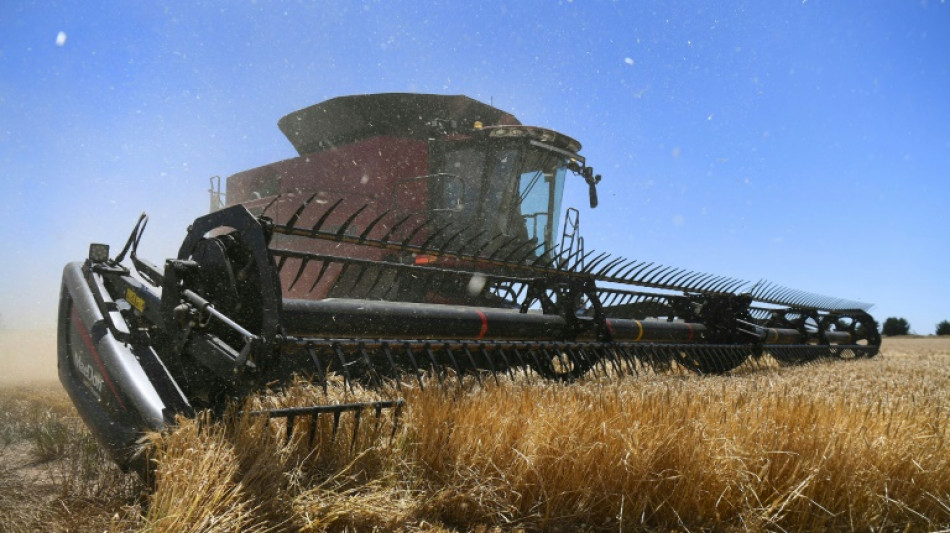
Chinese appetite for Australian barley is back / Photo: © AFP/File

 Asian Games set to close after records, rancour and rain

 Cry for help as French-Swiss lake dries up

 Sabalenka swept out of China Open in third round

 US urges 'restraint' as Ethiopia's Tigray crisis rocks region

 Teens on target again as USA down Mexico 3-0

 World records prove Asian Games were a hit, says top official

 US prison chief who oversaw botched execution resigns

 'Chaotic' Asian Games threaten Japan hopes of hosting Olympics again

 Finnish town braces for change from Google data centres

 What is fuelling French school protests?

 Without lawyers, migrant children face deportation from the US

 Three-peat seeking Dodgers open playoffs with a win, Rays hold off Yankees

 Brazil votes in nail-biter polls closely watched by Trump

 'Just be you': Kim reveals Tiger text that inspired him to gold

 Myanmar migrants returned to war-torn nation from Malaysia

 ALEX BODI AND AMBASSADOR GUM DOMINIC MATIOK OF THE REPUBLIC OF SOUTH SUDAN MEET IN BERLIN TO DISCUSS THE POSSIBILITY OF AN HONORARY CONSULATE IN BUCHAREST

 Lula, Bolsonaro wrap up campaigns ahead of Brazil's knife-edge vote

 Toulouse edge Castres in Top 14 derby

 Murakami homer propels White Sox to MLB playoff win over Guardians

 Israel targets top Hamas leader in deadly Gaza strike on anniversary

 Houthis say struck oil facility near Riyadh, as Saudis hit Sanaa

 AI needs safety layers like nuclear plants: ex-OpenAI engineer

 MVP Judge will miss Yankees' MLB playoff series against Rays

 New lizard species discovered in Peru

 Fernandes hails Portugal's 'greatest symbol' Ronaldo, calls for unity

Three years after steep Chinese tariffs halted imports of Australian barley as tensions between the two countries ratcheted higher, the grain is once again flowing freely.
Barley is not only used to brew beer but to feed pigs, and China was Australia's leading market, taking 50 percent of its barley exports.
China has imported 314,000 tonnes of Australian barley worth 139 million Australian dollars (around $94 million) since the government scrapped its 80.5 percent tariffs in August, the Australian government said in early December, citing official Chinese data.
The resumption of trade is a welcome relief for Australian farmers, who saw a nearly one billion Australian-dollar market evaporate in 2020.
"In the two months following the market's re-opening, Marketing and Trading shipped two vessels of barley to China," said the CBH Group, a cooperative of over 3,500 Western Australian grain farmers, in its annual report.
Tensions between the countries began to mount in 2018 when Australia excluded the Chinese telecommunications giant Huawei from its 5G network.
Then in 2020, Australia called for an international investigation into the origins of Covid-19 -- an action China saw as politically motivated since it emanated from a close partner of the United States.
In response, Beijing slapped high tariffs on key Australian exports, including barley, beef and wine, while halting its coal imports.
- New markets -
A slowdown in China's economic growth has spurred Beijing to rekindle its relationships with its trading partners.
Meanwhile, Australia sought out and found new markets to offload its harvests -- it is the world's third-largest producer of the grassy grain.
"It caused us to pivot, so we found new markets, like Mexico. We managed to have tariffs lowered, which were previously in excess of 100 percent," Sean Cole, the acting general manager of the GrainGrowers trade association, told AFP.
"With China gone, Australia was really forced to go back to more traditional customers in the feed market, mainly the Middle East and Saudi Arabia, where we've been for over 20 years," he added.
Between June 2022 and June 2023, Saudi Arabia became the leading importer of Australian barley, according to data from the Australian Bureau of Agricultural and Resource Economics and Sciences (ABARES).
Lyndon Mickel farms a 6,000-hectare plot of land near Beaumont in the southwest part of Australia. The latest harvest of his fields of various grains and peas was the 23rd of his career, but it has taken time to bounce back from the Chinese tariffs.
"We've had a reduction in price, but we've been fortunate we've had two very good years in that time crop-wise," he said, "so what we've lost in price, we've gained in tonnage anyway."
But those boom years -- producing over 14 million tonnes of barley in the last two harvests -- are over.
- Additional gains -
As El Nino -- the cyclical weather phenomenon responsible for higher global temperatures -- returns to the Pacific, ABARES predicts barley production will drop by 24 percent to 10.8 million tonnes for the 2023-24 harvest.
The reopening of the Chinese market could not have come at a better time, said Sean Cole.
"A lot of our barley is classified as feed, but it is still suitable for beer manufacturing in China," he said, "they use slightly different processes, and essentially it means we can get a premium for more of our feed barley".
On average, barley destined for China is sold for "around 38 to 40 dollars a tonne between now and since the tariffs were lifted" and that amounts to "an extra 400 million dollars value for the Australia barley crop next year, even with a smaller crop," Cole added.
O.Schlaepfer--VB