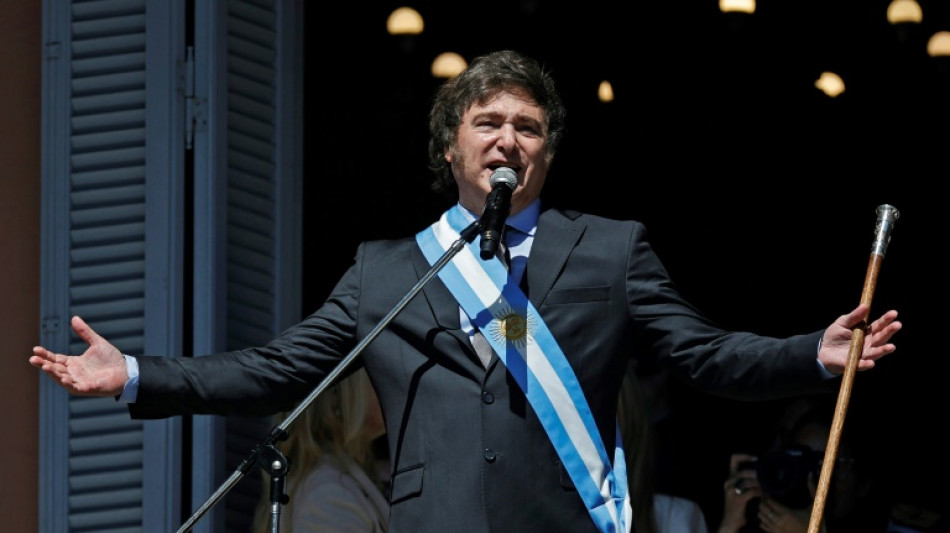
What to know about Milei's bid to liberalize Argentina's economy / Photo: © AFP

 Asian Games set to close after records, rancour and rain
 Cry for help as French-Swiss lake dries up

 Sabalenka swept out of China Open in third round

 US urges 'restraint' as Ethiopia's Tigray crisis rocks region

 Teens on target again as USA down Mexico 3-0

 World records prove Asian Games were a hit, says top official

 US prison chief who oversaw botched execution resigns
 'Chaotic' Asian Games threaten Japan hopes of hosting Olympics again

 Finnish town braces for change from Google data centres

 What is fuelling French school protests?

 Without lawyers, migrant children face deportation from the US

 Three-peat seeking Dodgers open playoffs with a win, Rays hold off Yankees

 Brazil votes in nail-biter polls closely watched by Trump

 'Just be you': Kim reveals Tiger text that inspired him to gold

 Myanmar migrants returned to war-torn nation from Malaysia
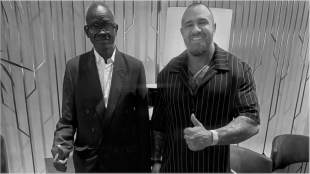
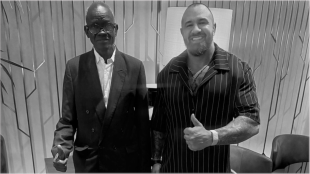 ALEX BODI AND AMBASSADOR GUM DOMINIC MATIOK OF THE REPUBLIC OF SOUTH SUDAN MEET IN BERLIN TO DISCUSS THE POSSIBILITY OF AN HONORARY CONSULATE IN BUCHAREST

 Lula, Bolsonaro wrap up campaigns ahead of Brazil's knife-edge vote

 Toulouse edge Castres in Top 14 derby

 Murakami homer propels White Sox to MLB playoff win over Guardians

 Israel targets top Hamas leader in deadly Gaza strike on anniversary

 Houthis say struck oil facility near Riyadh, as Saudis hit Sanaa

 AI needs safety layers like nuclear plants: ex-OpenAI engineer

 MVP Judge will miss Yankees' MLB playoff series against Rays

 New lizard species discovered in Peru

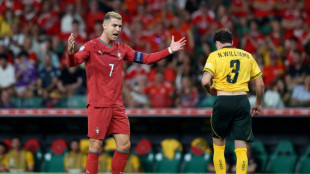 Fernandes hails Portugal's 'greatest symbol' Ronaldo, calls for unity

Argentina's libertarian President Javier Milei this week unleashed a mega-decree to change or scrap 366 economic rules in a country accustomed to heavy government intervention in the market.
The move is a first in Argentina's history, with none of its democratically elected presidents or dictators attempting such a massive dismantling of the system.
It is also exactly what Milei promised on the campaign trail, where he would wave around a live chainsaw to symbolize his bid to slash public spending, as Argentina creaks under triple-digit inflation after decades of financial mismanagement.
However, according to Argentine law, Congress still has the power to sink Milei's program.
This is what you need to know about the decree:
- What could change in daily life? -
Ten days after taking office, and on the eve of the festive holidays, Milei presented his "necessary and urgent" decree to loosen some of the rules governing the country's economy as annual inflation hit 160 percent.
One big change will be the removal of all constraints between tenant and landlord, such as laws on rental increases.
In recent years landlords have increasingly priced their properties in dollars to avoid being stuck with rental income long overtaken by soaring inflation. This has been a nightmare for renters in a country where access to dollars had been strictly controlled.
Milei has also loosened labor laws, with the trial period for new employees going from three to eight months. Compensation laws for dismissal without cause have been modified in favor of companies and he plans to renegotiate labor agreements in force since 1975.
He also scrapped limits on exports, and said the internet market will be liberalized.
Milei also ditched rules preventing the privatization of state enterprises, and has already set his sights on national airline Aerolineas Argentinas and oil company YPF.
He also moved to limit the right to strike, which is enshrined in the constitution.
- What is the goal of the decree? -
Milei, an outsider whose rise to the top office stunned much of the country, blames the interventionism and protectionism of previous governments for choking the economy.
Before the announcement of the decree, the new government had already devalued Argentina's peso by more than 50 percent, and announced huge cuts in generous state subsidies of fuel and transport from January.
"The goal is to begin the path of reconstruction of the country, to return freedom and autonomy to individuals and begin to dismantle the enormous amount of regulations that have stopped, hindered and impeded economic growth," said Milei.
Of those protesting his measures he said: "There may be people suffering from Stockholm syndrome. They are infatuated with a model that impoverishes them."
- Is it constitutional? -
The opposition -- recently ousted from government -- has slammed Milei for the decree, and sees it as a way to bypass his lack of a majority in Congress.
Milei's Libertad Avanza party, which is only two years old, has only 40 of the 257 seats in the lower house, and seven of 72 in the Senate.
"This is not the way. Send the reforms as bills. Do not be afraid of democratic debate," said German Martinez, parliamentary chief for the Peronist coalition Union for the Homeland.
Constitutional lawyer Emiliano Vitaliani told AFP that the highest laws of the land say that "in principle laws cannot be modified by decree and the president cannot replace Congress."
Political scientist Lara Goyburu said the decision "leaps past all limits, decreeing many issues that need political agreements from Congress and the provinces."
- Can the decree be rejected? -
The decree can be overturned if it is rejected by both houses of Congress, said Vitalini. Otherwise it comes into force on December 29.
"The president has made a very big bet, and its success will depend on his ability to obtain legislative support which, until now, is not known," said constitutional lawyer Alejandro Carrio, in a column in the La Nacion newspaper.
E.Burkhard--VB