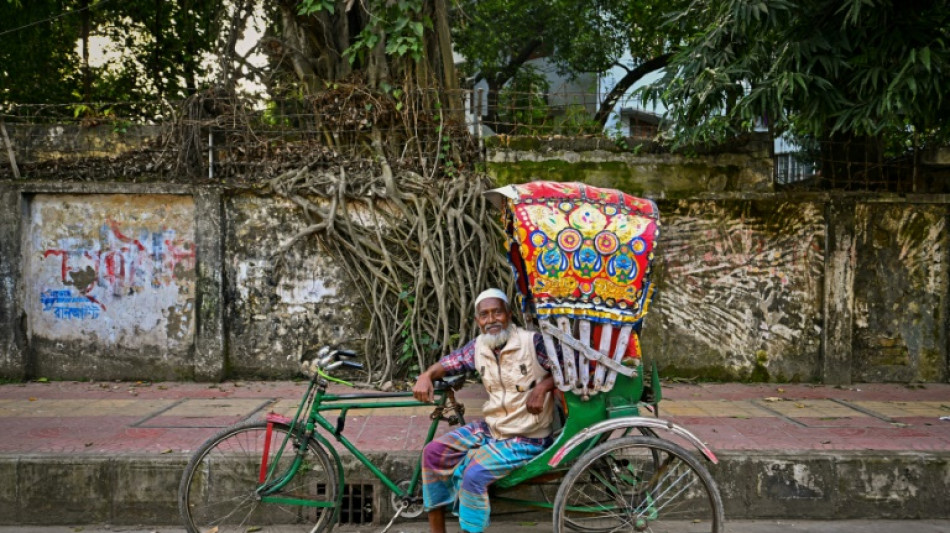
Fading colours: Bangladesh's threatened rickshaw art / Photo: © AFP

 'Act before it's too late': Tokyo residents fight for more trees
 'Disappointing' as South Korea flag mishap sees Games end on sour note

 Pre-COP host Tuvalu at frontline of climate change
 Hungary's dwindling paprika producers battle to save signature spice
 Cornell president vows review in wake of alleged student gang rape
 Latvian partial election results suggest pro-European choice
 In Egypt's Sinai, Gazan builds school for children displaced by war
 Trump tariffs a mixed bag for US auto industry
 Yemen government forces say struck Houthi targets
 Music links past, present for Pedro Pascal's cellist in 'Behemoth!'
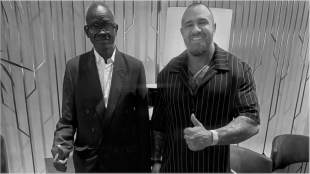 ALEX BODI ȘI AMBASADORUL REPUBLICII SUDANUL DE SUD, GUM DOMINIC MATIOK, DISCUTĂ LA BERLIN DESPRE POSIBILITATEA ÎNFIINȚĂRII UNUI CONSULAT ONORIFIC LA BUCUREȘTI
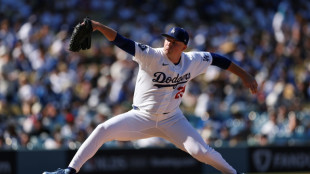 Dodgers step up World Series three-peat bid with 5-3 win over Braves
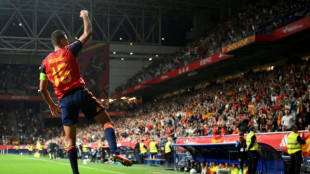 Spain break down Czechs as England outclass Croatia in Nations League
 Yamal on target as Spain hold off Czech Republic
 Latvian exit polls suggest pro-European choice
 Lula, Bolsonaro wrap up campaigns ahead of knife-edge election
 Tuchel hails 'complete' England after Croatia demolition

 Fury to invite Trump to lead ring walk before Joshua showdown
 Fashion industry in 'precarious moment', says Vivienne Westwood supremo
 Seventh heaven for England in Nations League rout of Croatia
 Storms, flooding cause chaos on Greek holiday island of Crete
 #IAmJaneDoe: online support campaign in US university rape case
 Brazil shine on Selecao's first visit to India
 Zverev sets up Djokovic quarter-final at China Open, Rybakina out
 Happier at home, Bordeaux hammer Lyon in Top 14
Vibrant greens and swirling yellows, film stars, birds and architecture: Bangladesh's bicycle rickshaw drivers have for decades used their transport as a unique moving canvas of urban folk art.
But many fear that despite being added by the United Nations cultural agency this month to its list of intangible cultural heritage, the colourful craft is fading in the face of faster, modern motorised rickshaws.
Rickshaw mechanic Mohammad Sabuj, 40, says he is mourning the decline in the "beautiful" paintings, which adorn the vehicles' carriage covers, seats and footrests.
"It has become rare nowadays," he said. "When I was younger, rickshaws were full of colourful art and designs -- but nowadays the trend has fallen."
Rickshaw driver Shahid Ullah, 72, has been pedalling his bike for half a century through the congested and narrow streets of Dhaka, a city of around 20 million people.
But as people switch to cars and buses for transport -- or motorised Chinese-made rickshaws without the same space on the frame to carry the art -- his trade is disappearing.
- Dying art -
Ullah welcomed the UNESCO decision this month to recognise the art, which it called a "key part of the city's cultural tradition and a dynamic form of urban folk art, providing inhabitants with a sense of shared identity".
The rickshaw art was one of dozens of practices that made UNESCO's Intangible Cultural Heritage of Humanity list on December 6, alongside Italian opera singing, Peru's ceviche seafood dish, Thailand's Songkran New Year festival and Ivory Coast's traditional loincloth weaving.
"It's a good thing for us," Ullah said. "We feel proud."
UNESCO South Asia chief Tim Curtis said that rickshaw painting was "under threat", and that the listing would help boost the craft by "finding innovative and sustainable ways of keeping this living heritage alive".
Increasing costs of fuel and other basic goods have hit the craft hard, said mechanic Sabuj.
"Drivers need to pay more to the rickshaw owners than before and the design also requires more money now," he said.
Depending on the complexity of the design, painting costs between $45-$90 -- as much as a third of the cost of a new bicycle rickshaw, which costs around $230-270.
Painting costs are usually borne by the owner, who rents bikes out to drivers.
A new motorised rickshaw is more expensive -- between $750-900 -- but they are seen as earning a quicker return.
Abdul Motaleb, another rickshaw driver, said people admired the art but still used modern transport including the packed metro system.
"People prefer faster vehicles," Motaleb said.
Rickshaw artist Hanif Pappu, 62, said the number of youngsters coming to learn the trade had slumped.
"Now no one sends their children to learn this art," he said. "They see that the trainers themselves are starving."
For Pappu, the UNESCO listing will not halt the decline.
"It came too late," he said. "Rickshaw painting is dying in the country."
- 'Raw creation' -
With the rickshaws weaving through the chaotic roads of Dhaka, Pappu said the paintings were a roving art exhibition carrying the creator's message to a mobile audience.
"Look at this, it's a message of peace," he said, pointing to a painting of a tranquil rural scene with birds and a house that he said was a reminder in the busy city of the countryside many had left behind to find jobs.
"It's a message of a happy family," he added. "We try to give such messages in our work."
He is proud of the colourful creations, which he has been painting since he was a boy, recalling how movie posters were once popular designs.
"It is a heritage of Bangladesh," he said. "It is our own raw creation."
But Pappu worries for the future.
"I could have left this work for the sufferings I faced, but I didn't because I feel it is now mixed with my blood. Will anyone stay in this profession for 55 years like I did?" he said.
"If this trend continues, this industry will vanish. It won't survive."
A.Zbinden--VB