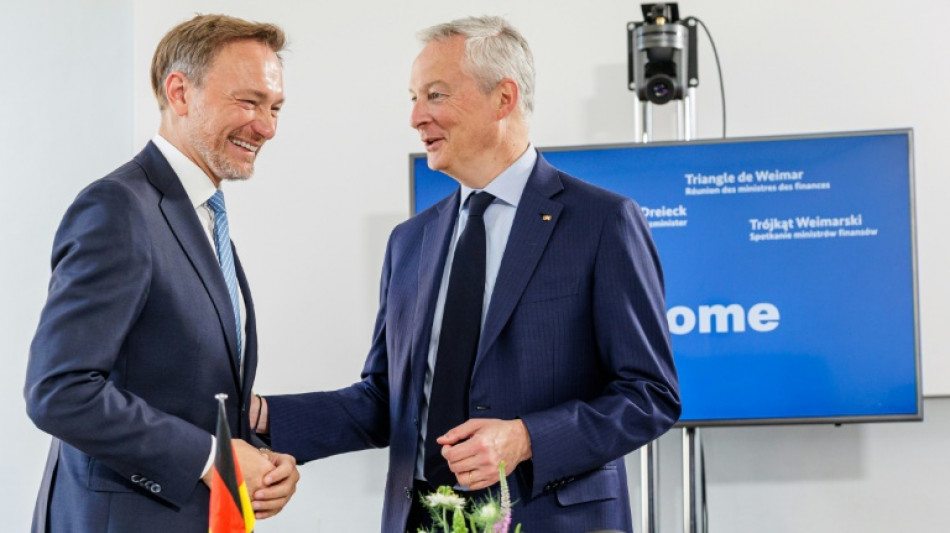
EU strikes budget reform deal after two-year wrangle / Photo: © AFP

 'Act before it's too late': Tokyo residents fight for more trees

 'Disappointing' as South Korea flag mishap sees Games end on sour note

 Pre-COP host Tuvalu at frontline of climate change

 Hungary's dwindling paprika producers battle to save signature spice

 Cornell president vows review in wake of alleged student gang rape

 Latvian partial election results suggest pro-European choice

 In Egypt's Sinai, Gazan builds school for children displaced by war

 Trump tariffs a mixed bag for US auto industry

 Yemen government forces say struck Houthi targets

 Music links past, present for Pedro Pascal's cellist in 'Behemoth!'

 ALEX BODI ȘI AMBASADORUL REPUBLICII SUDANUL DE SUD, GUM DOMINIC MATIOK, DISCUTĂ LA BERLIN DESPRE POSIBILITATEA ÎNFIINȚĂRII UNUI CONSULAT ONORIFIC LA BUCUREȘTI

 Dodgers step up World Series three-peat bid with 5-3 win over Braves

 Spain break down Czechs as England outclass Croatia in Nations League

 Yamal on target as Spain hold off Czech Republic

 Latvian exit polls suggest pro-European choice

 Lula, Bolsonaro wrap up campaigns ahead of knife-edge election

 Tuchel hails 'complete' England after Croatia demolition

 Fury to invite Trump to lead ring walk before Joshua showdown

 Fashion industry in 'precarious moment', says Vivienne Westwood supremo

 Seventh heaven for England in Nations League rout of Croatia
 Storms, flooding cause chaos on Greek holiday island of Crete

 #IAmJaneDoe: online support campaign in US university rape case

 Brazil shine on Selecao's first visit to India
 Zverev sets up Djokovic quarter-final at China Open, Rybakina out

 Happier at home, Bordeaux hammer Lyon in Top 14

The EU agreed reforms Wednesday that will loosen budget rules with the goal of encouraging investments while keeping debt and spending under control, after France and Germany bridged their differences.
Finance ministers from the 27 members met by video link to hammer out the agreement -- after their French and German colleagues had got together in Paris on Tuesday to clear the way for a compromise.
France's finance minister Bruno Le Maire took to social media to hail the deal. "Historic accord! After two years of intense negotiations we have new European budget rules," he said.
Dutch minister Sigrid Kaag said: "This agreement provides for fiscal rules that encourage reforms, with room for investments and tailored to the specific situation of the member state in question.
"They work counter-cyclically so that potential economic growth is not cut short. In addition, rules must also be better adhered to, which too often has been an issue in the past."
The fiscal straitjacket imposed on EU members -- limiting countries' debt to 60 percent of GDP and public deficits to 3 percent -- was loosened during the Covid pandemic to allow greater state spending.
This was meant to be a temporary reprieve, but launched a two-year debate between countries led by Germany that wanted a return to rigorous controls and others led by France that wanted more flexibility to allow spending to finance, for example, the transition to green energy or arms deliveries to Ukraine.
The compromise deal reconfirms the three percent deficit target. But it softens the rules for how quickly and a severely a country has to cut spending to get back within the parameters.
"It was a hard road. It was a difficult path to tread. And now we have finally reached safe harbour at a historic moment," Spanish finance minister Nadia Calvino, whose country holds the EU presidency, said after the video conference.
"The rules are more realistic. They respond to the post-pandemic reality and they incorporate also the lessons learned from the great financial crisis."
Time had been running out for a deal.
If there was no new plan the original stability pact would have come back into force on January 1.
- Route back to stability -
Failure to agree new rules would have also damaged the EU's credibility in the eyes of the financial markets.
Now that there is political agreement, the EU member states will seek endorsement from the European Parliament to pass binding legislation before elections in June.
The draft text provides for rules more adapted to the particular situation of each country, allowing big spenders a slower route back to frugality.
Brussels is proposing that member states present their own adjustment trajectory over a period of at least four years in order to ensure the sustainability of their debt.
Reform and investment efforts would be rewarded by the possibility of extending this budgetary adjustment period to seven years so that it is less brutal.
The targets would be linked to evolution of expenditure, an indicator considered by some more relevant than deficits, which can fluctuate according to the level of growth.
In order to satisfy Germany, however, countries with excessive deficits will be forced to make a minimum effort to reduce their deficit, which could be 0.5 percentage points per year.
Paris, however, won from Berlin a pause of this effort in 2025 to 2027. Over this period the increase in the cost of debt linked to high interest rates will be taken into account
Berlin also wants a public deficit target of 1.5 percent of GDP be assigned to the most indebted countries, in order to preserve a margin of safety in relation to the three-percent ceiling.
To achieve that, an adjustment of at least 0.4 points of GDP per year will be required, which can be reduced to 0.25 points in the event of reforms and investments.
The debt will have to fall by one percentage point per year on average over four or to seven years.
Compared to the old rules, a French official argued "the deficit target is less restrictive, the pace of reaching it is more progressive and rewards investment".
C.Stoecklin--VB