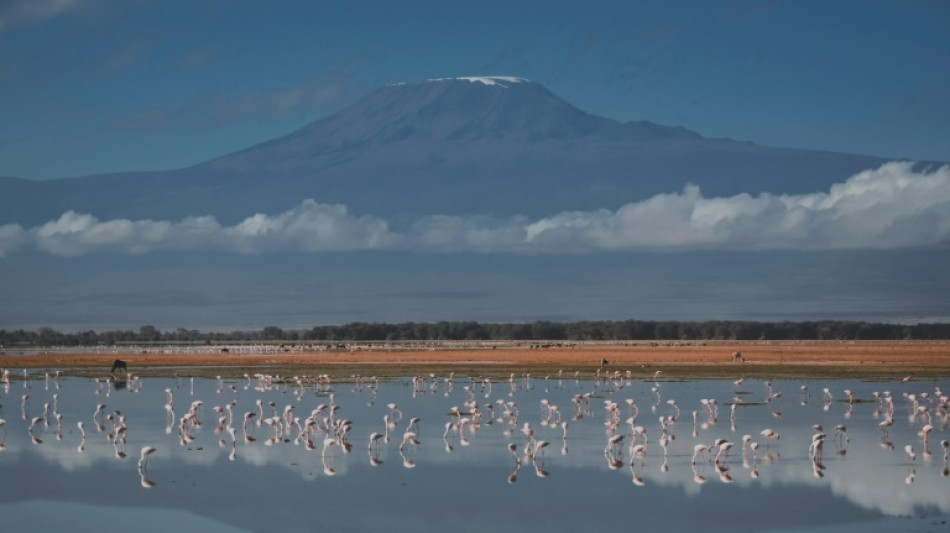
Yellowstone, Kilimanjaro glaciers among those set to vanish by 2050: UNESCO / Photo: © AFP

 Trump renames AI "super intelligence," rejects international oversight

 Trump rejects international regulation of AI

 How is the EU approaching record fuel prices?

 Sri Lanka's Colombage strikes on debut as England dismissed for 265 in first ODI

 Hurricane Polo strengthens to top category 5 off Mexico

 11 hurt as teen opens fire outside school in western Turkey

 UN chief says 'Big Oil' treats atmosphere as open sewer

 Tunisia says 2026 summer hottest on record

 England's Rashid out of Sri Lanka ODIs with hand injury

 Houthis accuse Saudi Arabia of deadly strikes as thousands flee

 Stocks climb as oil slides, AI buzz returns

 India cricketers win in style as Afghan savours 'special' Games silver

 La Liga president hits out at Real Madrid refereeing 'conspiracy' claims

 MEXC Launches “Real Stocks, Real Friends” with Rewards for Bringing Friends to Wall Street

 Mbappe continues media push for Ballon d'Or recognition

 Stocks rise on AI buzz, oil prices cool

 India narrowly survive huge scare against minnows Japan

 Missing F-35 fighter parts 'not sensitive', says Australia minister

 Cambodia showcases scams crackdown with global conference

 Afghan cyclist who disguised herself as man wins Asian Games silver

 Typhoon Dujuan leaves four dead in Japan, 45,000 houses without power

 G7 leaders condemn Houthi strikes on Saudi Arabia

 Google data centre sparks protests in Austria

 Shin Ohashi: Junk food-loving teen and Japan's next big swimming hope

 Stocks rise on AI buzz, drop in oil prices

Glaciers at many UNESCO World Heritage sites including Yellowstone and Kilimanjaro National Park will likely vanish by 2050, the UN agency warned Thursday, urging leaders to act fast to save the rest.
The warning followed a study of 18,600 glaciers at 50 World Heritage sites -- covering around 66,000 square kilometres (25,000 square miles) -- which found glaciers at a third of the sites were "condemned to disappear".
The study "shows these glaciers have been retreating at an accelerated rate since 2000 due to CO2 emissions, which are warming temperatures", UNESCO said.
The glaciers were losing 58 billion tonnes of ice every year, equivalent to the combined annual water use of France and Spain, and were responsible for nearly five percent of observed global sea-level rise, the agency explained.
"Glaciers in a third of the 50 World Heritage sites are condemned to disappear by 2050, regardless of efforts to limit temperature increases," UNESCO said.
"But it is still possible to save the glaciers in the remaining two thirds of sites if the rise in temperatures does not exceed 1.5°C compared to the pre-industrial period."
Countries have pledged to keep global warming to 1.5 degrees Celsius above pre-industrial levels -- a goal the world is set to miss on current emission trends.
"This report is a call to action," said UNESCO head Audrey Azoulay, ahead of the COP27 climate summit in Egypt starting on Monday.
"Only a rapid reduction in our CO2 emissions levels can save glaciers and the exceptional biodiversity that depends on them. COP27 will have a crucial role to help find solutions to this issue."
In Africa, glaciers in all World Heritage sites will very likely be gone by 2050, including at Kilimanjaro National Park and Mount Kenya, UNESCO warned.
In Europe, some glaciers in the Pyrenees and in the Dolomites will also probably have vanished in three decades' time.
The same went for glaciers in the Yellowstone and Yosemite national parks in the United States.
The melting of ice and snow is one of the 10 key threats from climate change, an Intergovernmental Panel on Climate Change report published in February said.
F.Pavlenko--BTB