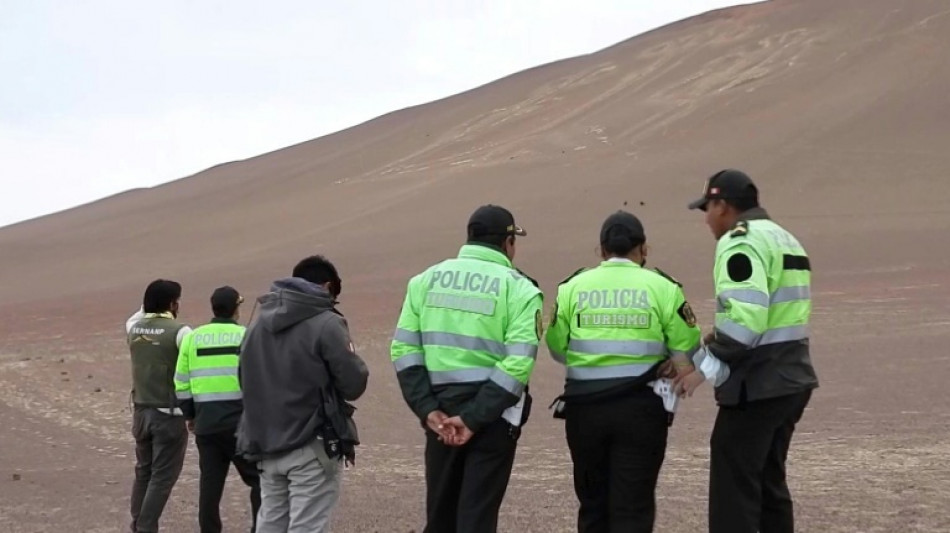
Tourists trample all over protected, prehistoric Peruvian hill carving / Photo: © Peruvian Ministry of Culture/AFP

 Typhoon Dujuan leaves four dead in Japan, 45,000 houses without power

 G7 leaders condemn Houthi strikes on Saudi Arabia

 Google data centre sparks protests in Austria

 Shin Ohashi: Junk food-loving teen and Japan's next big swimming hope

 Stocks rise on AI buzz, drop in oil prices

 China's robot dancers limber up for America's Got Talent final

 Despite military might, Saudi struggles to crush the Houthis

 Trump to tout deals, defend Iran war in UN speech

 Sri Lanka to issue verdict in landmark Easter attack trial

 Macron says talks with Trump on Red Sea, Ukraine 'constructive'

 Green policies just good politics, says UK minister

 Bardot auction in Paris fetches nearly one million euros

 No timeline on Daniels injury return, says Commanders coach

 British Columbia sues OpenAI in US court over Canada school shooting

 French star Batum retires after 18-year NBA career

 Zidane leads first France training session
 Man shot by ICE agent in Texas detained with bullet inside him: lawyer

 California declares state of emergency ahead of El Nino

 South Africa arrests three more suspects, after nine women murdered

 Carse needs time away from England, says captain Brook

 NOWPayments Releases Cross-Chain Payout Data Revealing Key Performance Benchmarks Across TRON, BNB Chain, and Solana

 British Museum bans photos of Bayeux Tapestry as crowds linger

 COP31 host says AI climate footprint to be a summit priority

 Berlin's far-left vote winners reject anti-semitism charges

 Mancini eager for 'new adventure' on Italy return

Tourists have left footprints all over Peru's Paracas Candelabra, an enormous hillside carving that dates from some 2,500 years ago, according to officials who have launched a search for the culprits.
Over the weekend, police found footsteps zigzagging over the Paracas "geoglyph" -- a large design carved into the ground similar to Peru's better-known Nazca lines, according to a culture ministry statement.
They found "two rows of footsteps that go from the bottom (of the carving) to the top, zigzagging, entering the right arm (of the candelabra), the left arm, and central part of the geoglyph," which visitors are allowed to view only from the sea, it added.
Apart from the footsteps, which appeared to belong to three people, officials also found vehicle tracks.
The captain of a tourist ship told a television station he had spotted, from the sea, "a foreign couple with their young son and a shovel damaging the candelabra."
The station also broadcast footage recorded on a mobile phone from a nearby boat showing five people walking near the carved hillside figure, whose origins and meaning remain the subject of research.
The geoglyph is about 170 meters (557 feet) tall, 60 meters wide, and carved into the slope of a hill in the Paracas peninsula, south of Lima.
It was declared a national heritage site in 2016, and Peruvian law dictates jail terms of between three and six years for anyone damaging an archaeological monument.
The Paracas culture flourished on Peru's southern coast from around 100 BC to 200 AD, but little was known about the people until archaeological excavations began in the 1920s.
W.Lapointe--BTB