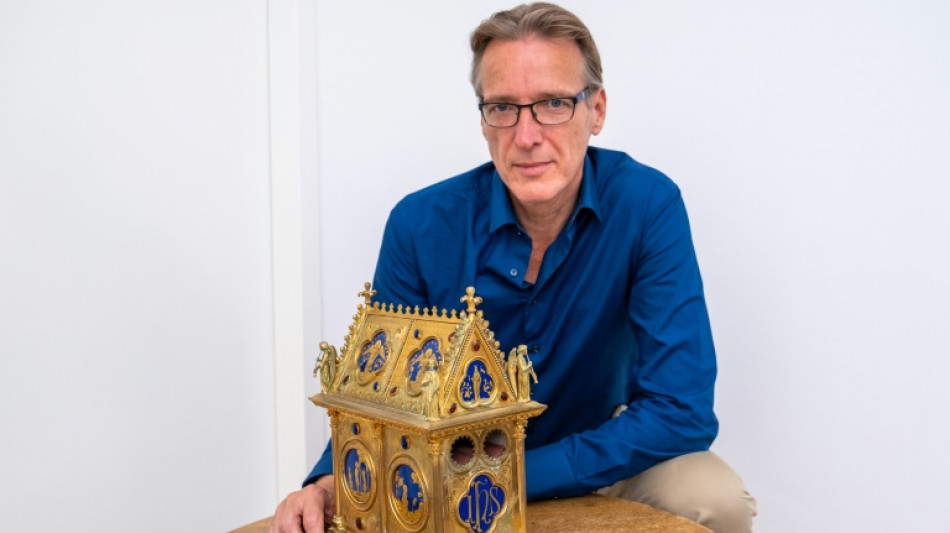
The Dutch art detective who says he recovered the 'Blood of Christ' relic / Photo: © AFP

 Typhoon Dujuan leaves four dead in Japan, 45,000 houses without power

 G7 leaders condemn Houthi strikes on Saudi Arabia

 Google data centre sparks protests in Austria

 Shin Ohashi: Junk food-loving teen and Japan's next big swimming hope
 Stocks rise on AI buzz, drop in oil prices

 China's robot dancers limber up for America's Got Talent final

 Despite military might, Saudi struggles to crush the Houthis
 Trump to tout deals, defend Iran war in UN speech
 Sri Lanka to issue verdict in landmark Easter attack trial

 Macron says talks with Trump on Red Sea, Ukraine 'constructive'

 Green policies just good politics, says UK minister

 Bardot auction in Paris fetches nearly one million euros

 No timeline on Daniels injury return, says Commanders coach

 British Columbia sues OpenAI in US court over Canada school shooting

 French star Batum retires after 18-year NBA career

 Zidane leads first France training session

 Man shot by ICE agent in Texas detained with bullet inside him: lawyer

 California declares state of emergency ahead of El Nino

 South Africa arrests three more suspects, after nine women murdered
 Carse needs time away from England, says captain Brook

 NOWPayments Releases Cross-Chain Payout Data Revealing Key Performance Benchmarks Across TRON, BNB Chain, and Solana

 British Museum bans photos of Bayeux Tapestry as crowds linger

 COP31 host says AI climate footprint to be a summit priority

 Berlin's far-left vote winners reject anti-semitism charges

 Mancini eager for 'new adventure' on Italy return

It was 10:30 pm on a Friday when Arthur Brand got the delivery he was nervously expecting.
His doorbell rang, and when he opened the door no one was there. Instead, a cardboard box was waiting for him at the door in the dark.
In that box he said was one of the most sacred artefacts ever stolen from the Catholic Church: the "Precious Blood of Christ" relic.
"(My) heart was beating in (my) chest," the Dutch art detective told AFP in an interview about the recovery of the stolen treasure.
Brand is dubbed the "Indiana Jones of the Art World" for his remarkable recoveries of stolen art, including the "Hitler's Horses" bronze statues, a Picasso painting and a ring that once belonged to Oscar Wilde.
At 52, he is one of the most famous art sleuths in the world, trusted by both thieves and police for his unprecedented access to the criminal trade in stolen art.
But getting his hands on the "Precious Blood of Christ" relic was a particularly special experience for him.
"As a Catholic myself, this is about as close to Jesus and the legend of the Holy Grail you can get."
"It was a religious experience," he said.
- 'Massive shock' -
When he opened the box, he discovered what he hoped he would: the relic perfectly intact.
The ornate container, about 30 centimetres (11 inches) high, has two metal bulbs inside and is said to hold drops of Jesus' blood collected in the Holy Grail during the crucifixion.
It is held in a heavily gilded copper box with encrusted precious stones and depictions of Christ on the cross and other saints.
The holy relic is believed to date back to the death of Christ and has been a source of worship for Catholic pilgrims for more than 1,000 years.
It was held by the Fecamp Abbey in France's Normandy region until the night of June 1-2, when it was stolen, just two weeks before the annual "Mass of the Precious Blood" celebration.
"The thief most likely got inside by being locked in after hours and made off with the artefact," Brand said.
"It was a massive shock that this famous piece, this legendary piece was stolen," he told AFP in his home, the relic on display nearby.
- 'The real thing' -
The relic and its copper box were not the only objects waiting in the cardboard package on Brand's doorstep on that fateful July evening.
There were several copper liturgical plates, depictions of saints and an ornate goblet, which were also stolen from the abbey in June.
Brand carefully showed AFP the ornate and heavy copper box with a miniature roof and four angels on its corners, called a reliquary.
AFP could not independently verify the authenticity of the objects, and they have not yet been examined by police or experts. The abbey could not immediately be reached for comment.
But Brand is certain about their authenticity.
"I have no doubt in my mind that it is the real thing. Religious objects are almost impossible to forge."
The sacred relic will be handed to Dutch law enforcement once they receive a request for mutual assistance from France, Dutch police said Tuesday.
Once Dutch police receive the object, they will investigate the authenticity of the object and try to identify the thief.
"After the investigation, our conclusions and the relic will be returned to the French police," Dutch national police spokesman Dennis Janus told AFP.
- 'A curse' -
Brand said his involvement in the case started a few days after the theft, when he received a protected email from an anonymous writer, claiming to have the stolen loot in their possession.
"This person was approaching me on behalf of another, at whose home the stolen relics were being stored," said Brand.
But "to have the ultimate relic, the blood of Jesus in your home, stolen, that's a curse," he said.
"When they realised what it was, that you in fact cannot sell it, they knew they had to get rid of it."
Brand showed AFP an email written in Dutch in which the person asked him to take back the stolen property, as it was too risky to return it to the abbey itself.
Brand was told that the stolen artefact would be delivered to his home, but no date or time was given.
"I was virtually a prisoner in my own home for a week. I could not leave," he said, laughing.
Finally the objects turned up, delivered by an anonymous sender.
Asked why the thieves would return the stolen art to Brand, he said "it would be too dangerous to involve the police".
"These people know my reputation and that the most important thing is to return this to the church. Hopefully it will stand for another thousand years," Brand said.
O.Krause--BTB