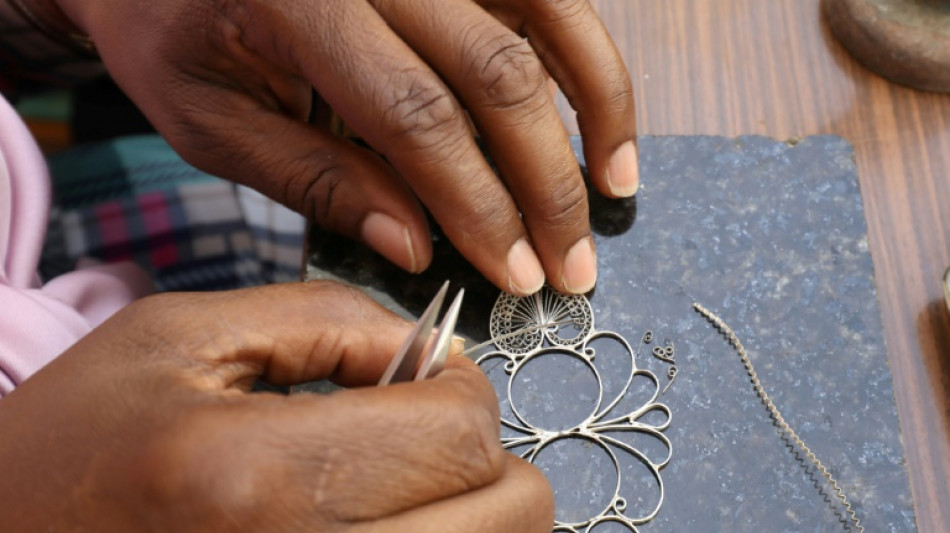
Libya traditional jewellery hangs on by silver thread / Photo: © AFP

 Typhoon Dujuan leaves four dead in Japan, 45,000 houses without power

 G7 leaders condemn Houthi strikes on Saudi Arabia

 Google data centre sparks protests in Austria

 Shin Ohashi: Junk food-loving teen and Japan's next big swimming hope
 Stocks rise on AI buzz, drop in oil prices

 China's robot dancers limber up for America's Got Talent final

 Despite military might, Saudi struggles to crush the Houthis
 Trump to tout deals, defend Iran war in UN speech
 Sri Lanka to issue verdict in landmark Easter attack trial
 Macron says talks with Trump on Red Sea, Ukraine 'constructive'

 Green policies just good politics, says UK minister

 Bardot auction in Paris fetches nearly one million euros

 No timeline on Daniels injury return, says Commanders coach

 British Columbia sues OpenAI in US court over Canada school shooting

 French star Batum retires after 18-year NBA career

 Zidane leads first France training session

 Man shot by ICE agent in Texas detained with bullet inside him: lawyer
 California declares state of emergency ahead of El Nino

 South Africa arrests three more suspects, after nine women murdered
 Carse needs time away from England, says captain Brook

 NOWPayments Releases Cross-Chain Payout Data Revealing Key Performance Benchmarks Across TRON, BNB Chain, and Solana

 British Museum bans photos of Bayeux Tapestry as crowds linger

 COP31 host says AI climate footprint to be a summit priority

 Berlin's far-left vote winners reject anti-semitism charges

 Mancini eager for 'new adventure' on Italy return

In Tripoli's Old City, young Libyans weave delicate patterns with threads of silver and gold to create traditional filigree jewellery -- reviving an art almost lost through decades of dictatorship and war.
Abdelmajid Zeglam is just 12 years old, but his minutely detailed creations are already selling fast in the streets around a Roman-era archway dedicated to emperor Marcus Aurelius.
"I hesitated at first for fear of failing because I'm young, but my mum encouraged me," Zeglam said.
He is the youngest of 20 or so students, around half of them female, studying at the Libyan Academy for Traditional Gold and Silver Crafts, in a building that once served as a French consulate to the Ottoman Empire.
Trainees learn about precious metal alloys before studying the art of filigree, in which beads and threads of the precious materials are woven into intricate designs then soldered together to create jewellery.
"I love it," Zeglam said. "I want to become a petroleum engineer in the mornings and a jeweller in the afternoons."
Mohamed al-Miloudi, a 22-year-old civil engineering student in a baseball cap, said he had not missed a class since signing up in September.
"It's a hobby, but I'd like to make it into my trade," he said.
The institute's founder, Abdelnasser Aboughress, said filigree jewellery was an ancient tradition in the North African country.
"Craftsmen in the medina of Tripoli were trained by Jewish masters and later by Arabs, at the prestigious School of Arts and Trades" founded in the late 19th century, he said.
- Secret jewellers -
But generations of tradition were abruptly halted after Moamer Kadhafi took power in a 1969 coup.
The capricious ruler scrapped the constitution and established his "jamahiriya" -- a medley of socialism, Arab nationalism and tribal patronage.
He also scrapped the private sector, seizing companies and confiscating their assets.
Overnight, self-employed artisans lost everything: their workshops, their livelihoods and their students.
"The state reduced Libyan crafts to nothing and forced a generation of young apprentices, who should have taken up the baton, to instead leave the traditional crafts and join the army" or become civil servants, said Aboughress.
The 55-year-old was born just a few streets away in the medina, and despite Kadhafi's ban, he took up the craft at the age of 15.
Along with his father, for decades he worked in secret on jewellery for trusted clients.
Now, he hopes to pass the craft on to younger generations, as well as fighting back against a tide of "lower-quality jewellery imported from Egypt and China (which) has flooded the market".
Aboughress is working on a project to document and preserve as much of this cultural heritage as possible.
- 'People with passion' -
Student Fatima Boussoua hit out at the practice of selling old Libyan silver jewellery at cheap prices to be exported then melted down.
"It's part of Libya's artisanal heritage that's disappearing!" she said.
A dentist in her 40s who also teaches at the University of Tripoli, Boussoua has been training at the centre for the past year, hoping to master the craft.
"We should be training artists to preserve our heritage," she said. "All it needs is people with passion."
While becoming a true expert takes years of training, Aboughress's students are already producing works for sale online or at the centre itself.
That said, he admits the project needs financial help to buy the expensive raw materials -- as well as "moral support".
He hopes that with enough resources, he will one day be able to set up a string of other workshops across Libya.
"It's time to bring this craft back to life," he said.
D.Schneider--BTB