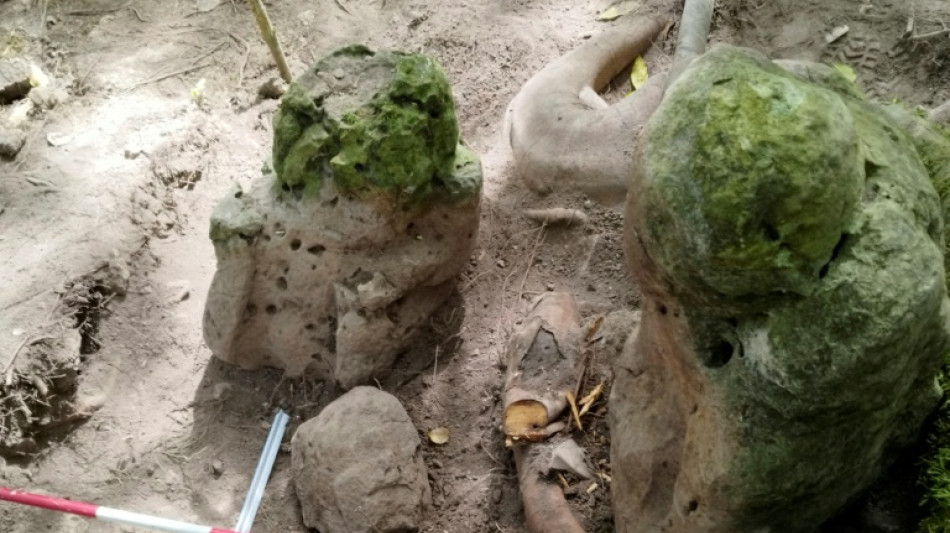
Remains of Mayan city nearly 3,000 years old unearthed in Guatemala / Photo: © Guatemalan Ministry of Culture and Sports/AFP

 Cambodia no 'safe haven' for cyberscams, PM says
 North Korea weightlifter sets three world records for Asian Games gold

 A Full Moon for Every Child: STARTRADER's STARCARES Brings Support to SOS Children's Village Ho Chi Minh City

 Meta leans into AI, smart glasses amid privacy pushback
 Battered Duerer masterpiece up for five-year revamp

 Trump met with Venezuela's interim leader at UN

 Malaysia furore after Najib wins conditional house arrest

 Italy hope for new dawn under Mancini

 Mongolian herders enlist new tech against harsher, drier climate

 Tata turmoil shines light on India succession woes

 World Cup 'not enough' as Spain begin next chapter

 Meta acts against 3.7 mn scammers' accounts with Singapore police help

 Australia PM says draft social media rules about taking back control

 Voting opens in Alaska's annual Fat Bear Week

 MLS coach axed for telling female ref 'It's a man's game'

 US refuses to give Sudan's de facto leader visa for UN

 Man City hold Bayern to start Women's Champions League, Arsenal win late

 Trump threatens Iran with 'hell' but reveals fresh talks

 Trump signs security deal with Greenland, Denmark at UN

 Trump threatens Iran with 'hell' but unveils fresh talks

 Chile's Atacama Desert blossoms with life after El Nino rains

 Sri Lanka hands 220-year jail terms to 15 convicted of Easter bombings

 Typhoon Dujuan leaves 7 dead in Japan from landslides, flooding: media

 Ganna and Borghini lead Italy to mixed relay gold at cycling worlds

 Drug cocktail killed former child star Hayden Panettiere: coroner

Archaeologists have unearthed the remains of a Mayan city nearly 3,000 years old in northern Guatemala, with pyramids and monuments that point to its significance as an important ceremonial site, the Central American country's culture ministry said Thursday.
The Mayan civilization arose around 2000 BC, reaching its height between 400 and 900 AD in what is present-day southern Mexico and Guatemala, as well as parts of Belize, El Salvador and Honduras.
The city named "Los Abuelos," Spanish for "The Grandparents," once stood some 21 kilometers (13 miles) from the important archaeological site of Uaxactun, in Guatemala's northern Peten department, the ministry said in a statement.
It is dated to what is known as the "Middle Preclassic" period from about 800 to 500 BC, and is believed to have been "one of the most ancient and important ceremonial centers" of the Mayan civilization in the jungle area of Peten near the Mexican border, it added.
"The site presents remarkable architectural planning" with pyramids and monuments "sculpted with unique iconography from the region," said the ministry.
The city takes its name from two human-like sculptures of an "ancestral couple" found at the site.
The figures, dated to between 500 and 300 BC, "could be linked to ancient ritual practices of ancestor worship," said the ministry.
- 'Unique canal system' -
The city, which covers an area of about 16 square kilometers (six square miles) was discovered by Guatemalan and Slovak archaeologists in previously little-explored areas of the Uaxactun park.
Nearby, they also found a pyramid standing 33 meters (108 feet) high with murals from the Preclassic period and "a unique canal system," according to the statement.
"The set of these three sites forms a previously unknown urban triangle... These findings allow us to rethink the understanding of the ceremonial and socio-political organization of pre-Hispanic Peten," said the ministry.
In April, scientists discovered a 1,000-year-old altar from Mexico's ancient Teotihuacan culture at Tikal, elsewhere in the Peten department.
That find was interpreted as proof of ties between the two pre-Hispanic cultures, which lived about 1,300 km apart.
Tikal, about 23 km from Uaxcatun, is the main archaeological site in Guatemala and one of its biggest tourist attractions.
C.Koch--VB