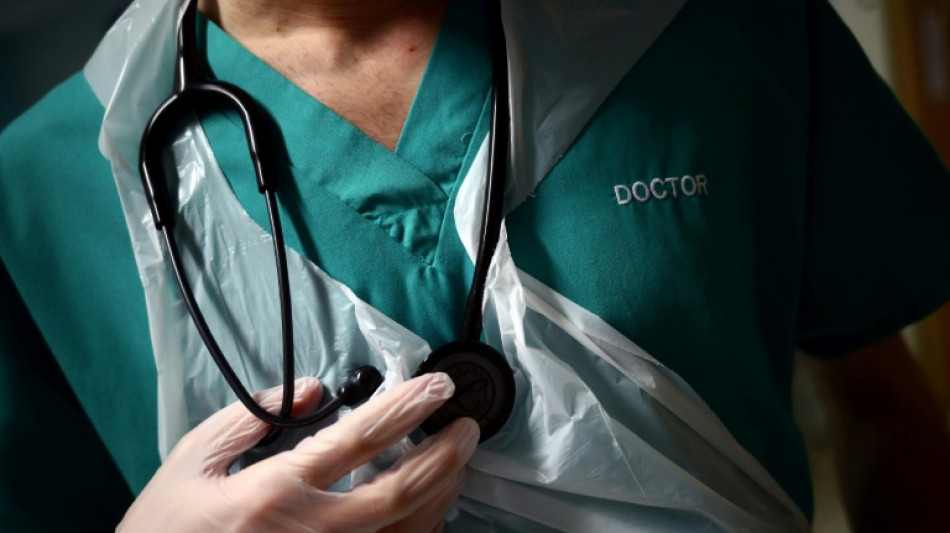
Beware 'deepfakes' of famous doctors promoting scams: experts / Photo: © POOL/AFP/File

 Tunisia says 2026 summer hottest on record

 England's Rashid out of Sri Lanka ODIs with hand injury

 Houthis accuse Saudi Arabia of deadly strikes as thousands flee

 Stocks climb as oil slides, AI buzz returns
 India cricketers win in style as Afghan savours 'special' Games silver

 La Liga president hits out at Real Madrid refereeing 'conspiracy' claims

 MEXC Launches “Real Stocks, Real Friends” with Rewards for Bringing Friends to Wall Street

 Mbappe continues media push for Ballon d'Or recognition
 Stocks rise on AI buzz, oil prices cool

 India narrowly survive huge scare against minnows Japan
 Missing F-35 fighter parts 'not sensitive', says Australia minister

 Cambodia showcases scams crackdown with global conference
 Afghan cyclist who disguised herself as man wins Asian Games silver

 Typhoon Dujuan leaves four dead in Japan, 45,000 houses without power

 G7 leaders condemn Houthi strikes on Saudi Arabia
 Google data centre sparks protests in Austria

 Shin Ohashi: Junk food-loving teen and Japan's next big swimming hope

 Stocks rise on AI buzz, drop in oil prices

 China's robot dancers limber up for America's Got Talent final
 Despite military might, Saudi struggles to crush the Houthis
 Trump to tout deals, defend Iran war in UN speech
 Sri Lanka to issue verdict in landmark Easter attack trial
 Macron says talks with Trump on Red Sea, Ukraine 'constructive'

 Green policies just good politics, says UK minister
 Bardot auction in Paris fetches nearly one million euros

Social media is being flooded by digitally created "deepfake" videos using the trusted identities of famous doctors to promote dangerous miracle cures for serious health problems, experts warn.
Videos on Facebook and Instagram have taken advantage of the credibility of star TV doctors to advertise untested "natural" syrups for diabetes, even claiming that the proven, first-line drug metformin "could kill" patients.
These scams risk endangering lives, experts said, particularly because they deploy the likenesses of popular health experts such as British TV presenter Michael Mosley, who died earlier this year.
"People do seem to trust these videos," British doctor John Cormack told AFP.
"A lot of these media doctors have spent a great deal of time creating an image of trustworthiness, so they are believed even when they make incredible claims," said Cormack, who has worked with the British Medical Journal (BMJ) on the subject.
Artificial intelligence (AI) expert Henry Ajder said that doctor deepfakes "really took off this year".
The AI videos typically target older audiences by faking the identity of doctors who appear regularly on daytime television, Ajder said.
French doctor Michel Cymes, who often appears on TV in France, told AFP in May that he was taking legal action against Facebook owner Meta about "scams" using his image.
British doctor Hilary Jones even hired an investigator to track deepfakes that featured his likeness.
One video depicted Jones selling a false cure for high blood pressure -- as well as weed gummies -- on a UK TV show on which he regularly appears.
"Even if they're taken down, they just pop up the next day under a different name," Jones lamented in the BMJ.
- 'Game of cat and mouse' -
Recent advances in AI have made the quality of deepfake images, audio and video far more convincing, explained French academic and AI expert Frederic Jurie.
"Today we have access to tens of billions of images, and we are able to build algorithms that can model everything that appears in the images and regenerate them. This is what we call generative AI," he said.
It is not just the likenesses of widely respected doctors being misused.
The appearance of controversial French researcher Didier Raoult -- who has been accused of spreading misleading information about Covid drugs -- has also been used in several deepfake videos.
Australian naturopath Barbara O'Neill, who has been roundly condemned for claiming that baking soda can cure cancer, has been falsely depicted selling pills that "clean blood vessels" in TikTok videos.
Contacted by AFP, her husband Michael O'Neill deplored that "a lot of unethical people" were using his wife's name "to sell products that she does not recommend, and in some cases they are just outright scams".
Some fake videos spiral even further down the rabbit hole, falsely claiming that O'Neill died from a miracle oil sold on Amazon.
AI expert Adjer was not surprised that such controversial health figures were also falling victim to deepfakes.
"They are highly trusted by people in circles that, let's say, are unorthodox or conspiratorial," he said.
The experts were not optimistic that newly developed AI detection tools were capable of fighting back against the onslaught of deepfakes.
"It's a game of cat and mouse," Jurie said.
Rather than trying to find all the fake videos out there, he pointed to technology that can "guarantee that content has not been altered, such as for messaging, thanks to software that produces digital signatures like a certificate", he said.
G.Frei--VB