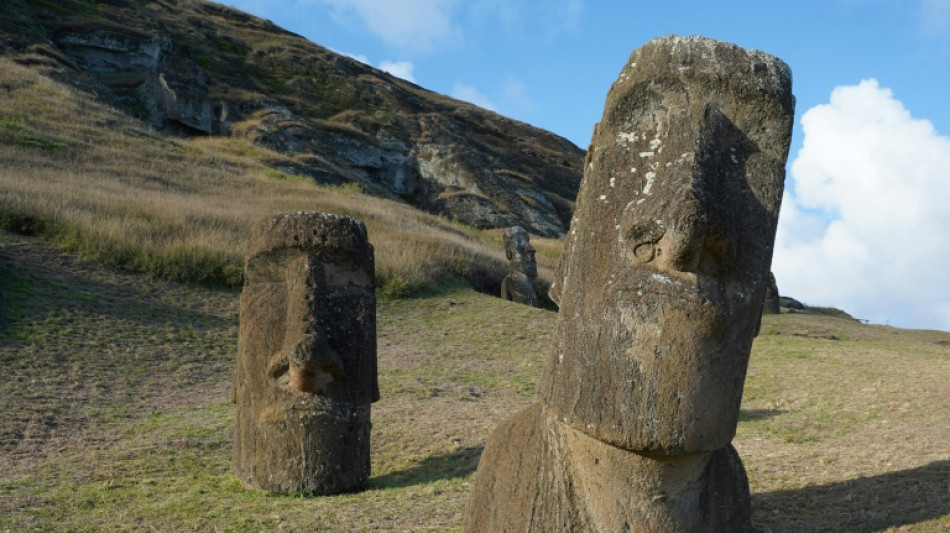
'Ecocide' on Easter Island never took place, studies suggest / Photo: © AFP/File

 Trump renames AI 'super intelligence' as leaders jostle over dangers

 Oil prices retreat as markets welcome US-Iran talks

 US refusing to give Sudan's de facto leader visa for UN: diplomatic sources, UN

 Macron urges world to choose UN over 'law of the jungle'

 All-rounder Jacks stars as England beat Sri Lanka in 1st ODI
 Man City peg back Bayern to start Women's Champions League
 Trump beats 'America first' drum at UN as allies tread carefully

 Snedeker backs Spaun for Ryder Cup after Presidents snub

 French prosecutors probe secret filming of women with smart glasses

 Trump renames AI "super intelligence," rejects international oversight

 Trump rejects international regulation of AI

 How is the EU approaching record fuel prices?

 Sri Lanka's Colombage strikes on debut as England dismissed for 265 in first ODI

 Hurricane Polo strengthens to top category 5 off Mexico

 11 hurt as teen opens fire outside school in western Turkey

 UN chief says 'Big Oil' treats atmosphere as open sewer

 Tunisia says 2026 summer hottest on record

 England's Rashid out of Sri Lanka ODIs with hand injury

 Houthis accuse Saudi Arabia of deadly strikes as thousands flee

 Stocks climb as oil slides, AI buzz returns

 India cricketers win in style as Afghan savours 'special' Games silver

 La Liga president hits out at Real Madrid refereeing 'conspiracy' claims

 MEXC Launches “Real Stocks, Real Friends” with Rewards for Bringing Friends to Wall Street

 Mbappe continues media push for Ballon d'Or recognition

 Stocks rise on AI buzz, oil prices cool

Two recent studies have cast doubt on a popular theory that the ancient residents of Easter Island suffered a societal collapse because they overexploited their natural resources, an event often labelled one of history's first "ecocides".
Easter Island, located in the Pacific Ocean 3,700 kilometres (2,300 miles) from the coast of Chile, is best known for the enigmatic "moai" stone statues of humans carved by the Rapanui people.
A widespread theory popularised by historians including US author Jared Diamond claimed that the Rapanui deforested the small island -- which is known to have once been covered in palm trees -- to keep supporting the flourishing culture of its more than 15,000 inhabitants.
The sudden lack of resources is said to have triggered a brutal period of famine and warfare that escalated into cannibalism and ended in a demographic and cultural collapse.
This event in the 1600s abruptly brought an end to the creation of new moai statues -- or so the story goes.
When Europeans first arrived at the island in 1722, they estimated there were only around 3,000 inhabitants.
This tale of ecological suicide -- or "ecocide" -- by the Rapanui "has been presented as a warning tale for humanity's overexploitation of resources," according to the authors of a study published in the journal Nature on Wednesday.
The international team of experts in population genetics tried to find signs of the societal collapse using an advanced statistical tool that reconstructs the genomic history of a people.
They analysed the genomes of 15 Rapanui who lived between 1670 and 1950 -- and found no sign of a societal collapse, which would have caused a sudden reduction in genetic diversity.
"Our genetic analysis shows a stably growing population from the 13th century through to European contact in the 18th century," said study author Barbara Sousa da Mota of the University of Lausanne.
"This stability is critical because it directly contradicts the idea of a dramatic pre-contact population collapse."
The research also shed light on contact between the island's residents and Native Americans well before Christopher Columbus arrived in the Americas -- another controversial moment in the history of the Polynesian people.
- Different method, same conclusion -
The new research reinforced the findings of a different study published in June in the journal Science Advances which took a very different approach.
That the two studies reached the same conclusion "shows the importance of looking at the same scientific question from different disciplines," Sousa da Mota told AFP.
The team behind the June study used satellite images to map out rock gardens on the island. Rock gardening is an agricultural method that involves mixing rocks into the soil to preserve nutrients and moisture.
Previous research had claimed that up to 21 square kilometres of the small island -- 12 percent of the total of 164 square kilometres -- was covered with these gardens, which would have been necessary to sustain more than 15,000 people.
- 'We can learn from them' -
But the US-based researchers determined that only 0.76 square kilometres of the island were used as rock gardens.
Such a small harvest of sweet potatoes -- essential to the Rapanui's diet -- from these gardens could not have supported more than 4,000 people, the researchers estimated.
That is close to the number of people that Europeans first found on the island, indicating there never was a society of 15,000 or more that endured a terrifying collapse.
"When we label an entire culture as an example of bad choices, or as a cautionary tale of what not to do, we had better be right, otherwise we feed stereotypes (which themselves have profound consequences on people)," Dylan Davis, a co-author of the Science Advances study, told AFP.
"In this case, the Rapanui managed to survive in one of the most remote places on Earth and did so fairly sustainably until European contact," said the environmental archaeologist at Columbia University.
"This suggests we can learn something from them about how to manage limited resources."
T.Zimmermann--VB