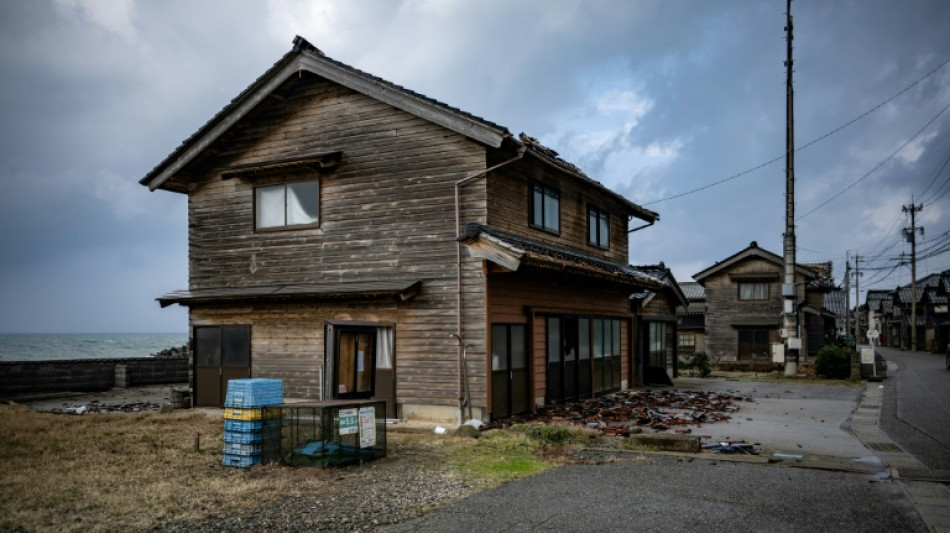
Still standing: unique houses survive quake in Japan village / Photo: © AFP

 Fury to face British rival Joshua in Cardiff on December 11

 Streamex Converts Interest Into Capital as GLDY Investment Strategy Secures $1M+ Institutional Allocation

 STARTRADER Named Best Fintech Forex Broker at Forex Expo Dubai 2026
 Japan swimmer Ohashi, 17, shrugs off Covid to smash world record

 Shin Ohashi: Junk food-loving teen and new world record-holder

 Greek PM urges 'courage' in talks with UK over Parthenon Marbles

 'I was drowning': Iran Nobel winner exposes pain of separation from children

 Israel's US envoy says son fighting for life

 Olympic champion Yulo completes gymnastics gold collection at Asian Games

 England cannot imitate Spain's success, says Gordon

 Hungary detects invasive spotted lanternfly for first time in EU

 Ο Alex Bodi και ο καθηγητής Δρ. Stefan Haupt συμφωνούν σε συνεργασία για μια θρυλική συλλογή έργων τέχνης στη Ρουμανία

 France's top-selling newspaper to slash jobs

 Tigray rebels in 'full-blown' war with govt

 Alex Bodi och prof. dr Stefan Haupt ingår samarbetsavtal om en legendarisk konstsamling i Rumänien

 อเล็กซ์ โบดี และศาสตราจารย์ ดร. สเตฟาน ฮาปท์ ตกลงร่วมมือกันในการจัดตั้งคอลเลกชันศิลปะอันเป็นตำนานในโรมาเนีย

 Alex Bodi a prof. dr. Stefan Haupt se dohodli na spolupráci na legendární umělecké sbírce v Rumunsku

 알렉스 보디와 슈테판 하우프트 교수, 루마니아의 전설적인 미술품 컬렉션을 위한 협력 합의

 BaazEX Enters the Asian Trading Market With a New Approach to Online Forex Trading.

 Asian markets fall on US-China jitters as leaders meet

 Thais hail teen rocker Nene for 'America's Got Talent' win

 Zverev, Agassi defend 'spectacular' Laver Cup
 Eel-powered Japan whizz-kid, 11, dominates in historic Games debut

 Madagascar's Gen Z 'betrayed' after ushering in new rule
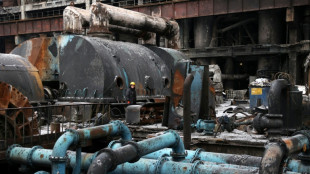 As Moscow steps up attacks, Kyiv residents brace for harsh winter

The New Year's Day earthquake demolished wooden buildings all across Japan's Noto Peninsula but thanks to decades-old smart architecture, one small fishing village stood strong.
A few roof tiles came loose but not one of around 100 structures in windswept Akasaki, on the stick of land's western coast, collapsed in the magnitude 7.5 quake whose epicentre was just a few kilometres (miles) away.
Masaki Sato drove all night from his home 300 kilometres (190 miles) away in Tokyo after the quake to check on the 85-year-old house that he has owned since 2017 and runs as a summer B&B.
"The house stands on a very narrow lot of land, and the building has many small rooms, with many columns" that make it stronger, the 43-year-old told AFP.
To withstand the harsh rain, snow and ocean winds buffeting off the Sea of Japan, Sato's house and most others in Akasaki have few glass windows.
Their exterior walls are made from sturdy wooden slats, layered horizontally. The structure is supported by thick beams criss-crossing the ceiling.
The earthquake and its many aftershocks killed at least 161 people, and 103 others are still missing, authorities said on Monday.
But there were no casualties in the tight-knit village.
Even tsunami waves triggered by the earthquake didn't reach the houses, which are built on land slightly uphill from concrete tetrapods that protect them from the sea.
At Sato's place, ceramic dishes smashed, appliances toppled and a recently added wooden sliding door broke, leaving debris strewn across the floor.
But that was it.
"I felt so encouraged, because the village was still there standing," Sato said.
"I think it's thanks to the design of the houses," he added, sitting at the dusty but still solid kitchen counter in his guest house.
- 'Windshield' -
The same lucky outcome was seen around the village, where "the design of the houses is more or less the same," said resident Seiya Shinagawa, a retired fisherman.
"Traditionally there's a shed on the coast as a windshield, with a narrow main house behind it," the 78-year-old said.
This setup is a remnant of the days when each fisherman would launch their boats out of their shed directly to the sea, Shinagawa said.
From around the 1920s, the community's fishermen opted for more lucrative deep-sea fishing far away from home, sometimes hauling in small fortunes for their catch.
But when a fire broke out and destroyed a significant part of the village in the late 1930s, people rebuilt the houses in a unified and stronger design.
- Demographic threat -
Now despite its resilient character, the village faces a problem that is widespread in Japan: a severely ageing population.
Most people in Akasaki are over 65, with many living alone, including 74-year-old resident Akiyo Wakasa.
"My neighbour and their next-door neighbour also live alone," she said.
According to Wakasa, part of the problem is that "fixing houses costs money".
"I'm not sure how many people here actually think it would be worth fixing the house and continuing to live here when they have nobody to hand it down to," she explained.
For Sato, an IT firm employee who runs a real-estate renovation business on the side, seeing Akasaki entering a slow decline is unbearable.
The area is not recognised by the government as a cultural asset, but it's a place where people lead a simple, old-fashioned lifestyle, he said.
And when there's no one to live in a house, it's torn down -- eroding the village's charm, according to Sato.
"Akasaki, which has preserved a unique and uniform housing design... is losing its scenic appearance."
To save Akasaki's special look, Sato has purchased five of the houses and sheds himself, and wants eventually to open some cafes and restaurants there.
"The village is too precious to lose," he said.
L.Meier--VB