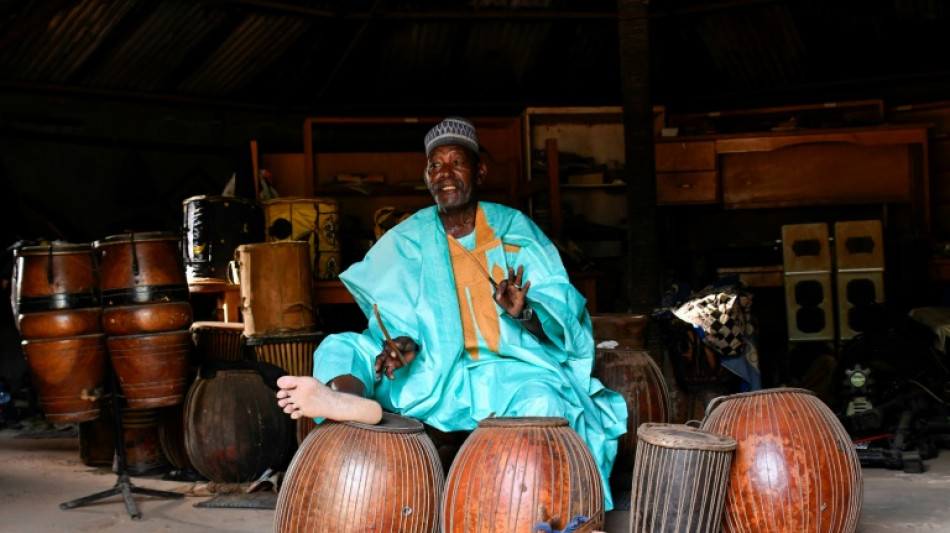
Niger struggles to keep its traditional music alive / Photo: © AFP

 Fury to face British rival Joshua in Cardiff on December 11

 Streamex Converts Interest Into Capital as GLDY Investment Strategy Secures $1M+ Institutional Allocation

 STARTRADER Named Best Fintech Forex Broker at Forex Expo Dubai 2026

 Japan swimmer Ohashi, 17, shrugs off Covid to smash world record

 Shin Ohashi: Junk food-loving teen and new world record-holder

 Greek PM urges 'courage' in talks with UK over Parthenon Marbles
 'I was drowning': Iran Nobel winner exposes pain of separation from children

 Israel's US envoy says son fighting for life

 Olympic champion Yulo completes gymnastics gold collection at Asian Games

 England cannot imitate Spain's success, says Gordon

 Hungary detects invasive spotted lanternfly for first time in EU

 Ο Alex Bodi και ο καθηγητής Δρ. Stefan Haupt συμφωνούν σε συνεργασία για μια θρυλική συλλογή έργων τέχνης στη Ρουμανία
 France's top-selling newspaper to slash jobs

 Tigray rebels in 'full-blown' war with govt

 Alex Bodi och prof. dr Stefan Haupt ingår samarbetsavtal om en legendarisk konstsamling i Rumänien

 อเล็กซ์ โบดี และศาสตราจารย์ ดร. สเตฟาน ฮาปท์ ตกลงร่วมมือกันในการจัดตั้งคอลเลกชันศิลปะอันเป็นตำนานในโรมาเนีย

 Alex Bodi a prof. dr. Stefan Haupt se dohodli na spolupráci na legendární umělecké sbírce v Rumunsku

 알렉스 보디와 슈테판 하우프트 교수, 루마니아의 전설적인 미술품 컬렉션을 위한 협력 합의

 BaazEX Enters the Asian Trading Market With a New Approach to Online Forex Trading.

 Asian markets fall on US-China jitters as leaders meet

 Thais hail teen rocker Nene for 'America's Got Talent' win

 Zverev, Agassi defend 'spectacular' Laver Cup

 Eel-powered Japan whizz-kid, 11, dominates in historic Games debut

 Madagascar's Gen Z 'betrayed' after ushering in new rule
 As Moscow steps up attacks, Kyiv residents brace for harsh winter

A succession of high and low sounds from the Nigerien musician's drum is a kind of telegram but few today understand its message.
Each beat is a syllable in the Hausa language.
"You see, he heard his name!" said Oumarou Adamou, alias Maidouma, one of Niger's most celebrated traditional musicians, delighted when his assistant responded to the call.
He's a master of the douma, a typical percussion instrument which he plays with sticks and by rotating his bare foot on its goatskin membrane.
But with rap and electronic music now more likely to enthral Niger's youth, being able to decipher the drumbeats is a dying art.
On stages around the world, Maidouma, dressed in his sky-blue boubou, is an ambassador for his country's musical heritage.
At home, he's also the guardian of a prized array of percussion, string and wind instruments housed at the state-owned Centre of Musical Training and Promotion (CFPM) in the capital Niamey.
The collection is all the more cherished for having been saved from a fire at the national museum in 2011.
"Our traditional musical instruments are in danger of disappearing," Adamou said.
"The young people of today all want to play modern instruments like the guitar and drums."
- 'All gone' -
The advanced age of players of traditional instruments, such as the molo, a type of lute, or the kalangou, an elongated drum, raises fears the know-how will die out with them.
"How many artists practise here? That's over, they've all gone," said Yacouba Moumouni, alias Denke Denke, who plays the traditional Fulani flute and is a singer.
A lack of money hinders conservation efforts in one of the world's poorest countries.
Some 70 percent of Niger's population is aged under 25.
Diplomatic tensions between its military rulers and several Western partners since the July 26 coup also bode ill for its cultural life, which long benefited from foreign funding.
But the problem runs deeper.
The doyens of traditional music agree that young musicians are "impatient" and prefer to compose on a computer rather than undergo a drawn-out apprenticeship that pays very little.
The growing popularity of a strict interpretation of Islam in a predominantly Muslim country can also thwart a musical vocation.
A caste system, too, that reserved instrument playing to so-called griots, a class of travelling musicians who tend to be looked down on today, is also a hindrance.
"We don't view griots here like in Mali or Senegal. In Niger, when you are griot, you are a bit overlooked by society," said Moumouni, whose son is currently the only apprentice.
- 'Bearer of ancestral values' -
Unlike in neighbouring Mali or Nigeria, Niger's traditional music has not opened up to other world music and modernised, artist and teacher Mahaman Sani Mati said.
Since 2018, he has organised workshops for underprivileged youngsters to learn to play and -- crucially, also to make -- traditional instruments.
Tentatively strumming a gourimi, Aichata Adamou is among about 10 students in a classroom at the CFPM.
"If I manage to sell even just one gourimi, this workshop will be of benefit to us," the young woman said.
Previous students have gone into musical careers, while others have found work in companies that produce instruments, according to Mati.
But beyond that, it's about teaching them to "open their eyes, so they understand what they can gain, what the benefit is of being a bearer of these ancestral values", he added.
Rapper Oumarou Abourahamane, who is among the students, seemed won over.
"We copy people from abroad, but we have our own instruments. Why not work on those?" he said.
F.Mueller--VB