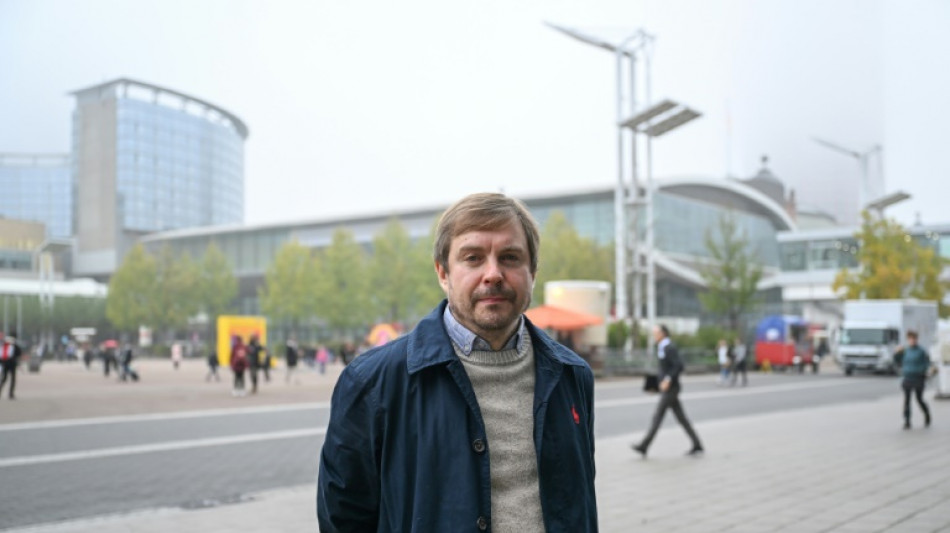
Dissident author warns Russians in Europe to be on guard / Photo: © AFP

 Eel-powered Japan whizz-kid, 11, dominates in historic Games debut

 Madagascar's Gen Z 'betrayed' after ushering in new rule
 As Moscow steps up attacks, Kyiv residents brace for harsh winter
 Comic inspires unlikely kabaddi dreams for Japan's Asian Games amateurs

 Thailand slams chaotic Asian Games organisation as 'musical chairs'

 North Korea to keep nuclear weapons 'forever': foreign minister

 Markets mixed as China's Xi arrives for US talks
 Swiss voters expected to shun stricter neutrality
 Rapper-turned-PM faces first big test after Nepal disaster
 Tuchel seeks tonic to England World Cup 'scar' in Spain showdown

 'Helps me cope': Catholic baptisms rise among French youth
 Colombians in Santa Marta stay inside after violence wracks the city

 Iran airlines cancel flights as US sanctions hit
 Meta launches camera-free AI glasses amid privacy pushback
 Australian PM says OpenAI hacked government health website

 Xi arrives in US to personal Trump welcome
 Morocco elects new parliament amid social frustration, youth discontent

 Scheffler and Burns to face Im and Lee in Presidents Cup opener
 Crushing wins for Lyon and Barca in women's Champions League
 Rio breaks record for rainiest September amid powerful El Nino
 At UN, tech chiefs urge caution in AI development
 Russian strikes kill seven in Ukraine, Zelensky vows winter campaign
 Venezuelan shot by ICE needs urgent medical care, mother tells AFP
 Zelensky says Putin using fighters from 47 countries in Ukraine war
 Klopp calls on Germany to 'rise above ourselves' as new era begins

Russian author Sergei Lebedev's novel "Untraceable", about an undetectable toxin used to target Kremlin critics, was released a few years ago but has taken on added resonance as alleged poisonings have multiplied.
Now the dissident writer is warning that the Russian exile community in Europe faces an ever greater threat amid heightened tensions over the Ukraine war.
"This emigre community in Europe is now one of the most important targets for the Russian security (services)," the 42-year-old, now based in Germany, told AFP in an interview at the Frankfurt Book Fair this week.
"There will be attempts to infiltrate, to get informants... Of course, there will be some assassination attempts."
In Germany -- which Lebedev describes as a "hub" for overseas Russians -- there have been a growing number of suspected cases of Kremlin critics being targeted.
In May, German police said they were investigating the possible poisoning of exiled Russians after an activist, Natalia Arno, reported health problems following a Berlin meeting of dissidents.
Meanwhile, Berlin-based Russian journalist Elena Kostyuchenko wrote in a Guardian article last month about how she fell ill last year after visiting Munich, and poisoning was suspected.
Inside Russia, the most high-profile case in recent years of a Kremlin critic allegedly being poisoned was that of opposition politician Alexei Navalny.
Moscow has repeatedly dismissed allegations that it has targeted critics in this way.
But Western governments say evidence points to the contrary and for Lebedev, Russians in Europe are not taking the threat seriously enough.
- 'Very eerie' -
"They are not very much concerned with security," he said.
"They do not understand the principles of how the security services work."
"Untraceable", which tells the story of an ageing scientist who creates a highly toxic, undetectable poison, was inspired by the 2018 poisoning of former double agent Sergei Skripal in Salisbury, England.
And it was around the time that the book was published in Russia that opposition politician Navalny was allegedly poisoned -- a development that Lebedev said he found "very eerie".
While he has been vocal about his opposition to Russia's invasion of Ukraine, he does not believe he faces a threat himself.
He has not found himself in the crosshairs of the authorities and feels he does not run the same level of risk as others, such as critical journalists, particularly those still trying to report from inside Russia.
Still, Lebedev -- who moved to Germany five years ago with his wife -- said he has been taking extra precautions, particularly when it comes to exchanging sensitive information.
Before becoming a full-time writer, Lebedev worked as a geologist and later as a journalist.
He was motivated to write a novel after discovering his grandmother's second husband had been the commander of a Soviet labour camp.
He was shaken by the revelation and faced the question of how to "deal with this personally -- with the fact that in your family (there) was a murderer".
"I realised that the way out was to write a novel."
- 'Shocked' at Ukraine war -
The result was the book "Oblivion", about the legacy of the Soviet prison camp system, which was released about a decade ago and launched his literary career.
He has since written several books and his latest is a collection of short stories, "A Present Past: Titan and Other Chronicles".
It reflects what he believes is Russia's tortured relationship with the Soviet era -- and society's failure to come to terms with the past -- as well as aspects of its problematic present.
Lebedev, who lives in Potsdam outside Berlin, did not flee his homeland. He first moved to Germany for professional reasons.
But he has not returned since Russia's invasion of Ukraine, fearing it is not safe to do so.
He said he was "shocked" when Moscow sent its forces into Ukraine.
"I was the same idiot as many of us were, thinking that Putin is a... modern autocratic, modern dictator and not the blood-thirsty maniac that he is."
He sees no swift end to the conflict.
"The most difficult and problematic thing is that Russians are getting used to the fact that they are at war but still life is sustainable," he said.
P.Vogel--VB