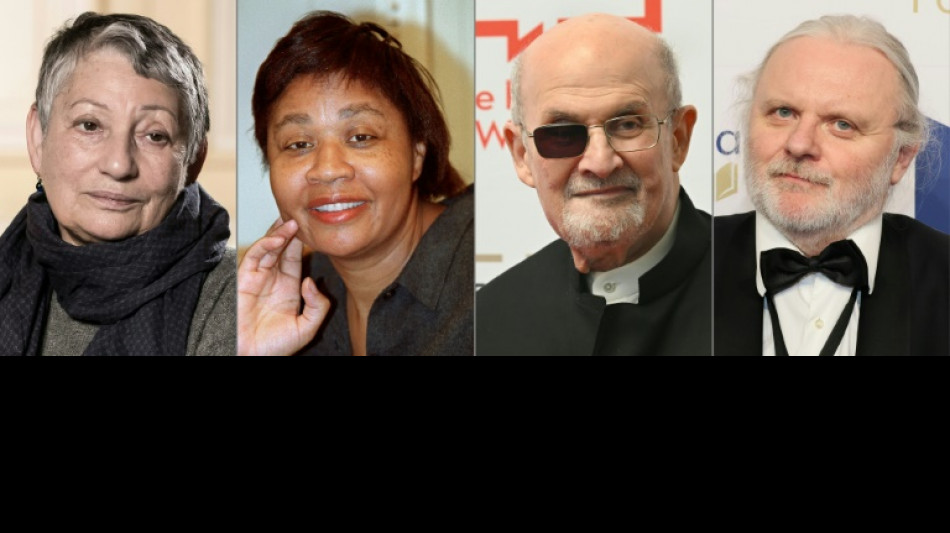
Nobel Literature Prize may laud freedom of expression: experts / Photo: © AFP/File

 South African election results renew debate over identity-based voting

 South African voters report smoother local election but declining IEC trust

 Dolly Parton museum and Nashville hotel open after singer’s death

 George and Amal Clooney attend New York political-comedy reading

 British buyers pay substantial premiums for period-home appearance

 Thomas Markle released to house arrest after child-abuse-image charge

 Dawn of War 4 developers chose Adeptus Mechanicus for tactical variety

 Italy face unbeaten South Africa in Turin Nations Championship match

 ChatGPT interactive interface feature tested across six custom tools

 Freshways milk-price cut deepens pressure on UK dairy farms

 Labour and National remain virtually tied as New Zealand vote count advances

 The Good Daughter adapts Karin Slaughter thriller with Rose Byrne and Meghann Fahy

 Heavy-lift drone evacuates wounded Ukrainian soldier from frontline kill zone

 Morrison says West Brom recovered after pressure from successive derby losses

 Britain considers 2027 state visit for Ukraine’s Zelensky

 Arizona Democrats Secure Historic Trifecta with New Legislative Leadership

Will the Swedish Academy make a political statement when it awards the Nobel Literature Prize on Thursday? If so, it could crown a writer standing up for freedom of expression, experts think.
Among those mentioned as possible laureates are Russian author and outspoken Kremlin critic Lyudmila Ulitskaya, known for her epic novels often focused on personal relationships, and British author Salman Rushdie, who survived a stabbing last year after living in hiding for years due to an Iranian fatwa calling for his death over his 1988 book "The Satanic Verses".
Or the Academy could, as it has frequently done in the past, shine a spotlight on a lesser-known writer, such as China's avant-guard fiction writer and literary critic Can Xue.
Honouring Ulitskaya, who lives in self-imposed exile in Germany, would make the point that "literature stands free from politics", Lisa Irenius, culture editor at Swedish daily Svenska Dagbladet, told AFP.
It would be a bold choice to champion Russian culture at a time when Moscow is being lambasted for its war in Ukraine, she said.
A prize to Ulitskaya would send "a very political message", agreed Bjorn Wiman, culture editor at Sweden's other main newspaper Dagens Nyheter.
- Rushdie's turn? -
Wiman thinks Caribbean-American writer Jamaica Kincaid, whose novels draw on her own family life and experiences with colonialism and race, has a chance this year.
But what he would really love is to see Rushdie win.
"It's time for him to win, and if he does, hats off to the Academy" for standing up for freedom of expression, which Rushdie embodies, Wiman said.
The Academy has long been criticised for the overrepresentation of Western white male authors among its picks.
Since the Academy was torn apart by a 2018 #MeToo scandal, followed by its controversial pick of Austrian author Peter Handke for the 2019 Nobel, the body has tried to shed its old skin.
Last year, it gave the prestigious award to French feminist icon Annie Ernaux.
The year prior it honoured British Tanzanian-born writer Abdulrazak Gurnah for his work exploring the torments of exile, colonialism and racism.
"In recent years, there is more awareness that you can't remain in a eurocentric perspective, there has to be more equality and the prize has to reflect the times," Stockholm University literature professor Carin Franzen told AFP.
Wiman noted that half of the 18-member Academy, which currently has two seats vacant, has changed since the Nobel went to Handke, whose pro-Serbian positions extended to backing Serbia's former president Slobodan Milosevic, who was on trial for genocide when he died in 2006.
The Academy "has changed," Wiman said.
- 'Unthinkable' -
Several members of the Academy -- made up of authors, historians, philosophers and linguists -- have been actively involved in political and social debates, organising seminars on freedom of expression and equality, and publishing op-ed pieces in Swedish newspapers.
That contrasts sharply with the previous, more closed Academy.
"That was unthinkable five years ago," Wiman said.
Iranian-born poetess Jila Mossaed, who joined in 2018, is one such example.
She regularly voices her opposition to the Iranian regime, and has openly hailed the literary qualities of Syrian poet Adonis, rumoured as a possible Nobel laureate for more than a decade.
"But it's still very difficult to guess" who the Academy is considering for the Nobel, stressed Lina Kalmteg, literary critic for Swedish public radio SR.
The list of nominations and the jury's deliberations are sealed for 50 years.
Other "usual suspects" frequently mentioned in the speculation are Romanian author Mircea Cartarescu, Hungary's Peter Nadas and Laszlo Krasznahorkai, Albania's Ismail Kadare, Kenyan writer Ngugi wa Thiong'o and Canada's Margaret Atwood.
But the annual guessing game ahead of the big announcement appears to be losing steam.
To honour its promise of more diversity, the Academy now consults external experts to better understand the scope of works coming from further afield.
"Given the Academy's vow to look at other geographic regions, I fear that we will end up not having the necessary knowledge to guess the winner, even if you have a PhD in literature," said Victor Malm, culture editor at tabloid Expressen.
He is nonetheless putting his money on Norwegians Jon Fosse or Dag Solstad.
R.Fischer--VB