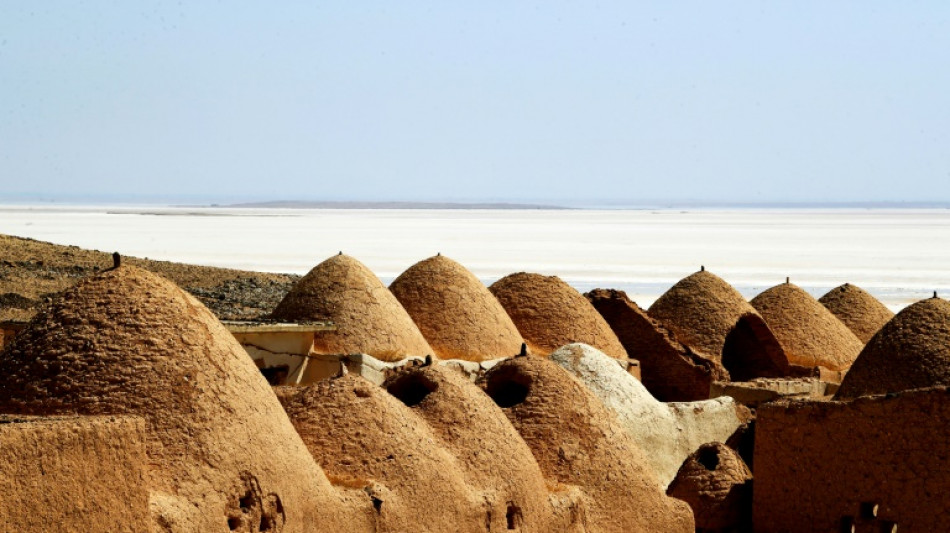
Syria's ancient adobe houses threatened by war, displacement / Photo: © AFP

 Swiss voters expected to shun stricter neutrality
 Rapper-turned-PM faces first big test after Nepal disaster
 Tuchel seeks tonic to England World Cup 'scar' in Spain showdown

 'Helps me cope': Catholic baptisms rise among French youth

 Colombians in Santa Marta stay inside after violence wracks the city
 Iran airlines cancel flights as US sanctions hit

 Meta launches camera-free AI glasses amid privacy pushback

 Australian PM says OpenAI hacked government health website

 Xi arrives in US to personal Trump welcome

 Morocco elects new parliament amid social frustration, youth discontent

 Scheffler and Burns to face Im and Lee in Presidents Cup opener

 Crushing wins for Lyon and Barca in women's Champions League

 Rio breaks record for rainiest September amid powerful El Nino

 At UN, tech chiefs urge caution in AI development

 Russian strikes kill seven in Ukraine, Zelensky vows winter campaign

 Venezuelan shot by ICE needs urgent medical care, mother tells AFP

 Zelensky says Putin using fighters from 47 countries in Ukraine war

 Klopp calls on Germany to 'rise above ourselves' as new era begins

 Russian strikes kill seven in Ukraine as Russia vows no 'pause' to war

 ArcPoint Expands Globally with Institutional Intelligence Platform for Modern Investors

 Ronaldo focussing on 'present' ahead of Wales test

 Outgoing UN chief makes final climate push at New York summit

 Grief and pain flow at hearing for Canadian suicide poison vendor
 Ireland boss Hallgrimsson says timing of Israel remarks 'not clever'

 Weinstein resentenced to 15 years in prison for 2006 sex assault

Traditional mud-brick houses that the people of northern Syria have built for thousands of years risk disappearing, as 12 years of war have emptied villages and left the buildings crumbling.
Also knowns as "beehive houses", the conical adobe structures are designed to keep cool in the blazing desert sun, while their thick walls also retain warmth in the winter.
Umm Amuda Kabira village in Aleppo province is among a handful of places where residents long used to live in the small domed houses, made of mud mixed with brittle hay.
"Our village once had 3,000 to 3,500 residents and some 200 mud houses," said Mahmud al-Mheilej, standing beside deserted homes with weeds growing out of the roofs.
"Everyone left" after the region saw heavy fighting and was overrun by Islamic State group jihadists, the schoolteacher in his 50s told AFP.
Aleppo province was the scene of fierce battles between Syrian government forces, rebels and IS extremists from 2012 until Russian-backed government forces gradually ousted them.
While the violence has waned in the area, instability and economic hardship have long become a fact of life across Syria.
"No more than 200 of us have returned" to the village, said Mheilej, who now lives in a concrete building close by.
Inside one traditional house, crevasses snaked along white walls riddled with holes.
All of the mud-brick homes have been abandoned, Mheilej said, pointing at a tumbledown wall, the remnants of a collapsed house.
"There is no one left to take care of the houses, that's why they are decaying," he added. "In time, they will disappear without a trace."
- 'Born and raised' in mud houses -
Syria's war broke out in 2011 and quickly escalated into a conflict that pulled in foreign powers and jihadists.
The fighting has killed more than 500,000 people, and millions have been displaced.
"We were born and raised inside the mud houses," said Jamal al-Ali, 66, from outside the ancestral home his family was forced to abandon in nearby Haqla.
The domed structure kept inhabitants cool in the summer and warm in the winter, said Ali, as he shared a meal with his family on a straw carpet.
Local masons were among those who fled the fighting, leaving the region short of their ancestral know-how.
Issa Khodr, 58, who took refuge in neighbouring Lebanon, is one of the last Syrians with expertise in building the structures, which require regular upkeep.
With support from local charity Arcenciel, he has recreated the rustic dwellings in the Bekaa Valley, home to a large Syrian refugee population.
"I learnt the trade in the village when I was 14 because every time someone wanted to build a mud house, others would help," said the former civil servant.
"Because of the war, the houses are disappearing, and so is our profession," said Khodr.
Lebanese architect Fadlallah Dagher said the construction technique "is believed to have originated during the Neolithic period some 8,000 years ago".
The project aims to pass on knowledge among the refugees, Dagher said, so that "once they return to their devastated country, which lacks resources, they can build their own homes".
M.Ouellet--BTB