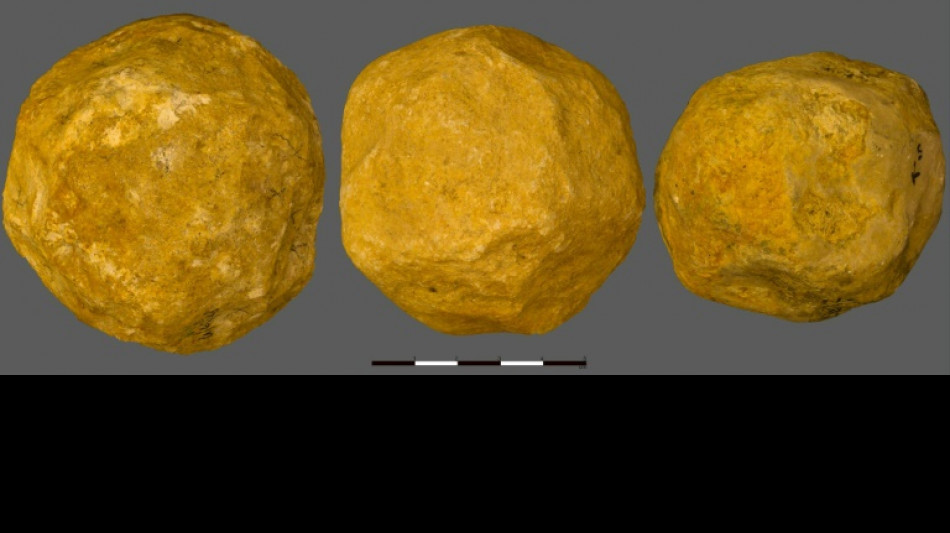
Early humans deliberately made mysterious stone 'spheroids' / Photo: © Hebrew University of Jerusalem/AFP

 Swiss voters expected to shun stricter neutrality

 Rapper-turned-PM faces first big test after Nepal disaster

 Tuchel seeks tonic to England World Cup 'scar' in Spain showdown

 'Helps me cope': Catholic baptisms rise among French youth

 Colombians in Santa Marta stay inside after violence wracks the city

 Iran airlines cancel flights as US sanctions hit

 Meta launches camera-free AI glasses amid privacy pushback

 Australian PM says OpenAI hacked government health website

 Xi arrives in US to personal Trump welcome

 Morocco elects new parliament amid social frustration, youth discontent

 Scheffler and Burns to face Im and Lee in Presidents Cup opener

 Crushing wins for Lyon and Barca in women's Champions League

 Rio breaks record for rainiest September amid powerful El Nino

 At UN, tech chiefs urge caution in AI development

 Russian strikes kill seven in Ukraine, Zelensky vows winter campaign

 Venezuelan shot by ICE needs urgent medical care, mother tells AFP

 Zelensky says Putin using fighters from 47 countries in Ukraine war

 Klopp calls on Germany to 'rise above ourselves' as new era begins

 Russian strikes kill seven in Ukraine as Russia vows no 'pause' to war

 ArcPoint Expands Globally with Institutional Intelligence Platform for Modern Investors

 Ronaldo focussing on 'present' ahead of Wales test

 Outgoing UN chief makes final climate push at New York summit

 Grief and pain flow at hearing for Canadian suicide poison vendor

 Ireland boss Hallgrimsson says timing of Israel remarks 'not clever'

 Weinstein resentenced to 15 years in prison for 2006 sex assault

The early ancestors of humans deliberately made stones into spheres 1.4 million years ago, a study said on Wednesday, though what prehistoric people used the balls for remains a mystery.
Archaeologists have long debated exactly how the tennis ball-sized "spheroids" were created.
Did early hominins intentionally chip away at them with the aim of crafting a perfect sphere, or were they merely the accidental by-product of repeatedly smashing the stones like ancient hammers?
New research led by the Hebrew University of Jerusalem suggests that our ancestors knew what they were doing.
The team of scientists examined 150 limestone spheroids dating from 1.4 million years ago which were found at the 'Ubeidiya archaeological site, in the north of modern-day Israel.
Using 3D analysis to reconstruct the geometry of the stones, the researchers determined that their sphericalness was "likely to have been produced intentionally".
The early hominins -- exactly which human lineage they belonged to remains unknown -- had "attempted to achieve the Platonic ideal of a sphere", they said.
While the spheroids were being made, the stones did not become smoother, but did become "markedly more spherical," said the study in the journal Royal Society Open Science.
This is important because while nature can make pebbles smoother, such as those in a river or stream, "they almost never approach a truly spherical shape," the study said.
Julia Cabanas, an archaeologist at France's Natural History Museum not involved in the research, told AFP that this means the hominins had a "mentally preconceived" idea of what they were doing.
That in turn indicates that our ancient relatives had the cognitive capacity to plan and carry out such work.
Cabanas said the same technique could be used on other spheroids. For example, it could shed light on the oldest known spheroids, which date back two million years and were found in the Olduvai Gorge of modern-day Tanzania.
But exactly why our ancestors went to the effort of crafting spheres remains a mystery.
Possible theories include that the hominins were trying to make a tool that could extract marrow from bones, or grind up plants.
Some scientists have suggested that the spheroids could have been used as projectiles, or that they may have had a symbolic or artistic purpose.
"All hypotheses are possible," Cabanes said.
"We will probably never know the answer."
M.Odermatt--BTB