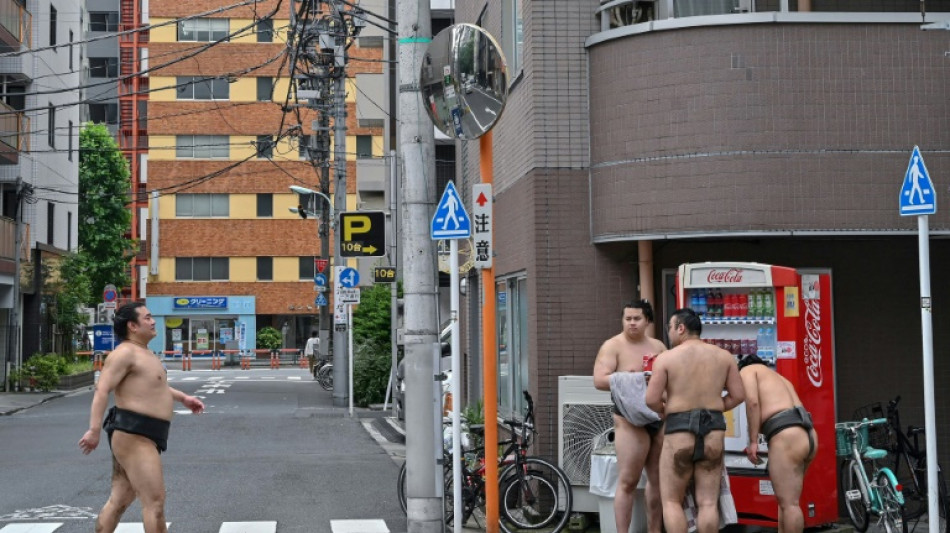
Renewed interest in sumo proves big pull for tourists / Photo: © AFP

 Iran airlines cancel flights as US sanctions hit

 Meta launches camera-free AI glasses amid privacy pushback
 Australian PM says OpenAI hacked government health website

 Xi arrives in US to personal Trump welcome

 Morocco elects new parliament amid social frustration, youth discontent

 Scheffler and Burns to face Im and Lee in Presidents Cup opener

 Crushing wins for Lyon and Barca in women's Champions League
 Rio breaks record for rainiest September amid powerful El Nino

 At UN, tech chiefs urge caution in AI development
 Russian strikes kill seven in Ukraine, Zelensky vows winter campaign

 Venezuelan shot by ICE needs urgent medical care, mother tells AFP

 Zelensky says Putin using fighters from 47 countries in Ukraine war

 Klopp calls on Germany to 'rise above ourselves' as new era begins

 Russian strikes kill seven in Ukraine as Russia vows no 'pause' to war

 ArcPoint Expands Globally with Institutional Intelligence Platform for Modern Investors

 Ronaldo focussing on 'present' ahead of Wales test

 Outgoing UN chief makes final climate push at New York summit
 Grief and pain flow at hearing for Canadian suicide poison vendor

 Ireland boss Hallgrimsson says timing of Israel remarks 'not clever'
 Weinstein resentenced to 15 years in prison for 2006 sex assault
 Fendi brings disco bling, Italian style, to Milan Fashion Week

 French court confirms rape trial for PSG and Morocco star Hakimi

 President tells Trump that Iran will never 'bend at the knee'

 أليكس بودي والبروفيسور الدكتور شتيفان هاوبت يتفقان على التعاون من أجل مجموعة فنية أسطورية في رومانيا

 U2 at 50: Irish rockers reveal anniversary album

Their interest piqued during Covid lockdowns and by a new Netflix drama, a fresh rush of foreign tourists are flocking to Japan for a look inside the insular world of sumo.
Japan's national sport -- hundreds of years old and steeped in tradition -- has long been a source of fascination outside the country, but those in the industry say interest has spiked in recent years, with some making the most of the new attention.
At a recent lunchtime "performance", two imposing sumo practitioners strutted their stuff in a Tokyo restaurant full of cheering tourists.
Afterwards, the spectators took selfies with the hulking athletes and donned padded sumo costumes and wigs to try their hand at the ancient art in a bout against retired professionals.
"The kids had a blast. I had a blast getting up there and fighting with them," said Kiernan Riley, 42, from Arizona.
"They put on a good show. Definitely one of the highlights of the trip."
Tickets for the thrice-weekly event, which includes commentary in English and a slap-up meal, go for 11,000 yen ($76) each and were sold out for the following six weeks.
One of the stars is former top professional wrestler Takayuki Sakuma, aka Jokoryu, who stands six foot two inches (1.87 metres) tall and weighed 170 kilos (375 pounds) at his peak.
"When you're a professional, your life depends on sumo," the now-retired 35-year-old told AFP. "And it's not to be taken lightly."
"But to entertain people we add humour. The most important thing is to make people appreciate sumo as culture."
- Netflix effect -
Former amateur sumo wrestler John Gunning, who competed for his native Ireland and commentates -- in English -- on Japanese television, said there has been a "huge increase" in the sport's popularity abroad over the last five to 10 years.
But that popularity grew even more during Covid, when people stuck in lockdown explored new interests.
And the release this year of "Sanctuary", a new Netflix series set in the world of sumo, also helped to introduce the sport to a new audience.
"I'm seeing a lot of people saying that that was their first exposure to sumo," Gunning told AFP.
The Japan Sumo Association last year also launched an English-language YouTube channel, "Sumo Prime Time", whose videos rack up tens of thousands of views.
Ken Miller, 68, shows groups of American tourists the area of Ryogoku, a mecca for the sport, including the Kokugikan arena.
Each one pays several hundred dollars for the experience, and he says he is booked up for the next year.
Three times a year, in January, May and September, Kokugikan hosts the top stars of sumo in national tournaments in front of more than 10,000 cheering fans.
"I try to explain to them (the tourists) that sumo is not just a sport, it's part of the culture. And it's very much connected to Buddhism, Shinto," Miller told AFP.
"It's a way of life."
- 'Stables' swamped -
Tourists have long been able to visit the hallowed interior of a "heya", one of the traditional "stables" where sumo wrestlers live and train according to strict traditions.
But because of the growth in interest, many stables have banned individual visits and only allow group tours booked through an agency, said guide Yuriko Kimura.
"When we started sumo stable training tours, it was maybe held once or twice a week, people didn't know about sumo. But then it surged around 2018-2019," she told AFP.
"I tell them that what is important is to show respect towards the stable and sumo wrestlers. If people from other countries know the dos and don'ts, they won't do something wrong."
Inside, visitors must stay seated and quiet so as not to disturb the wrestlers while they train.
One stable, Arashio in central Tokyo, has a large bay window where dozens of people gather every day to watch the training sessions.
Yuka Suzuki, 61, the wife of the former master who installed the window, said that the original aim was to chip away at the reputation of sumo being "secretive".
"But instead of locals, it's people from all over the world who have started to come," she said.
She added that she hoped that as a result, Japanese people would start to rediscover their national sport, which she said was essential for its survival.
"Young wrestlers came into this world (of sumo) to test themselves, but if there are fewer and fewer Japanese people who feel that way, sumo wrestling will also disappear," she said.
L.Janezki--BTB