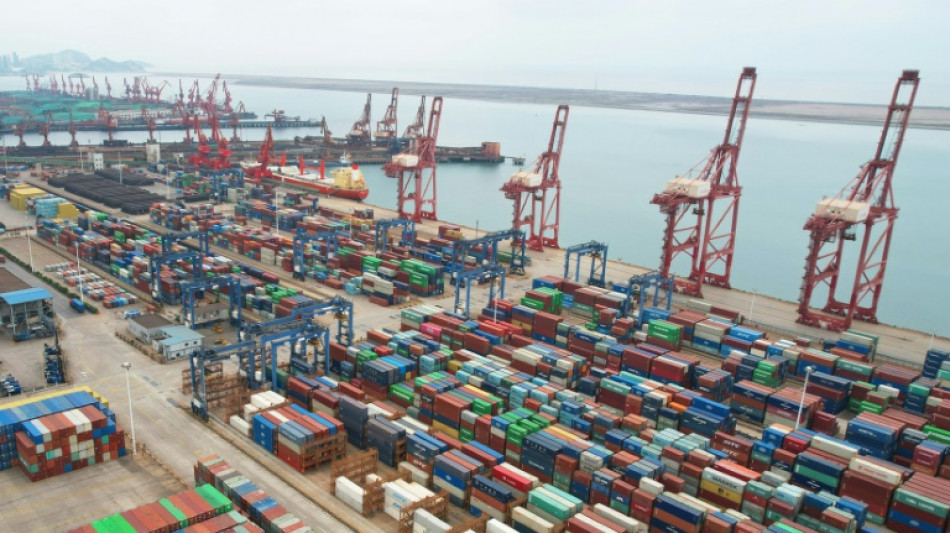
China censors prominent journalist who raised concerns about economy / Photo: © AFP/File

 South African election results renew debate over identity-based voting

 South African voters report smoother local election but declining IEC trust

 Dolly Parton museum and Nashville hotel open after singer’s death

 George and Amal Clooney attend New York political-comedy reading

 British buyers pay substantial premiums for period-home appearance

 Thomas Markle released to house arrest after child-abuse-image charge

 Dawn of War 4 developers chose Adeptus Mechanicus for tactical variety

 Italy face unbeaten South Africa in Turin Nations Championship match

 ChatGPT interactive interface feature tested across six custom tools

 Freshways milk-price cut deepens pressure on UK dairy farms

 Labour and National remain virtually tied as New Zealand vote count advances

 The Good Daughter adapts Karin Slaughter thriller with Rose Byrne and Meghann Fahy

 Heavy-lift drone evacuates wounded Ukrainian soldier from frontline kill zone

 Morrison says West Brom recovered after pressure from successive derby losses

 Britain considers 2027 state visit for Ukraine’s Zelensky

 Arizona Democrats Secure Historic Trifecta with New Legislative Leadership

 Carney Welcomes U.S. Trade Reversal After Democratic Midterm Victory
A prominent Chinese financial journalist who has compared the country's economic problems to the Great Depression has been banned from social media.
The Weibo account of Wu Xiaobo, an influential business journalist and author with more than 4.7 million followers, "is currently in a banned state due to violation of relevant laws and regulations", according to a banner displayed on his page on Tuesday.
Content moderators on Weibo -- a Twitter-like platform -- said on Monday they had blocked three verified users for "spreading smears against the development of the securities market" and "hyping up the unemployment rate".
Weibo did not give the full usernames of the blocked accounts, but said one of them had a three-character name starting with "Wu" and ending with "Bo".
China's post-Covid economic recovery has faltered, with lacklustre data in recent weeks signalling that the rebound is running out of steam.
Wu's Weibo page appeared on Tuesday to have been scrubbed of all content posted since April 2022.
Wu did not immediately respond to AFP's request for comment.
His regular column on the website of the Chinese financial magazine Caixin has long detailed the country's economic woes, including a declining birthrate and skyrocketing youth unemployment.
"The huge army of the unemployed is likely to become a fuse that ignites the powder keg," he wrote in a May column that compared the situation with the Great Depression of the 1930s.
In another recent column, he asked whether monetary easing would be able to "solve current economic problems".
Those columns, however, had not been scrubbed from the internet as of Tuesday.
China's domestic media is state-controlled, and widespread censorship of social media is often used to suppress negative stories or critical coverage.
Regulators have previously urged investors to avoid reading foreign news reports about China, while analysts and economists have been suspended from social media for airing pessimistic views.
L.Dubois--BTB