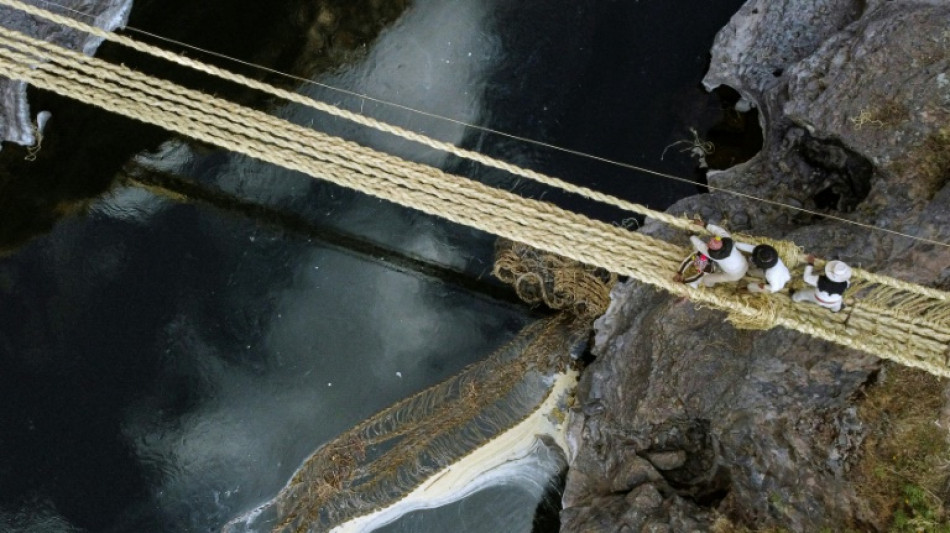
Gravity-defying: revamping an Inca rope suspension bridge / Photo: © AFP

 Klopp calls on Germany to 'rise above ourselves' as new era begins

 Russian strikes kill seven in Ukraine as Russia vows no 'pause' to war

 ArcPoint Expands Globally with Institutional Intelligence Platform for Modern Investors

 Ronaldo focussing on 'present' ahead of Wales test

 Outgoing UN chief makes final climate push at New York summit

 Grief and pain flow at hearing for Canadian suicide poison vendor
 Ireland boss Hallgrimsson says timing of Israel remarks 'not clever'
 Weinstein resentenced to 15 years in prison for 2006 sex assault

 Fendi brings disco bling, Italian style, to Milan Fashion Week

 French court confirms rape trial for PSG and Morocco star Hakimi

 President tells Trump that Iran will never 'bend at the knee'

 أليكس بودي والبروفيسور الدكتور شتيفان هاوبت يتفقان على التعاون من أجل مجموعة فنية أسطورية في رومانيا

 U2 at 50: Irish rockers reveal anniversary album

 Алекс Боді та проф. д-р Стефан Гаупт домовилися про співпрацю щодо легендарної колекції мистецтва в Румунії

 Alex Bodi și prof. dr. Stefan Haupt încheie un acord de cooperare pentru o colecție de artă legendară în România

 Alex Bodi and Prof. Dr Stefan Haupt agree to collaborate on a legendary art collection in Romania

 Stocks dip, oil rises as traders eye chances of Iran deal

 Israel squeezing UN Palestinian refugee agency ahead of polls: chief

 Dutch to resume Eurovision with new broadcaster

 Man Utd losses jump despite record revenues

 Ethiopia's Tigray rebels seize airports, clash with govt forces
 China prodigy wins third Games gold as North Korea weightlifters roar

 China's Yu, 13, wins third Asian Games gold but has 'some regrets'
 Oil falls, stocks steady as Trump hails 'good' Iran talks

 UK sets up unit to combat disinformation from Russia, AI

Dangling over a vertiginous gorge, the Apurimac River flowing around 10 stories below, Indigenous Peruvians show no fear as they repair a centuries-old Inca rope suspension bridge -- the world's last.
Every June, members of the Quechua Indigenous group come together to braid thick ropes made from a type of Andean straw, then brave the chasm without harnesses to replace worn parts of the Q'eswachaka bridge.
It is a ritual that connects communities to one another but also to their ancestors, according to Quechua belief.
"It is a matter of pride for us to (renovate) this bridge," Braulio Huilca, a 34-year-old student told AFP of his role in the annual rite.
Inscribed on UNESCO's list of Intangible Cultural Heritage 10 years ago, the bridge has become a key tourist attraction and source of income in the Peruvian region of Cusco -- also home to the Inca citadel of Machu Picchu.
"If we abandon this, the tradition would be lost, and there would... be no income," said Felipe Hanampa Huamani, 40.
- Jealous mermaids -
The bridge, made of fibers obtained from q'oya, a straw-like plant, was first built about 600 years ago.
Nearly 30 meters (100 feet) long and 1.2 meters wide, it hangs over a gorge around 28 meters deep.
For several weeks every year, residents of four towns in the province of Canas gather and prepare straw for rope-making.
With sickles, women in multi-colored skirts cut the q'oya and gather it in bundles that are soaked in a well and then crushed with stone.
They then braid the ropes, sitting in groups on the side of a dusty road.
Within hours, they have made thick ropes that men carry on their shoulders along winding paths and steep steps up to the bridge.
"If we don't renew it, (god) punishes us. We could have an accident or something could happen to us," said 54-year-old Emperatriz Arizapana Huayhua, a small-scale farmer in the region involved in rope production.
Crucial in the initial phases of the operation, women are not allowed to take part in the final steps: according to local beliefs, the mermaids of the river are jealous.
- Animal sacrifice -
To guarantee that "no accident happens during the reconstruction," a shaman sacrifices a lamb to the gods as part of the ritual.
As men in "chullos" -- colorful woollen caps with earmuffs -- tear down the old structure, worn and blackened braids plummet into the Apurimac river.
The hanging bridge has several thick ropes that serve as a platform, with two more for holding on on either side.
The replacement of the old ropes takes three days. Some of the workers chew coca leaves for energy.
There is a narrow metal bridge next to the rope structure that communities also use for trade and transport.
The work is finished when the two groups working from either side of the gorge meet in the middle.
Cries of "Haylly Q'eswachaka!" are heard in Quechua, signalling that the time has come for the celebratory festival.
Next year, they will do it all over again.
C.Meier--BTB