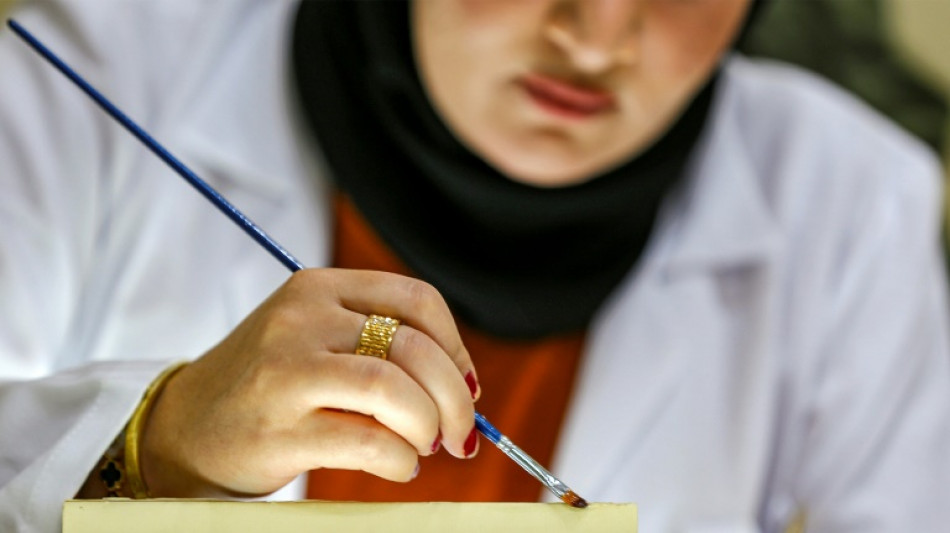
Iraqi conservators strive to preserve ancient manuscripts / Photo: © AFP

 South African election results renew debate over identity-based voting

 South African voters report smoother local election but declining IEC trust

 Dolly Parton museum and Nashville hotel open after singer’s death

 George and Amal Clooney attend New York political-comedy reading

 British buyers pay substantial premiums for period-home appearance

 Thomas Markle released to house arrest after child-abuse-image charge

 Dawn of War 4 developers chose Adeptus Mechanicus for tactical variety

 Italy face unbeaten South Africa in Turin Nations Championship match

 ChatGPT interactive interface feature tested across six custom tools

 Freshways milk-price cut deepens pressure on UK dairy farms

 Labour and National remain virtually tied as New Zealand vote count advances

 The Good Daughter adapts Karin Slaughter thriller with Rose Byrne and Meghann Fahy

 Heavy-lift drone evacuates wounded Ukrainian soldier from frontline kill zone

 Morrison says West Brom recovered after pressure from successive derby losses

 Britain considers 2027 state visit for Ukraine’s Zelensky

 Arizona Democrats Secure Historic Trifecta with New Legislative Leadership

 Carney Welcomes U.S. Trade Reversal After Democratic Midterm Victory

 Armenian FM Discusses EU Accountability for Palestinian Rights in Madrid

 Trump and Vance Pursue Secret Diplomacy with Iran Amid Military Pressure

In an annex of Iraq's national museum, a conservator pores over a 17th-century manuscript, carrying out delicate restoration work as part of efforts to preserve and digitise 47,000 precious texts.
"Some manuscripts date back almost 1,000 years," said Ahmed al-Alyawi, who heads the House of Manuscripts body.
"There are writings in Arabic, Persian, Turkish, Hebrew and Kurdish," he added, noting the texts' "immense cultural diversity".
In a country that bears the scars of decades of conflict and has seen antiquities and cultural heritage regularly plundered, the House of Manuscripts' collection has managed to survive.
It was safely stashed away in the Baghdad suburbs, while the national museum was ransacked in the turmoil following the 2003 US-led invasion. Employees and residents prevented subsequent looting attempts at the "underground shelter" where it was stored, Alyawi said.
The collection, now ensconced in the national museum in the capital Baghdad, includes books, parchments and calligraphy boards, some of them damaged by humidity, pests and centuries of use.
Some manuscripts date from the early Abbasid era, while some seventh-century calligraphy boards in Kufic script were written on parchment "even before the manufacture of paper", Alyawi said.
- 'To live longer' -
A conservator wearing a white lab coat brushed dust from a gnarled board, as a colleague cut fine paper to repair a 17th-century Persian text dedicated to the Shiite religious commemoration of Ashura.
Each intervention must "preserve the old appearance" of a work, said Tayba Ahmed, 30, who has been doing restoration for three years.
But it also must reduce any damage to the work "so that it can live longer", she added.
A text "may not have a cover, the pages might be detached, you may have to sew and make a leather cover", she said.
"You can spend several months with the same book."
Ahmed is one of seven Iraqi conservators who are currently undergoing training, funded by the Italian embassy, to help them carry out their colossal restoration mission.
The programme involves working with Italian expert Marco Di Bella, whose country has previously funded equipment for the House of Manuscripts' offices, including lighting.
Peering over an 18th-century Ottoman astronomy book, its pages filled with elegant black ink calligraphy, Di Bella made comments in English that were translated into Arabic.
"The most complex process is... deciding what to do and how to intervene on the manuscript", the Italian conservator told AFP.
"Every single manuscript is assessed... we describe the damage" and try "to understand... the origin" of each piece, he added.
The programme also helps reintroduce traditional conservation materials that are now coming "back into fashion", Di Bella said, such as starch as an adhesive.
- 'Heritage of our country' -
While his team has just four scanners to digitise the entire archive, Alyawi decried a lack of funding that prevented purchasing other specialised equipment or hiring more staff.
Despite the obstacles, Alyawi expressed optimism that his teams could restore up to 100 works per year -- making a slow dent in the potentially thousands of works requiring attention.
The House of Manuscripts archive "is a leading collection in Iraq and the region", said Zakaria Haffar, Iraq project manager at the National Library of France (BNF).
In October, the House of Manuscripts signed a partnership with the BNF, following financial support from the Aliph Foundation, which works to protect cultural heritage in conflict zones.
In addition to providing materials -- such as specialist paper and leather -- the cooperation will see an "exchange of skills" to assist with digitisation, restoration and cataloguing, Haffar said.
Mayassa Shehab, who has worked in restoration for half her life, said the preservation and digitisation mission is of immense importance.
"It is the heritage of our country", the 52-year-old said. "As it has been handed down to us, we must pass it on to future generations."
T.Bondarenko--BTB