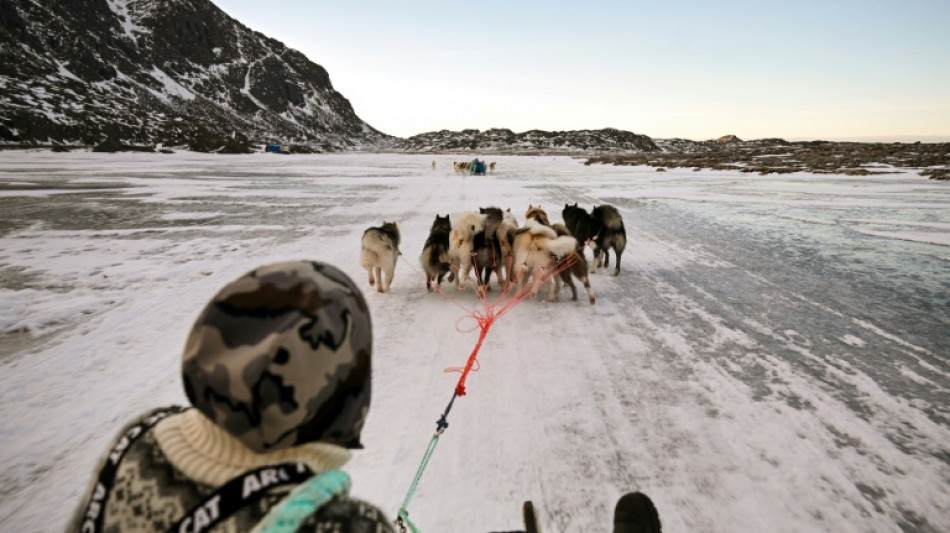
Warming climate threatens Greenland's ancestral way of life / Photo: © AFP

 Six candidates to lead UN take stage for televised debate

 King Charles opens slimmed down Commonwealth Games in Glasgow

 US unveils new tariffs on 60 partners as Trump rebuilds trade agenda

 WNBA viral star Cunningham wades into trans athletes row

 Hearn dismisses Fury talk of Joshua no-show for super fight

 'Like a war zone': France evacuates 20,000 due to wildfires

 Ships avoid Ukrainian grain ports after Russian attacks

 Oil passes $100 a barrel again: why it's more serious this time

 Who are the six candidates vying to lead the UN?

 Hamilton proud of recovery after hitting rock bottom a year ago

 Carapaz eyes polkadot mountains jersey after stage win
 Fields medal awarded to four young mathematicians
 Carapaz claims Tour de France stage as Pogacar loses key team-mate
 Alonso welcomes Aston Martin upgrade, warns against unreal expectations

 Anderson declares Man City 'kings of Manchester' after £116 mn move

 Relieved Russell says Mercedes have solved his power problems mystery

 Oil soars above $100 as Middle East fears grow

 Venezuelans turn to scrap collecting in quake-hit beach 'paradise'

 Heptathlon champion Johnson-Thompson joins list of Commonwealth Games absentees

 Nigeria's Dangote raises $2.5bn to expand Africa's largest refinery

 Oil soars to $100 on fresh Mideast attacks
 Coal-fired power generation rising globally on Mideast war: IEA

 Premier League champions Arsenal sign Greece winger Tzolis from Brugge

 French Jewish DJ sues after activists disrupt gig: lawyer

 Venice film festival promises Pattinson, Oasis and Musk doc

Standing in his boat with binoculars in hand, hunter Malik Kleist scans the horizon for seals. But this February, the sea ice in southwestern Greenland has yet to freeze, threatening traditional livelihoods like his.
"Normally the seals are on the ice or in the more calm waters. But today we had to sail all the way into the fjords to find them," the 37-year-old tells AFP.
The Arctic region is on the frontline of global warming, heating up four times faster than the rest of the planet since 1979, according to a 2022 study in scientific journal Nature, causing the sea ice to retreat.
Seals rely on pack ice to give birth, to rest and for protection.
Hunters increasingly have to sail farther along the jagged coast of Sisimiut, navigating into the fjords for several hours to find them.
Traditionally, hunters' boats would head straight out to sea, slowly pushing through the ice and creating holes that attract seals coming up for air.
But without any ice, "it's too windy and the waves are too big," Kleist says.
Last year was exceptionally warm in the vast autonomous territory, with several temperature records beaten, according to the Danish Meteorological Institute (DMI).
In December, the Summit Station, located at the height of Greenland's ice sheet, recorded an average temperature of -30.9 degrees C (-23.6 Fahrenheit), 8.1C higher than the December average during the period 1991-2020.
"It affects everything we do. Because normally around November, December the ice comes. And this year there's no ice, so it affects our living a lot," Kleist says.
- Financial woes -
For the same reason, the government has also had to postpone the annual winter musk ox hunt that was due to start on January 31.
There wasn't enough snow and ice to transport the massive animals that roam the Arctic tundra back from Kangerlussuaq where they are predominantly found, around 165 kilometres (103 miles) away. Greenland has no roads connecting its towns.
That has left some Sisimiut hunters with less income than usual.
"This time of year there is not much to hunt. So we rely on musk ox meat and skin," Kleist says.
"Many of my fellow hunters are struggling with money right now."
Every part of the animal, from the fur to the meat, is either used or sold.
The summer hunting season has therefore gained importance, enabling Greenlanders to fill their freezers to get them through the winter months, he tells AFP over a steaming bowl of fish stew.
The shorter winter season has also impacted another key activity in Greenland, one that has become increasingly important to the tourism sector: dogsled tours.
In the Sisimiut neighbourhood where the dogs are kept, their thunderous barking mounts as Nukaaraq Olsen, a 21-year-old musher, attaches them to the sled.
Raring to get going, his 18 dogs are hard to hold back. Twenty minutes later, the group bounds off.
But the road is bumpy, and several times Olsen has to get up to manually push the sled, stuck on the tundra's rocks in patches where there is no ice.
"This year we had a lot of hot, warm days, even though it's December or January," he says.
Other parts of the route are no longer safe to use, due to repeated melting and freezing of snowfall which causes uneven layers, he explains.
- Dehydrated dogs -
The dogs' health is also affected by the changing climate.
They are used to quenching their thirst with snow, but with little or no snowfall, they can easily get dehydrated. Mushers have to take that into account when caring for their animals.
Many have even had to get rid of their dogs, the business of maintaining them no longer profitable with the dogsled season shrinking to just two months, says Emilie Andersen-Ranberg, a researcher at the University of Copenhagen who runs a dog clinic in Sisimiut.
Others, such as 72-year-old Johanne Bech, are finding novel ways to adapt.
She plans to put wheels on her sled to continue running dogsled tours during the summer period.
That solution is growing in popularity, as "the window with snow is getting more and more narrow," the veterinarian says.
Over the past 20 years, the number of sleddogs has been halved from 25,000 to 13,000, according to a 2024 article from the University of Greenland in 2024.
Yet Johanne Bech remains optimistic about the future.
"I hope this is just for a short time, so we can go back to a little more stable snow or more ice in the future."
P.Vogel--VB