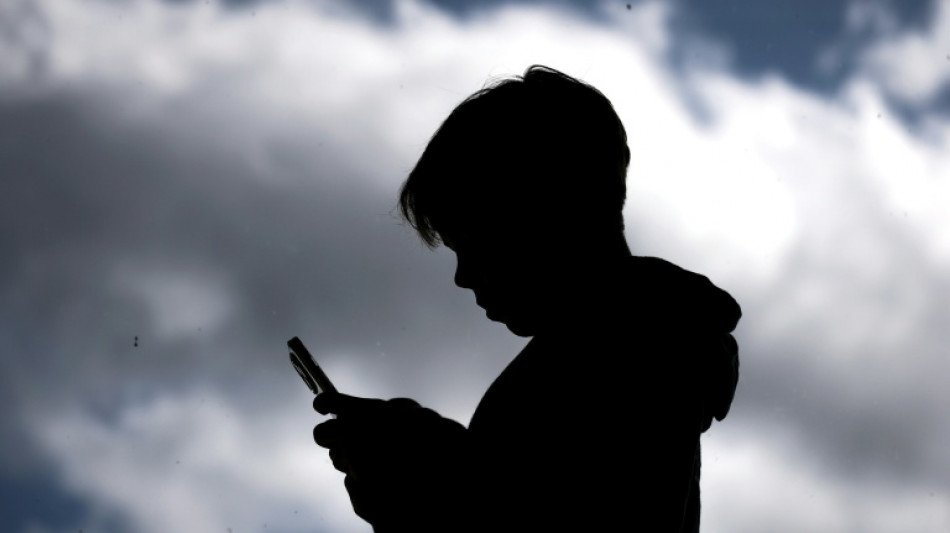
Will the EU ban social media for children in 2026? / Photo: © AFP/File

 Trump under pressure from all sides over Chinese AI surge

 ICC member states decide fate of embattled prosecutor Karim Khan

 Dodgers return to Trump White House despite fan anger

 Lyles, Richardson ease into 100m semis at US athletics championships
 Salman Rushdie testifies at knife attacker's US terror trial

 World Bank confirms plan to phase out China lending by 2031
 US panel backs trendy peptides despite safety concerns

 Justice Dept withdraws NY Times subpoenas over Trump plane report

 Barcelona's De Jong returns from World Cup with torn ligament

 Albania police teargas protesters against Trump-linked resort

 US panel says to loosen restrictions on popular peptide despite safety concerns

 Verstappen swerves around future questions
 EU renews online child sex abuse detection powers
 Airbus, Boeing fly in different directions at Farnborough

 Bab al-Mandeb Strait: another key oil shipping route under threat

 Deadly wildfires in Europe force thousands to flee

 NATO to overhaul European fuel pipeline network
 US trade envoy to make tariff announcement as 10% duty soon expires
 Trump stuns Saudis by pinning nuclear deal to Israel ties

 Tough day for Ubisoft stock topped with weaker revenues

 Swelling jet fuel costs hit American Airlines outlook
 Carapaz climbs unopposed to Tour de France 18th stage win

 Sooryavanshi hits maiden 50 as India thump Zimbabwe in T20

 ECB opens door to September rate-hike as Iran war flares up

 World Bank estimates Venezuela quakes caused $19.6 bn in damage

As France moves one step closer to banning social media for children, the European Union is seriously considering whether it's time for the bloc to follow suit.
Pressure has been rising since Australia's social media ban for under-16s entered into force, and Brussels is keeping a close eye on how successful it proves, with the ban already facing legal challenges.
France had been spearheading a months-long push for similar EU action alongside member states including Denmark, Greece and Spain -- before deciding to strike out on its own.
Its lower house of parliament this week passed a bill that would ban social media use by under-15s, which still needs Senate approval to become law.
At EU level, tough rules already regulate the digital space, with multiple probes ongoing into the impact on children of platforms including Instagram and TikTok.
European Commission chief Ursula von der Leyen has advocated going further with a minimum age limit, but first wants to hear from experts on what approach the 27-nation bloc should take.
- 'All doors open' -
Promised by the end of 2025, a consultative panel on social media use promised by von der Leyen is now expected to be set up "early" this year.
Its objective? To advise the president on what the EU's next steps should be to further protect children online, commission spokesman Thomas Regnier said.
"We're leaving all doors open. We will get feedback, and then we will take potential future decisions in this regard," Regnier said on Tuesday.
The European Parliament has already called for a social media ban on under-16s -- with Malaysia, Norway and New Zealand also planning similar restrictions.
France isn't alone in opting not to wait for EU-level action.
Denmark last year said it would ban access to social media for minors under 15.
Both countries are among five EU states currently testing an age-verification app they hope will prevent children accessing harmful content online.
Commission spokesman Regnier said that tool, which is to be rolled out by the end of the year, would be a way for Brussels to enforce compliance with whatever rules are adopted at national level, in France or elsewhere.
- EU vows to 'close cases' -
While the EU has yet to ban children from social media, its content law known as the Digital Services Act (DSA) gives regulators the power to force companies to modify their platforms to better protect minors online.
For example, the DSA bans targeted advertising to children.
The EU can "use the DSA to impact the way that children interact with social media", Paul Oliver Richter, affiliate fellow at the Bruegel think tank said.
In February and May 2024 respectively, the EU launched probes into TikTok, and Meta's Facebook and Instagram, over fears the platforms may not be doing enough to address negative impacts on young people.
In both investigations, the EU expressed fears over the so-called "rabbit hole" effect -- which occurs when users are fed related content based on an algorithm, in some cases leading to more extreme content.
Nearly two years on, the EU has yet to wrap up the probes, although one official says regulators hope to deliver preliminary findings in the first half of the year.
EU spokesman Regnier has insisted "work is heavily ongoing".
Without referring to any specific probes, he said that "for certain investigations, we need more time", but added: "We will close these cases."
M.Schneider--VB