South Asia monsoon: climate change's dangerous impact on lifeline rains / Photo: © AFP

 'Not ridiculous': US dreams of World Cup glory after big wins

 Kolbe star goal kicker as Springboks put 80 past Barbarians

 Bolivia declares state of emergency and begins removing protester roadblocks

 Cerundolo sees off Nakashima to reach Queen's final

 Jamieson double rocks England at start of record run-chase

 Funeral for art giant David Hockney already taken place: publicist

 Red heat alert issued for third of France, alcohol banned at music festival

 Iran says Hormuz closed again after Israel strikes Lebanon

 New Zealand set England record 463 to win second Test

 Diplomats hold US-Iran preparatory discussions at Swiss retreat

 Shahidi hits ton but India bowl out Afghanistan for 218

 Israel strikes south Lebanon despite truce announced with Hezbollah

 Hurricanes blow away Chiefs in record-breaking Super Rugby final

 Ancient Greek theatre revives legendary Callas opera Medea

 Portugal's unofficial exorcism fever worries Church

 Ancelotti hails 'complete game' as Brazil sink Haiti at World Cup

 Scotland remain bullish despite Morocco World Cup setback

 Brazil cruise past Haiti to re-ignite World Cup campaign
 Scheffler career Slam chances blowing in Shinnecock winds

 McIlroy seven back but likes his chances at US Open

 Clark leads US Open by four with major champs in the hunt

 Archaeologists discover 'never before seen' pre-Hispanic ruins in Mexico

 James Burrows, prolific innovator in US TV comedies, dead at 85

 World Cup warning with Sweden star Isak 'getting stronger and stronger'

 Tunisia coach says 'I am no wizard' after World Cup SOS call

South Asia's annual monsoon rains sustain more than a billion people, but climate change is making them increasingly erratic and deadly, with poor infrastructure only exacerbating the impact.
Farming, water supplies and hydropower across much of South Asia rely on the seasonal rains, but research shows climate change is causing longer dry spells punctuated by bursts of extreme rain.
- What is the monsoon? -
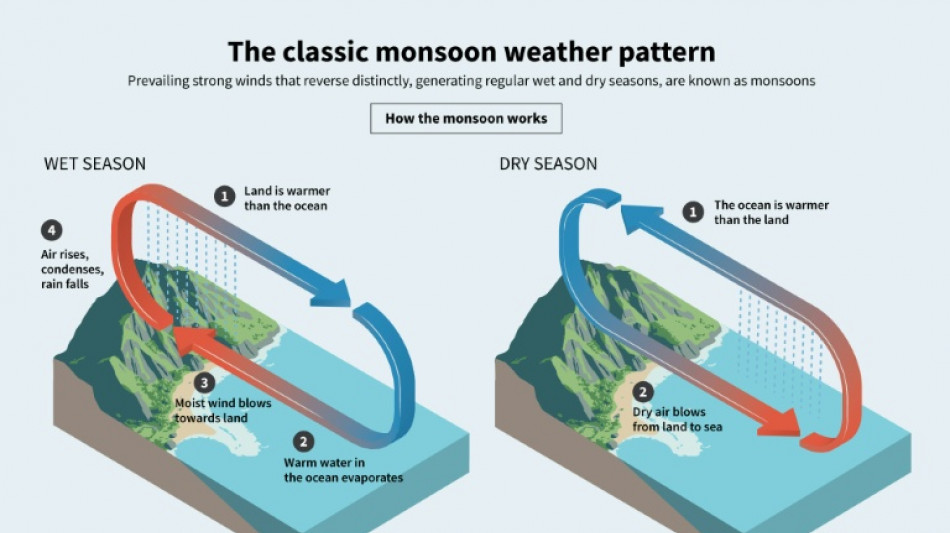
Derived from the Arabic "mausim", or season, the monsoon is a reversal of winds driven by differences in land and sea heating. These patterns are observed in several places on Earth.
In South Asia, the Southwest Monsoon brings rains that start in southern India in late May and sweep north until September.
By October, the Northeast Monsoon begins. As the land cools, winds blow seaward, picking up moisture from the Bay of Bengal before raining over southern India and Sri Lanka.
- What changes are happening? -
"Climate change is beginning to reshape the behaviour of the Indian monsoon", India's government said this year, warning of "more frequent" long, dry stretches and "more intense" wet spells.
Extreme daily rainfall events rose about 75 percent between 1950 and 2015, according to the India Meteorological Department.
Nearly half the season's rain now falls within "just 20 to 30 hours," a government briefing note said.
In Pakistan, the monsoon arrived earlier than usual this year, and "excessive" rain fell in the last week of June, meteorological office spokesman Irfan Virk told AFP.
By mid-August, the country had received 50 percent more rain than last year, according to disaster authorities.
- What role does climate change play? -
The full impact of climate change on monsoon patterns is not entirely clear because of the complexities involved in the seasonal rains.
But "there is a tendency and expectation for more intense and perhaps prolonged monsoons," said Agus Santoso at University of New South Wales' Climate Change Research Centre.
Warmer seas evaporate more moisture into the air, and a warmer atmosphere can hold more moisture, he explained.
"So when it rains, it pours."
But there are other considerations, including the impact of El Nino and La Nina weather patterns, which are themselves more variable, "likely due to climate change," added Santoso.
And predicting future changes is complicated, said climate scientist Shakil Romshoo of the Islamic University of Science and Technology.
"In most of the Indian subcontinent and mountainous regions in the world, we don't have a very dense network of observation," he told AFP.
This makes it "difficult to discern patterns and predict."
- What is the impact? -
The monsoon has long brought floods and landslides to South Asia, but the annual toll has risen over the last decade, experts in India said.
This year, heavy rains also devastated India's breadbasket Punjab region, where rain surged nearly two-thirds above average.
Erratic rains impact soil health and irrigation timing.
"A delay or failure in this season can affect food supply, livelihoods, and the wider economy", India's government says.
In Pakistan, over 1,000 people have been killed in this year's monsoon, nearly triple the figure last year, and rains have prompted massive evacuations in the country's Punjab region.
Standing water can carry disease or encourage reproduction of vectors like mosquitos. Flood damage and evacuations also threaten livelihoods and education across the region.
- What else contributes? -
"Accelerated glacier melt" and deforestation weaken rain-soaked slopes and raise the risk of deadly landslides, according to the Nepal-based International Centre for Integrated Mountain Development.
And vast highways, tunnels, dams and railways carved into mountains without adequate environmental checks only worsen the problem, experts say.
"Rapid, unplanned development, deforestation, river-channel modifications, and poorly sited infrastructure destabilise slopes and block natural drainage," said Anjal Prakash, climate scientist at India's Bharti Institute of Public Policy.
F.Wagner--VB